Summary
The Department of War (DoW) is refocusing acquisition around one core principle: everything we buy must directly support warfighting readiness and operational effectiveness. Programs, contracts, and pilots that do not contribute to that mission are being eliminated. Pass-through contracting models that dilute accountability are being dismantled.Under this framework, sustainment functions—including foodservice infrastructure—are no longer viewed as peripheral support. They are treated as operational enablers that directly affect force endurance, morale, and mission execution.This is where Aldevra’s commercial kitchen and sustainment work fits squarely into today’s Department of War priorities.
Foodservice as a Warfighting Readiness Function
In Department of War environments, foodservice is not a convenience—it is a combat sustainment function.
Reliable feeding capability supports:
• Sustained operations and deployments
• Maritime and shipboard missions
• Surge and contingency operations
• Installations operating under modernization or disruption
Equipment failures, utility constraints, or poorly integrated systems create real operational risk. Aldevra’s approach focuses on field-ready execution, ensuring kitchens function in the same environments where warfighters operate.
Containerized Military Kitchens for Expeditionary Operations
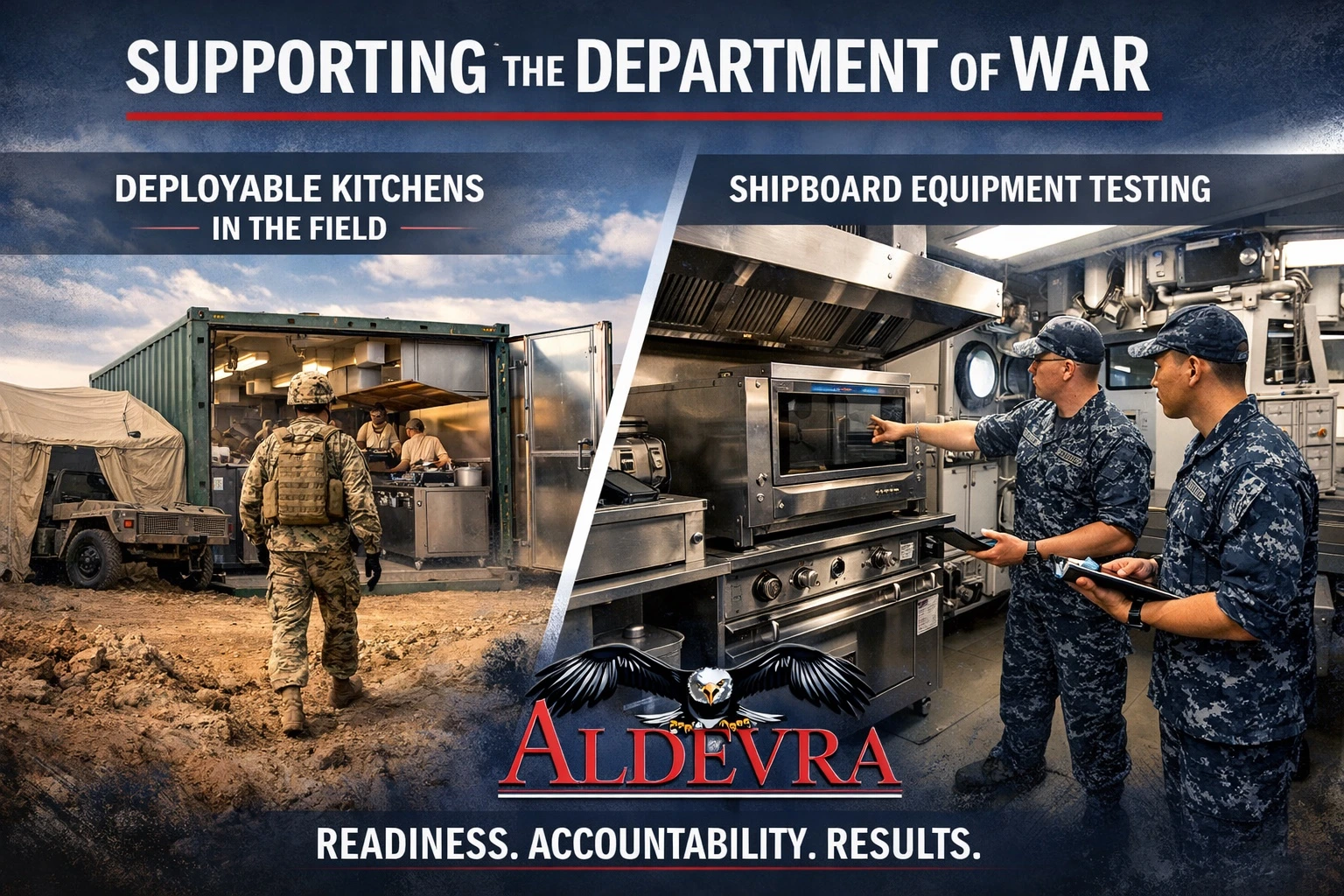
Aldevra has supported the deployment of containerized commercial kitchens into operational environments, enabling rapid feeding capability with minimal permanent infrastructure.
Why Containerized Kitchens Matter to the Department of War
Containerized kitchen systems allow DoW commands to:
• Deploy feeding capability rapidly to forward or temporary locations
• Pilot and refine layouts, utilities, and equipment configurations
• Swap equipment without full facility redesign
• Capture operational performance data before scaling
These systems are particularly relevant for:
• Expeditionary and austere operations
• Contingency response
• Training and surge environments
• Transitional or temporary installations
Aldevra serves as the integrator and accountable executor, coordinating equipment sourcing.
Naval and Maritime Equipment Testing Under Real Conditions
Shipboard and maritime environments represent some of the most demanding operating conditions within the Department of War.
Operational Constraints Include:
• Extreme space limitations
• Power variability
• Constant vibration and motion
• Corrosion from salt air
• High-throughput feeding with limited maintenance windows
Aldevra works directly with manufacturers to help test and adapt commercial kitchen equipment for naval and maritime use, ensuring performance is validated under real operational stress—not just theoretical compliance.
This approach allows the Department of War to make informed, data-driven decisions before scaling solutions fleet-wide.
Authorized Dealer Relationships Without Pass-Through Risk
Aldevra is a manufacturer-authorized dealer with direct relationships to multiple commercial kitchen equipment OEMs. This provides the Department of War with:
• Verified, authorized sourcing
• OEM-backed warranties and technical support
• Configuration and quality control
• Faster access to parts and service
Aldevra also participates in an equipment buying group to:
• Control cost
• Stabilize supply chains
• Protect taxpayer value
Critically: these relationships support sourcing efficiency—not execution outsourcing.
👉 Aldevra is not a pass-through contractor.
When Aldevra is awarded work, Aldevra performs the work.
This aligns directly with acquisition priorities articulated by Secretary Pete Hegseth—ensuring that small businesses awarded contracts are the ones accountable for outcomes, not intermediaries funneling work elsewhere.
Why This Model Aligns With DoW OTAs
Department of War Other Transaction Authority (OTA) efforts prioritize:
• Rapid prototyping
• Iteration in operational environments
• Evaluation before standardization
Aldevra’s model supports this by:
• Enabling evaluation of multiple manufacturers under a single accountable integrator
• Supporting configuration changes during pilots
• Producing actionable operational data
• Allowing clean transition to follow-on production or sustainment
This is how OTAs move from experimentation to fielded capability.
Strengthening the Warfighting Industrial Base
Aldevra’s approach strengthens the warfighting industrial base by:
• Giving manufacturers a real-world pathway to validate performance
• Providing acquisition teams data instead of assumptions
• Ensuring execution accountability remains with the awarded small business
This is mission-driven execution, not innovation theater.
DoW / DoD FAQs
How does foodservice support warfighting readiness?
Reliable feeding capability sustains force endurance, morale, and operational tempo—directly affecting mission success.
What is a containerized military kitchen?
A deployable, modular kitchen system designed for rapid deployment and operation in austere or temporary environments.
Why test commercial equipment for naval ships?
To validate survivability, maintainability, and performance under real maritime operating conditions before fleet-wide adoption.
What does “pass-through contractor” mean in DoW acquisitions?
A contractor that holds a contract but outsources most execution, adding cost without adding operational value—now explicitly disfavored.
Why are OTAs important to the Department of War?
OTAs allow faster testing and fielding of solutions aligned to modern threat environments without unnecessary acquisition friction.
Conclusion: Execution Is the Mission
Under the Department of War’s current acquisition direction, success is measured by readiness, accountability, and results.
Aldevra supports that mission by:
• Deploying containerized kitchens
• Supporting naval and maritime equipment testing
• Working directly with manufacturers
• Remaining fully accountable for execution
This is how sustainment capability supports warfighting—and how Aldevra turns commercial kitchen innovation into operational readiness.
.png)
.png)