Summary
How Often Should You Clean a Commercial Deep Fryer?
Clean commercial fryer baskets and exterior surfaces every operating day, remove food debris throughout service, and filter oil at least daily—or more often when your equipment or production volume requires it. Deep-clean the frypot according to the manufacturer’s instructions. A weekly boil-out is appropriate for some fryers, but it is not a universal requirement. For restaurant managers, hospital foodservice teams, school nutrition departments, and government dining facilities, the goal is a cleaning routine staff can follow consistently. That starts with separating three tasks: cleaning the equipment, filtering the oil, and replacing the oil.
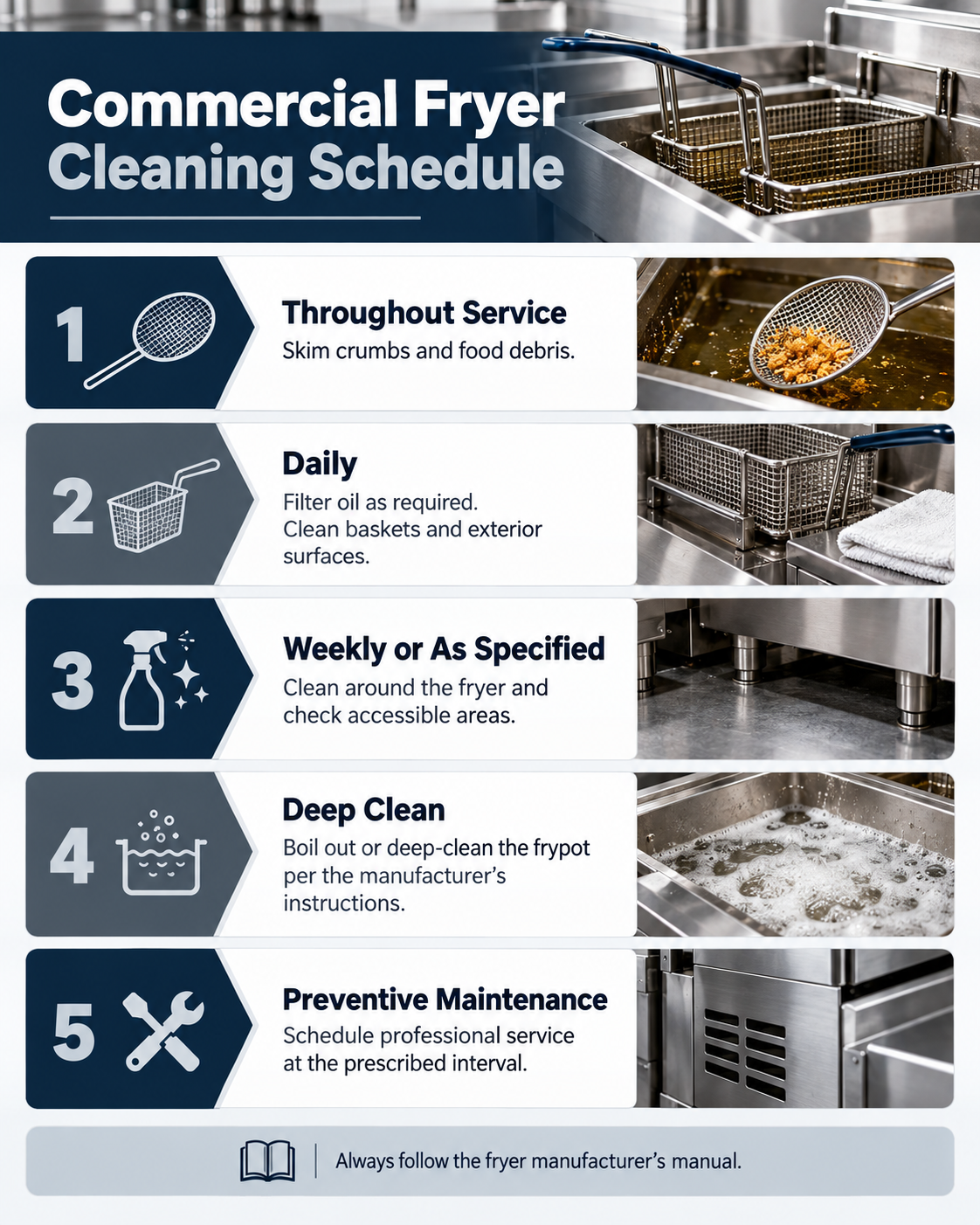
Commercial Fryer Cleaning Schedule
Use this schedule as a planning guide, then establish model-specific procedures using your fryer’s operating manual.
Manufacturer schedules distinguish daily cleaning from less frequent deep cleaning and professional service. Filtration frequency may also increase with production volume.
Why Isn’t Every Fryer on a Weekly Boil-Out Schedule?
Different models have different requirements. For example, Vulcan’s GRM Series manual specifies a boil-out weekly or as required, while Henny Penny’s F5 OFE-51X maintenance schedule lists quarterly deep cleaning, alongside daily cleaning and filtration tasks. Neither interval should be applied automatically to other equipment.
Build your cleaning schedule around the exact model—not a generic rule found online.
How to Clean a Commercial Fryer Daily
Remove Food Debris and Filter the Oil
Use an appropriate fryer skimmer to remove loose breading and food particles during service. Complete filtration at the intervals required by your equipment and operating conditions; high-volume kitchens may need more than one filtration cycle daily. Removing debris helps protect oil quality, but filtration does not replace periodic deep cleaning of the frypot.
Follow the filtration system’s specified temperature and operating sequence. Some built-in systems are designed to filter hot oil; that does not make manually carrying or straining an open container of hot oil safe. OSHA advises allowing oil to cool before moving or straining containers.
Clean Baskets and Exterior Surfaces
Once safe to handle, clean baskets and removable supports using the approved procedure. Remove residue, rinse as directed, and dry completely before reuse.
Wipe exterior surfaces with an appropriate cleaner and nonabrasive cloth. Do not pressure-wash the fryer or direct water into controls and electrical components.
Clean the Filtration Components
Follow the manual for disassembling and cleaning the filter pan, screen, and crumb catcher. Replace disposable filter media at the required interval rather than waiting until filtration slows down.
Dry cleaned components thoroughly before reassembly. Water left in the filter assembly can interfere with filtration and must not be introduced into cooking oil.
How to Deep Clean a Commercial Fryer
A fryer boil-out is a deep-cleaning process that removes cooked-on grease, carbonized residue, and deposits from the frypot. It typically uses water and a compatible cleaning product after the cooking oil has been removed.
The following is an overview for trained staff. Use your equipment manual and cleaning-product instructions for the exact shutdown sequence, protective equipment, dilution, temperature, and cleaning time. Do not assume an open-fryer procedure applies unchanged to a pressure fryer or another specialized model.
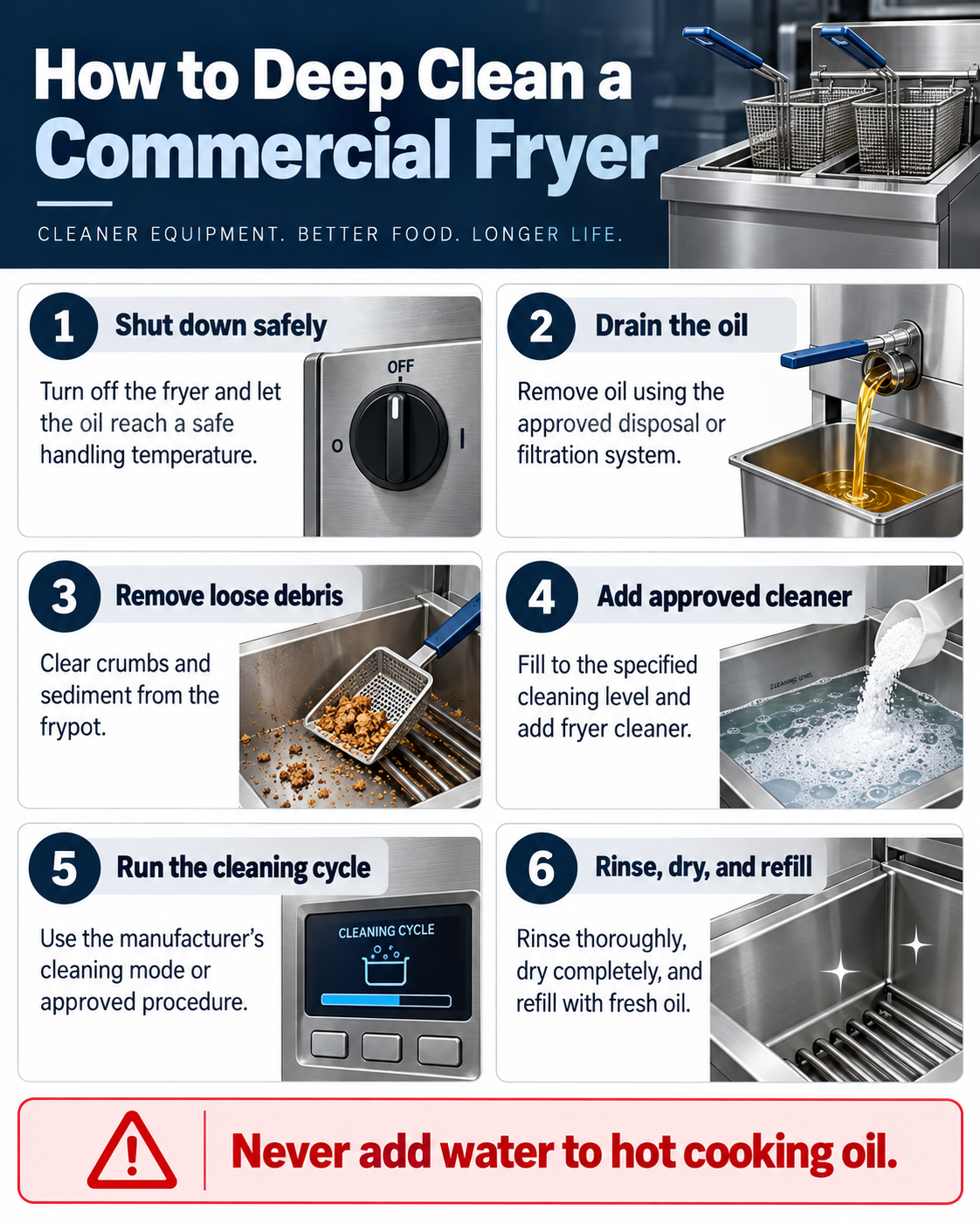
1. Prepare the Work Area and Shut Down Safely
Keep the surrounding floor clear and dry. Wear the protective equipment specified for the task, including appropriate gloves, apron, and eye or face protection.
Follow the manufacturer’s shutdown instructions and allow the oil and equipment to reach the required handling temperature. Do not move a fryer containing hot oil.
2. Drain the Oil and Remove Loose Residue
Drain the oil using the approved disposal or filtration system and a suitable container. Remove loose crumbs and sediment with the recommended fryer tools.
Do not add water or cleaning solution to cooking oil. Complete the required draining and cooling steps before beginning water-based cleaning.
3. Add the Approved Cleaning Solution
Close the drain valve and fill the frypot to the cleaning level specified in the manual. Use a fryer-compatible cleaner at the stated dilution.
Do not assume that a general-purpose degreaser is suitable for the inside of a frypot. Cleaning products and procedures vary by equipment and formulation.
4. Run the Manufacturer’s Cleaning Cycle
Restore power only as required for the approved heated-cleaning procedure. Use the dedicated cleaning mode or the specified temperature and duration.
Despite the name, a “boil-out” does not necessarily mean a rolling boil. Monitor the solution continuously and follow the manual’s instructions for controlling foam and preventing overflow. Use only approved tools around heating elements and temperature probes.
5. Drain and Rinse as Directed
Shut off heating and follow the prescribed cooling and draining procedure. Remove the cleaning solution through the approved route—not by treating it like cooking oil and pumping it through the oil-filtration circuit.
Rinse thoroughly. Use a neutralizing rinse only when the equipment and cleaning-product instructions require it.
6. Dry Completely Before Refilling
Dry the frypot, drain area, baskets, and other components that will contact oil. Reassemble the equipment, confirm that the drain valve is closed, and refill with fresh oil to the specified fill level.
Never return the fryer to cooking service with water or cleaning solution remaining inside.
How Often Should You Change Commercial Fryer Oil?
Oil replacement should be based on oil condition and your operation’s quality-control procedure—not simply the same day each week.
Warning signs include excessive smoking, unusual foaming, and unacceptable flavor. Appearance and smell alone, however, do not provide a complete assessment of oil quality.
An oil-quality testing program can support more consistent decisions. For example, total polar materials, or TPM, measurements assess compounds that accumulate as frying oil degrades. Establish testing procedures and replacement criteria appropriate to your operation rather than adopting an unsupported universal threshold.
Regular skimming and filtration help manage debris, but good oil management also requires attention to food type, operating temperature, and exposure to moisture.
Make Fryer Cleaning Part of Your Operating Routine
Create a cleaning log for each fryer rather than relying on a verbal handoff between shifts. Record the equipment model, completed cleaning and filtration tasks, oil-quality checks, oil changes, employee initials, and the next scheduled deep clean.
Keep the manufacturer’s procedure available at the cleaning station. Assign responsibility for checking completion and escalating problems.
Daily cleaning should not be treated as a substitute for the manufacturer’s preventive maintenance schedule.
Free Commercial Fryer Cleaning Log
Keep your fryer-maintenance records in one place. Download Aldevra’s printable cleaning log to track daily cleaning, oil filtration, oil-quality checks, oil changes, deep cleaning, and supervisor review. Use one weekly sheet per fryer and shift, and complete the second page for deep cleaning or corrective actions as needed.
Choosing a Commercial Fryer That Is Easier to Maintain
When comparing replacement equipment, include cleaning and oil management in the purchasing decision. Consider access to the frypot, filtration options, removable components, compatible filter supplies, and staff training—not just tank capacity and purchase price.
Aldevra’s commercial fryer and oil-system buying guide provides additional considerations for matching equipment to your kitchen’s production needs.
Find Fryer Equipment and Supplies Through Aldevra
Aldevra supplies commercial kitchen equipment, parts, and supplies for foodservice operations. Browse commercial fryers and fryer supplies, or contact Aldevra for help comparing equipment and identifying the right supplies for your model.
Contact our team at sales@aldevra.com or (269) 350-1337.
Frequently Asked Questions About Commercial Fryer Cleaning
Do Commercial Fryers Need to Be Cleaned Every Day?
Yes. Daily tasks generally include cleaning baskets and exterior surfaces, completing required oil filtration, and cleaning specified filter components. A full water-and-cleaner boil-out is a separate task performed at the interval required for your model.
How Often Should You Boil Out a Commercial Fryer?
Follow your model’s manual. Some fryers specify weekly boil-outs; others use different cleaning intervals or procedures. Frying volume, food type, and oil-management practices also affect cleaning needs, so do not assume one schedule fits every kitchen.
How Long Does a Fryer Boil-Out Take?
There is no single cleaning time for all fryers. Follow the manufacturer’s cycle duration, and allow additional time for draining, cooling, rinsing, and drying. Do not confuse the heated-cleaning stage with the total time needed to return the fryer to service.
Can You Use Vinegar to Clean a Commercial Deep Fryer?
Only as directed. Some procedures call for a vinegar rinse to neutralize cleaning residue; others state that it is unnecessary with the specified cleaner. Vinegar is not an automatic substitute for an approved fryer-cleaning product.
How Do You Remove Burnt-On Grease from a Commercial Fryer?
Use the manufacturer-approved deep-cleaning procedure and compatible fryer cleaner to loosen cooked-on deposits. Work with the recommended brushes or pads rather than scraping aggressively with metal tools that could damage surfaces, heating elements, or probes.
Can You Put Water in a Deep Fryer to Clean It?
Water may be used as part of an approved cleaning procedure after the oil has been removed and the equipment has been prepared as directed. Never add water to hot cooking oil. Drain and dry all affected components before refilling with oil.
How Do You Know When Fryer Oil Needs to Be Replaced?
Evaluate oil using your operation’s testing procedure and quality standards. Unusual smoking, persistent foaming, or unacceptable flavor warrant attention, but color alone is not a reliable replacement rule. An appropriate oil-quality tester can help make decisions more consistent.