Summary
Refrigerant Recovery, EPA Section 608, Commercial Kitchen Equipment, Refrigeration, Walk-In Coolers, Ice Machines, Foodservice Equipment, Equipment Disposal, SDS, Refrigerant Removal
Refrigerant Removal Requirements for Commercial Kitchen Equipment: What Customers Need to Know
Commercial kitchen equipment keeps food safe, operations moving, and customers served. But when refrigeration equipment needs service, replacement, removal, or disposal, there is one important compliance issue that should not be overlooked: refrigerant removal.
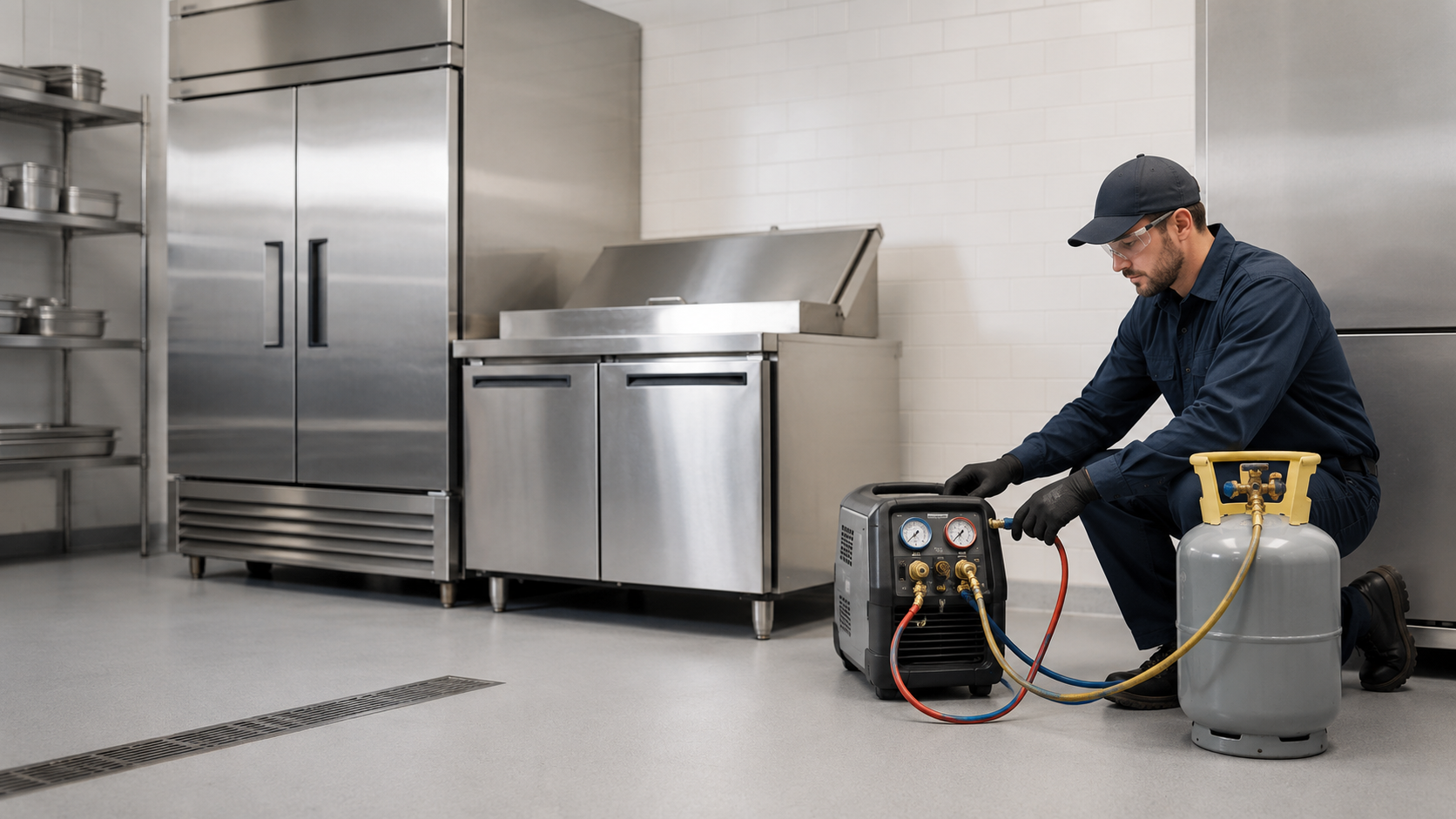
Refrigerants are used in equipment such as reach-in refrigerators and freezers, walk-in coolers and freezers, ice machines, refrigerated prep tables, refrigerated display cases, blast chillers, and other commercial refrigeration systems. These units may contain regulated refrigerants that must be handled properly under EPA Section 608 requirements.
This blog explains the basics customers should understand before replacing, repairing, removing, or disposing of commercial kitchen refrigeration equipment.
Why Refrigerant Removal Matters
Refrigerant is not something that should simply be released into the air when equipment is serviced or discarded. EPA rules generally prohibit the intentional venting of regulated refrigerants during maintenance, service, repair, or disposal of refrigeration and air-conditioning equipment.
That means refrigerant must typically be recovered using proper recovery equipment before the refrigeration system is opened, dismantled, hauled away, scrapped, or disposed of.
For commercial kitchens, this often comes up when:
- A walk-in cooler or freezer is being removed or replaced.
- A reach-in refrigerator or freezer is being disposed of.
- An ice machine is being disconnected or replaced.
- A refrigerated prep table is being hauled away.
- A refrigeration system is being repaired and the sealed system must be opened.
- Equipment is being scrapped after a renovation or end-of-life replacement.
Who Is Responsible for Refrigerant Recovery?
The responsibility depends on the situation, but the safest approach is simple: make sure qualified personnel recover the refrigerant before equipment is opened, removed, scrapped, or disposed of.
For commercial refrigeration equipment that is dismantled on-site, refrigerant must generally be recovered before disposal in accordance with EPA service practice requirements.
If equipment is sent into the waste stream with the refrigerant charge intact, the final person in the disposal chain, such as a landfill or scrap metal recycler, may be responsible for ensuring refrigerant was recovered. However, they may also require documentation from the person or company delivering the equipment.
In practical terms, customers should not assume that the delivery team, installer, freight carrier, recycler, or landfill will automatically handle refrigerant recovery. It should be addressed before removal.
Identify the Refrigerant Before Work Begins
Before commercial kitchen refrigeration equipment is serviced, removed, recovered, recycled, or disposed of, customers should confirm what type of refrigerant is in the unit.
The refrigerant type is usually listed on the equipment nameplate, data plate, service label, or manufacturer documentation. This matters because different refrigerants have different safety, recovery, storage, handling, and disposal considerations.
For example, older equipment may contain legacy refrigerants, while newer self-contained refrigeration equipment may use hydrocarbon refrigerants such as R-290 propane or R-600a isobutane. Other systems may use HFC, HFO, or A2L refrigerants. Some refrigerants may be flammable, require specific recovery equipment, or have different handling precautions.
Customers should ask the technician, contractor, or facility maintenance team to verify:
- The refrigerant type
- The estimated refrigerant charge amount
- Whether the refrigerant has already been recovered
- Whether the applicable SDS is available
- Whether the technician is qualified to handle that refrigerant
- Whether any special safety, storage, ventilation, or transport precautions apply
Do not assume all refrigerated equipment uses the same refrigerant. Confirming the refrigerant type early helps avoid safety issues, disposal delays, and compliance problems.
What Customers Should Do Before Removing Refrigerated Equipment
Before commercial kitchen refrigeration equipment is removed, customers should confirm:
- Does the equipment contain refrigerant?
- What type of refrigerant is in the equipment?
- What is the estimated refrigerant charge amount?
- Has the refrigerant already been properly recovered?
- Who is performing the recovery?
- Is the person qualified to perform the work?
- Is the applicable SDS available?
- Will documentation be provided?
- Who is responsible for hauling away the equipment after refrigerant recovery?
- Are there any state, local, facility, or agency-specific requirements?
This is especially important for government facilities, healthcare facilities, schools, correctional institutions, and other regulated environments where documentation and chain-of-custody expectations may be higher.
Common Commercial Kitchen Equipment That May Require Refrigerant Recovery
Customers should ask about refrigerant recovery when removing or replacing equipment such as:
- Walk-in coolers
- Walk-in freezers
- Reach-in refrigerators
- Reach-in freezers
- Undercounter refrigerators
- Undercounter freezers
- Refrigerated prep tables
- Refrigerated chef bases
- Refrigerated display cases
- Ice machines
- Blast chillers
- Milk coolers
- Refrigerated merchandisers
- Remote refrigeration systems
Even smaller units may still contain refrigerant. The size of the equipment does not automatically eliminate the requirement to handle refrigerant properly.
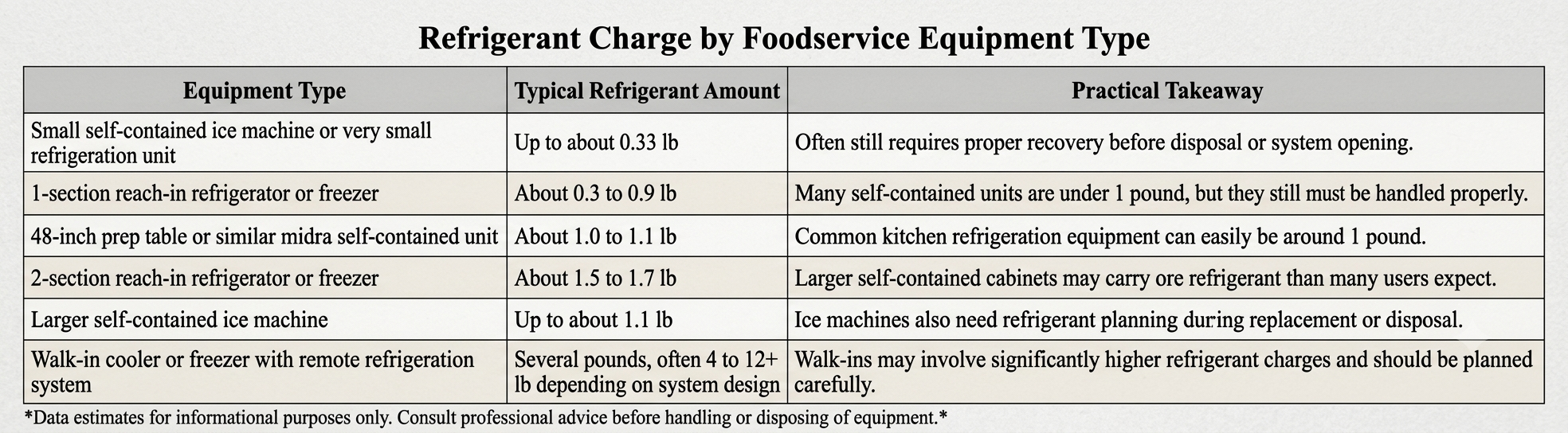
Typical Refrigerant Amounts in Commercial Kitchen Equipment
The amount of refrigerant in commercial kitchen equipment can vary widely based on the equipment size, refrigerant type, age of the equipment, and whether the unit is self-contained or connected to a remote refrigeration system.
The chart below is a practical planning guide only. Customers should always verify the actual refrigerant type and charge amount on the equipment nameplate, service manual, or manufacturer documentation before service, removal, or disposal.
Service, Repair, and Disposal Are Different — But All Matter
Refrigerant rules can apply in several situations:
Service or Repair
If a technician opens the refrigeration circuit for maintenance, service, or repair, refrigerant generally must be recovered to required levels before the system is opened.
Replacement
When old equipment is replaced, the existing unit may need refrigerant recovery before it is disconnected, removed, scrapped, or disposed of.
Disposal or Scrap
If refrigerated equipment is being discarded, scrapped, or recycled, refrigerant recovery should be completed and documented before final disposal.
Documentation Matters
Customers should request documentation showing that refrigerant was recovered properly. Depending on the situation, documentation may include:
- Date refrigerant was recovered
- Location of recovery
- Equipment description or asset number
- Refrigerant type
- Estimated or actual amount of refrigerant recovered, when applicable
- Name and address of the person or company that recovered the refrigerant
- Confirmation that recovery was completed before disposal or recycling
- SDS availability or review, when applicable
This documentation can help protect the customer, the contractor, the facility, and the disposal provider.
Do Not Forget the Safety Data Sheet
Customers should also ask whether the applicable Safety Data Sheet, or SDS, is available for the refrigerant being recovered or handled.
An SDS provides important safety information about the refrigerant, including potential physical and health hazards, handling precautions, storage considerations, first aid information, fire response information, and recommended protective measures.
This is especially important because commercial kitchen refrigeration equipment may contain different refrigerants depending on the age and type of equipment. Some newer self-contained units use hydrocarbon refrigerants such as R-290 propane or R-600a isobutane, while other equipment may use HFC, HFO, A2L, or legacy refrigerants. Each refrigerant has its own safety considerations.
For service, repair, removal, or disposal projects, customers should consider asking the technician, contractor, or facility team to:
- Identify the refrigerant type before work begins.
- Review the applicable SDS before handling refrigerant.
- Follow SDS guidance for PPE, ventilation, storage, fire safety, and emergency response.
- Keep refrigerant cylinders properly labeled.
- Make sure recovered refrigerant is stored and transported in appropriate recovery cylinders.
- Include SDS review as part of the project safety planning when refrigerant recovery is involved.
The SDS does not replace EPA Section 608 refrigerant recovery requirements, but it helps ensure refrigerant is handled safely and properly during service, removal, recovery, storage, and disposal.
Do Not Assume “Haul Away” Includes Refrigerant Recovery
A common misunderstanding is that “remove and dispose of existing equipment” automatically includes refrigerant recovery. It may not.
In commercial kitchen projects, the scope should clearly state who is responsible for refrigerant recovery. For example:
- The customer may have facility maintenance staff recover refrigerant before removal.
- The contractor may include refrigerant recovery in its scope.
- A licensed refrigeration subcontractor may be used.
- The disposal or recycling provider may require proof that refrigerant was removed before accepting the equipment.
If the scope is not clear, ask before work begins.
Recommended Project Language
For customers preparing a statement of work, purchase order, or removal scope, consider language like this:
“Contractor shall identify the refrigerant type and ensure refrigerant is properly recovered from all refrigeration equipment requiring refrigerant removal prior to disposal, recycling, or system opening. Refrigerant recovery shall be performed in accordance with applicable EPA Section 608 requirements and any applicable state, local, and facility requirements. Contractor shall provide documentation of refrigerant recovery upon request, including the refrigerant type, recovery date, equipment identification, and company or technician performing the recovery.”
If the customer wants to handle refrigerant recovery separately, the scope should say that clearly:
“Government/facility/customer will be responsible for refrigerant identification and refrigerant recovery prior to contractor removal of existing equipment. Contractor shall not remove equipment until written confirmation of refrigerant recovery has been provided.”
Why This Matters for Commercial Kitchen Projects
Refrigerant recovery is not just an environmental issue. It can affect project schedule, disposal coordination, safety planning, and compliance documentation.
If refrigerant recovery is missed, a project may face:
- Delays in removing old equipment
- Refusal by a recycler or landfill to accept equipment
- Added service costs
- Compliance concerns
- Confusion over contractor versus customer responsibility
- Safety risks from improper handling
The best time to address refrigerant removal is before the equipment is disconnected or hauled away.
Final Takeaway
If commercial kitchen refrigeration equipment is being serviced, replaced, removed, recycled, or disposed of, ask about refrigerant recovery early.
Do not assume refrigerant removal is included. Confirm the refrigerant type, review the SDS when applicable, assign responsibility in writing, use qualified personnel, request documentation, and check applicable EPA, state, local, and facility requirements.
Proper refrigerant handling protects the environment, keeps projects moving, and helps customers avoid preventable compliance issues.
FAQs: Refrigerant Removal for Commercial Kitchen Equipment
Does refrigerant have to be removed before commercial kitchen equipment is disposed of?
In most cases, yes. Refrigeration equipment should not be disposed of with regulated refrigerant still inside unless the disposal process is specifically set up to handle refrigerant recovery in compliance with applicable requirements. For commercial equipment that is dismantled on-site, refrigerant generally must be recovered before disposal.
Can refrigerant be released into the air?
No. EPA rules generally prohibit intentional venting of regulated refrigerants during maintenance, service, repair, or disposal. Refrigerant should be recovered using proper equipment and handled in accordance with applicable requirements.
How do I know what kind of refrigerant is in my commercial kitchen equipment?
Check the equipment nameplate, data plate, service label, owner’s manual, or manufacturer documentation. A qualified refrigeration technician can also verify the refrigerant type before service, recovery, removal, or disposal. This should be done before work begins because refrigerant type affects safety precautions, recovery procedures, SDS review, storage, transportation, and documentation.
Does this apply to walk-in coolers and freezers?
Yes. Walk-in coolers and freezers typically contain refrigerant and should be evaluated before removal, service, replacement, or disposal. Refrigerant recovery should be planned before the equipment is dismantled or hauled away.
Does this apply to ice machines?
Yes. Ice machines often contain refrigerant and may require proper refrigerant recovery before sealed-system repair, replacement, or disposal.
Does this apply to reach-in refrigerators and freezers?
Yes. Reach-in refrigerators and freezers may contain refrigerant and should not be treated as ordinary scrap without confirming refrigerant recovery requirements.
Does this apply to prep tables and chef bases?
Yes. Refrigerated prep tables, pizza prep tables, sandwich prep tables, and chef bases usually contain refrigerant. Even if the unit is relatively small, refrigerant recovery should be addressed before disposal or sealed-system service.
Who can remove refrigerant?
Refrigerant recovery should be handled by qualified personnel using proper recovery equipment. For service and repair work, EPA Section 608 technician certification requirements may apply. Customers should verify qualifications before work begins.
Should I ask for the SDS before refrigerant recovery?
Yes. Customers should ask whether the applicable Safety Data Sheet, or SDS, is available for the refrigerant being handled. The SDS helps identify hazards, PPE, ventilation needs, storage precautions, fire response information, and first aid guidance. This is especially important when equipment uses flammable refrigerants such as R-290 propane or R-600a isobutane, or newer A2L refrigerants. The SDS does not replace EPA Section 608 requirements, but it is a helpful safety and documentation tool.
Is a sticker enough to prove refrigerant was removed?
A sticker alone may not be enough. Customers should request written documentation showing who recovered the refrigerant, when it was recovered, what equipment was involved, and what refrigerant was recovered.
What documentation should I ask for?
Ask for documentation that includes the date of recovery, location, equipment description, refrigerant type, name and address of the person or company that recovered the refrigerant, amount of refrigerant recovered when applicable, and confirmation that refrigerant recovery was completed before disposal or recycling.
Is refrigerant recovery included when I buy replacement equipment?
Not always. Refrigerant recovery is often separate from delivery, installation, or haul-away. The purchase order or scope of work should clearly state whether refrigerant recovery is included and who is responsible.
Can the old unit be hauled away before refrigerant is removed?
That depends on the disposal arrangement, but it is usually best to recover refrigerant before equipment is removed from the site. Some recyclers or disposal facilities may refuse equipment without proof that refrigerant was properly recovered.
Does this apply to small refrigeration units?
Yes. Small refrigeration units may still contain refrigerant. Smaller equipment may have different recovery standards, but it should still be handled properly.
What if the equipment is broken or leaking?
If equipment is leaking or damaged, refrigerant recovery may still be required to the extent possible under EPA requirements. A qualified refrigeration technician should evaluate the equipment and determine the proper recovery process.
What if the customer owns the equipment but the contractor removes it?
The scope should clearly state who is responsible for refrigerant identification and recovery. If the contractor is responsible, it should be included in the contract language. If the customer is responsible, the contractor should receive confirmation that refrigerant recovery was completed before removal.
Are there state or local requirements too?
Possibly. EPA requirements are not the only rules that may apply. Customers should also check state, local, facility, landfill, recycler, and agency-specific requirements.
What should government buyers include in the solicitation or statement of work?
Government buyers should clearly state who is responsible for refrigerant identification, SDS review, refrigerant recovery, documentation, disposal, recycling, and compliance with EPA Section 608 and any applicable state, local, and facility requirements. This avoids confusion during installation or removal.
What is the simplest way to avoid problems?
Address refrigerant removal before work begins. Identify which equipment contains refrigerant, confirm the refrigerant type, assign responsibility in writing, use qualified personnel, review the SDS when applicable, and collect documentation before disposal or recycling.


.png)
.png)