Summary
What if your refrigerator or freezer started warming up, but your monitoring system couldn’t tell you?
That’s one of the risks identified in a new federal cybersecurity warning involving industrial refrigeration and cold-chain monitoring systems.
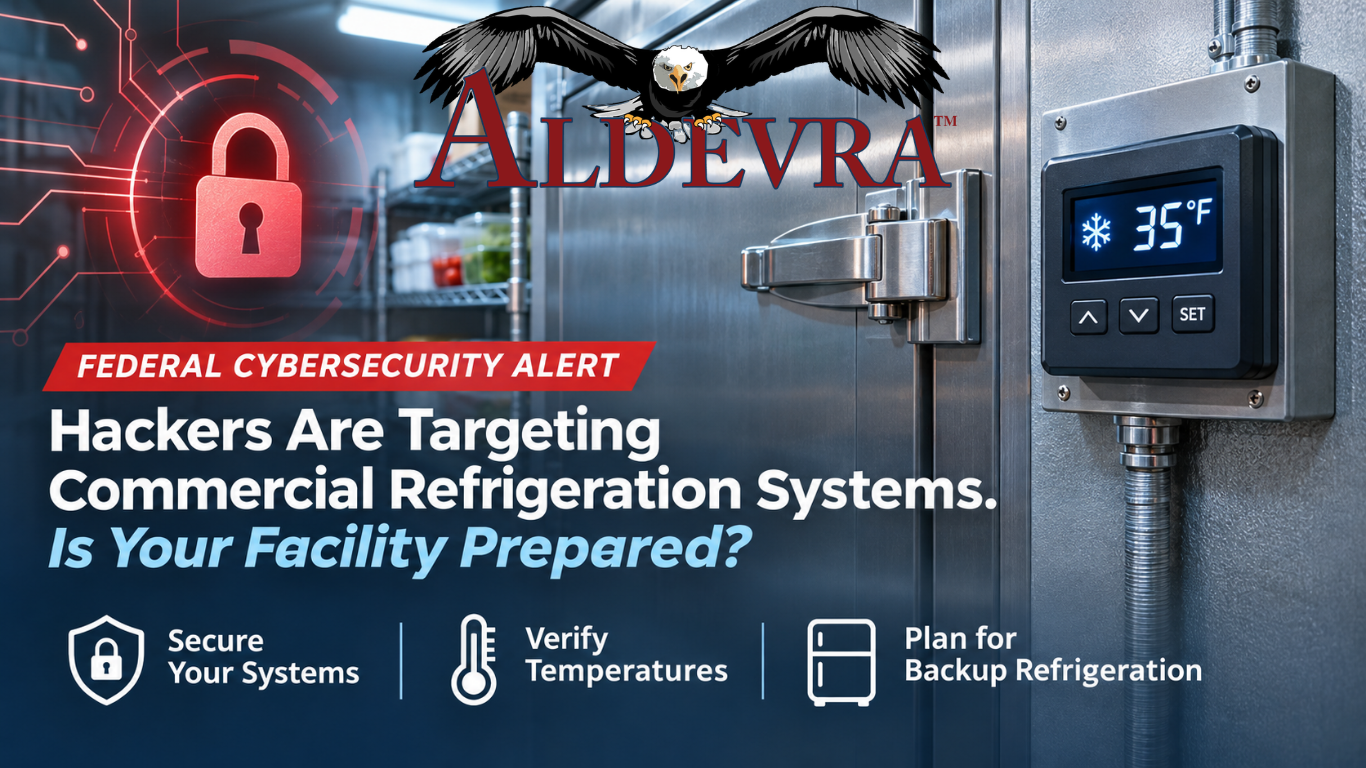
On November 5, 2026, five federal agencies issued a joint advisory warning that cybercriminals are targeting electronic temperature controllers and commercial refrigeration systems. Attackers may be able to change temperature settings remotely, manipulate defrost cycles, and interfere with operators’ ability to monitor actual temperatures.
For hospitals, military installations, commercial kitchens, grocery operations, and cold-storage facilities, the consequences could extend far beyond a broken refrigerator.
Spoiled food, compromised medications, damaged equipment, interrupted operations, and potential safety hazards are all concerns.
The warning is serious, and federal agencies are urging organizations to take action now.
Read the Official November 5, 2026, Federal Cybersecurity Advisory (PDF)
What Did the Federal Government Warn About?
The November 5 advisory, titled US Government Partners Urge Hardening Industrial Refrigeration and Cold Chain Monitoring Systems, was issued jointly by:
- Cybersecurity and Infrastructure Security Agency (CISA)
- Federal Bureau of Investigation (FBI)
- Department of Health and Human Services (HHS)
- U.S. Department of Agriculture (USDA)
- Department of Transportation (DOT)
The agencies report ongoing malicious cyber activity targeting refrigeration controllers and cold-chain systems globally.
These systems are widely used to control temperatures, manage defrost cycles, record temperature data, and allow equipment to be monitored remotely.
Unfortunately, some of the same connectivity features that make modern refrigeration equipment convenient can also introduce cybersecurity vulnerabilities.
The government specifically warns that attackers may exploit outdated software, weak security configurations, and controllers accessible through the internet.
What Could Happen If a Refrigeration System Is Compromised?
According to the advisory, successful attacks could result in:
- Unauthorized temperature changes: Attackers could modify settings and cause refrigerated products to warm beyond acceptable limits.
- Manipulated defrost cycles: Refrigeration equipment could be forced into continuous heating or defrost operation.
- Loss of temperature visibility: Operators could lose access to current temperature information, making it harder to recognize unsafe conditions.
- Spoiled or compromised inventory: Food, medications, biological materials, and other temperature-sensitive products could be affected.
- Equipment damage and safety hazards: Abnormal operation could shorten equipment life and potentially create fire hazards.
One of the most concerning scenarios is a refrigeration system developing unsafe conditions while personnel cannot access reliable monitoring information.
A refrigeration failure is dangerous enough. A refrigeration failure that goes undetected can be even more costly.
Why This Matters for Hospitals, Military Facilities, and Commercial Kitchens
Refrigeration is essential to daily operations across numerous industries.
Hospitals and Healthcare Facilities
Medical facilities depend on refrigeration to store medications, vaccines, specimens, and food for patients.
A temperature excursion can compromise sensitive inventory and create serious operational consequences.
In healthcare environments, even a relatively small amount of compromised inventory can represent a significant financial loss, while disrupted storage can affect patient services.
Military Installations and Government Facilities
Military dining facilities, commissaries, and federal institutions depend on reliable refrigeration to protect food supplies and maintain essential services.
A compromised refrigeration system could lead to inventory losses, foodservice interruptions, and unexpected replacement expenses.
Commercial Kitchens and Foodservice Operations
Restaurants, schools, correctional facilities, and institutional kitchens rely on refrigerators, freezers, and walk-in coolers to maintain food safety.
A refrigeration failure can mean losing thousands of dollars in inventory, replacing equipment unexpectedly, and potentially suspending foodservice operations.
For any organization responsible for temperature-sensitive products, refrigeration security should be part of its overall risk-management and business-continuity planning.
What Should Facility Managers Do Now?
The federal government recommends immediate cybersecurity measures to protect refrigeration controllers and monitoring systems.
Here are practical steps to discuss with your facility management, IT, cybersecurity, and equipment maintenance teams.
1. Identify Which Refrigeration Systems Are Connected
Not every commercial refrigerator is connected to the internet.
However, some refrigerators, freezers, walk-in systems, and centralized temperature-monitoring platforms may have network connections or remote-access capabilities.
Determine which systems are connected, how they are accessed, and whether equipment manufacturers or outside service providers can connect remotely.
2. Remove Unnecessary Internet Access
The federal advisory recommends eliminating direct public internet exposure for refrigeration controllers.
If remote access is necessary, qualified IT and operational technology professionals should secure the connection with appropriate network protections.
Do not disconnect power or disable essential refrigeration controls when addressing network security.
3. Update Software and Change Default Passwords
Contact the equipment manufacturer or authorized service provider to confirm whether controller firmware and software are current.
Replace factory-default passwords, restrict unauthorized access, and implement stronger authentication wherever feasible.
Older controllers that no longer receive manufacturer support may require additional protections or replacement.
4. Separate Refrigeration Controls From Business Networks
CISA recommends isolating operational technology from ordinary business networks.
Separating refrigeration controllers from systems used for email, accounting, and other business functions can help limit potential pathways for cyberattacks.
5. Verify Temperatures Independently
Do not depend exclusively on a single network-connected monitoring system to confirm that temperature-sensitive products remain safe.
Consider using an independent, calibrated temperature-monitoring device or data logger that operates separately from the primary refrigeration controller.
Where continuous monitoring is required, make sure the independent system can provide reliable alerts through an appropriately protected or separate communication method.
Regularly verify temperature readings, review alarm settings, and establish procedures for responding to unexpected changes.
For additional guidance on common refrigeration alarms and mechanical problems, see Aldevra’s article:
Should Your Facility Have a Backup Refrigerator That Isn’t Connected to the Internet?
For facilities that cannot afford extended refrigeration downtime, an independently operating backup refrigerator or freezer deserves serious consideration.
Cybersecurity precautions reduce risk, but no equipment or network is completely immune to disruption.
A standalone backup refrigerator or freezer that does not rely on the internet, a shared network, or the same central control system can provide another layer of protection.
For example, if a hospital’s connected refrigeration equipment experiences a cybersecurity incident, a separate, operational backup unit could provide temporary storage while the primary system is evaluated and restored.
Likewise, a military dining facility or institutional kitchen could benefit from having additional refrigeration capacity available if its main system becomes unusable.
What Should You Look for in Backup Refrigeration?
When evaluating backup equipment, consider five important factors:
- Independent controls: Choose a unit that operates without an internet connection or dependence on the primary system’s network or controller.
- Appropriate temperature performance: The backup equipment must be capable of maintaining the required temperatures for the products being stored. Medical products may require specialized, validated storage equipment.
- Sufficient capacity: Determine how much essential inventory would need to be transferred during an emergency.
- Independent monitoring: Equip backup storage with appropriate temperature verification and alarms.
- Power and operational readiness: Consider emergency electrical power, regular equipment testing, and documented inventory-transfer procedures.
A non-internet-connected refrigerator is not immune to mechanical failures, power outages, or physical tampering. However, independence from the primary network and controls can reduce shared points of failure.
Facilities should also consider whether backup refrigeration should be located in a separate area or connected to an emergency power source.
For organizations with high-value medications, critical food supplies, or uninterrupted-service requirements, the investment in backup capacity may be far less than the cost of losing inventory or disrupting operations.
Importantly, backup refrigeration must be available and maintained before an emergency occurs. It cannot protect products that have already experienced unacceptable temperature exposure.
This recommendation for separate backup refrigeration is an additional business-continuity measure, not a specific requirement imposed by the November 5 federal advisory.
What About Existing Refrigeration Equipment? Does It Need to Be Replaced?
The government advisory does not mean every connected refrigerator or freezer needs to be replaced.
It is not a blanket recall of commercial refrigeration equipment.
The appropriate response depends on the specific equipment, its electronic controls, software support, connectivity, and security configuration.
A refrigerator may still have years of mechanical service life remaining while its electronic controller has become outdated or no longer receives security updates.
Facility managers should consider asking their equipment manufacturers:
- Does this model support remote access or internet connectivity?
- Is the controller still supported with software and security updates?
- What security protections are available?
- Can the refrigeration system operate independently if the network becomes unavailable?
- Are replacement controllers or upgraded equipment available?
When existing equipment cannot be adequately secured or supported, planning for replacement may be the most practical long-term solution.
What Should You Do If You Suspect a Refrigeration Cyberattack?
If refrigeration temperatures change unexpectedly, monitoring information becomes unavailable, or controller settings appear to have been altered without authorization, involve your facility’s maintenance and IT/security personnel.
First, verify conditions using an independent temperature-measuring device and follow established food safety, medication storage, or laboratory procedures.
Protect affected products from further temperature exposure, document the incident, and contact qualified refrigeration service personnel when necessary.
Do not assume products remain safe simply because the equipment is running, and do not return temperature-sensitive inventory to use without following applicable product-specific requirements.
The federal government also encourages reporting suspected malicious activity.
Cybersecurity incidents can be reported to CISA or the FBI’s Internet Crime Complaint Center.
How Aldevra Can Help
At Aldevra, we understand the importance of dependable refrigeration in healthcare, government, and commercial foodservice operations.
As a Service-Disabled Veteran-Owned Small Business serving federal agencies and commercial customers, Aldevra provides equipment sourcing, installation coordination, and equipment support to help facilities maintain reliable operations.
We can assist customers with:
- Commercial refrigeration equipment: Sourcing refrigerators, freezers, and walk-in systems suited to operational requirements.
- Medical-grade refrigeration: Evaluating refrigeration and freezer options designed for healthcare applications.
- Backup refrigeration planning: Helping facilities evaluate standalone refrigeration equipment and appropriate storage capacity.
- Equipment replacement: Coordinating equipment selection, manufacturer information, delivery, and installation.
- Manufacturer coordination: Helping customers obtain product information, controller details, and available support resources.
Cybersecurity assessments, network protection, and incident response should be handled by qualified cybersecurity professionals in cooperation with equipment manufacturers.
Explore Aldevra’s Commercial Kitchen Equipment Solutions and Healthcare Equipment Solutions.
Protect Your Refrigeration Equipment Before a Problem Occurs
The November 5, 2026, federal cybersecurity advisory highlights a growing concern: modern refrigeration reliability involves more than compressors, condensers, and mechanical components.
Electronic controllers, network connections, monitoring systems, and software security can all affect whether equipment operates safely and reliably.
For facility managers, now is the time to review existing refrigeration systems, confirm cybersecurity protections, verify independent temperature-monitoring capabilities, and evaluate contingency plans.
Secure your systems. Verify your temperatures. Have a backup plan.
And when refrigeration is critical to your operation, consider whether having an independently operating backup unit could prevent a manageable incident from becoming a major disruption.
Need Help Evaluating Your Refrigeration Equipment?
Aldevra can assist with commercial and medical-grade refrigeration equipment, replacement planning, and backup refrigeration options.
Contact Aldevra:
Email: sales@aldevra.com
Phone: (269) 350-1337
Website: www.aldevra.com
Contact Aldevra
Official Reference:
This article is provided for general awareness and equipment planning. Facilities should consult qualified cybersecurity professionals, equipment manufacturers, and applicable regulatory guidance when evaluating specific systems.