Summary
How restaurants, hospitals, schools, and institutional kitchens can safely donate surplus food, reduce waste, and support their communities.
Every day, commercial kitchens prepare food that never reaches a customer. Restaurants have surplus ingredients, hospitals prepare extra meals, schools experience fluctuations in attendance, and catering operations sometimes produce more food than an event requires.
When that food has been handled and stored safely, donating it may be a better option than throwing it away.
Food donation programs can help feed people in need, reduce unnecessary waste, and support sustainability initiatives. But successful food recovery requires more than identifying a local food bank.
Operators need safe food handling procedures, reliable refrigeration, appropriate containers, temperature monitoring, and a process for transferring food safely.
Fortunately, commercial kitchens may already have much of the equipment needed to get started.
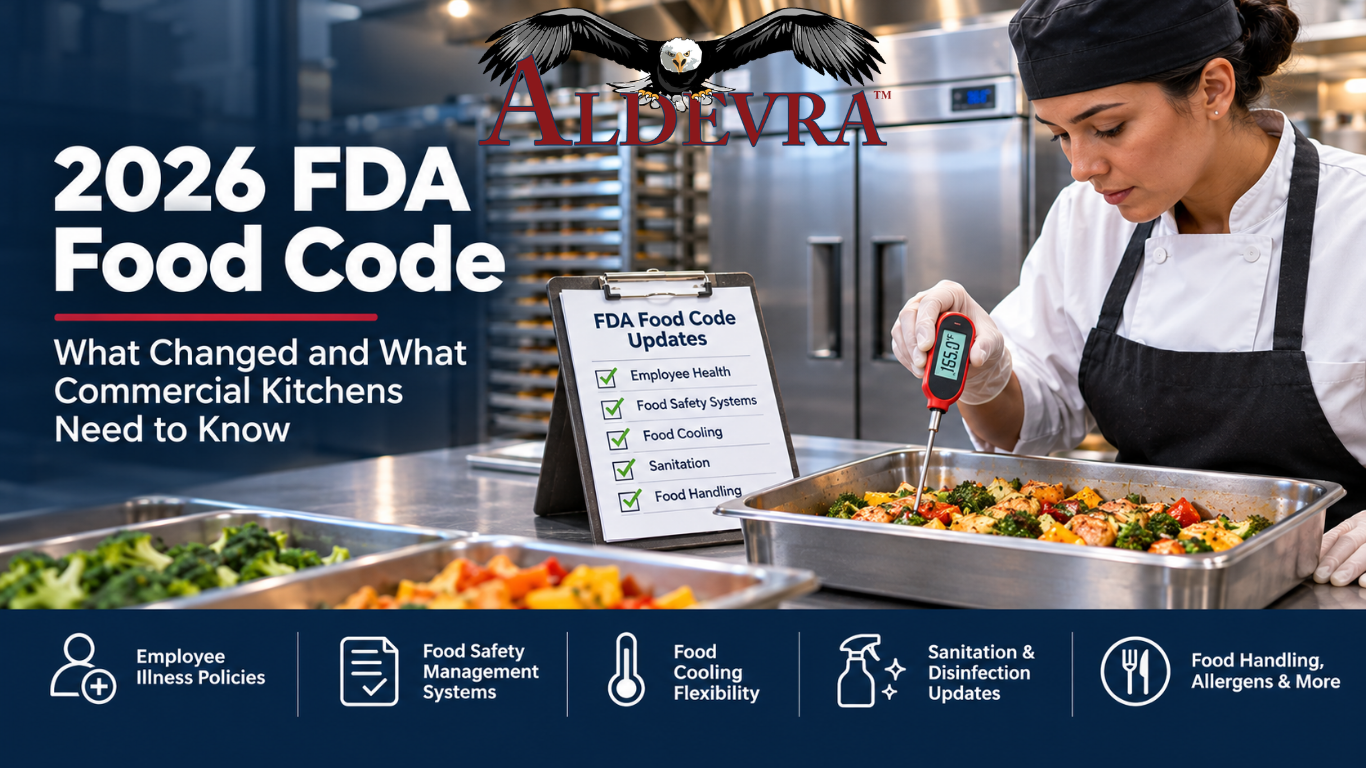
In this guide, we’ll explain what the 2026 FDA Food Code says about food donation, which foods may qualify, the equipment needed to support a safe program, and how to begin.
1. What Does the 2026 FDA Food Code Say About Food Donation?
The FDA Food Code recognizes food donation as an acceptable practice when food has been handled properly.
Section 3-204.10, first introduced in the 2022 edition and retained in the 2026 FDA Food Code, allows food to be donated when it has been stored, prepared, packaged, displayed, and labeled in accordance with applicable food safety requirements.
The important distinction is that food does not become exempt from food safety requirements simply because it is being donated.
The same precautions used to protect paying customers must also protect people receiving donated meals.
The FDA Food Code is a model for state and local food safety regulations. Operators should verify the requirements adopted by their jurisdiction rather than assuming the newest edition automatically applies.
Important considerations for food donation include:
- Maintaining appropriate temperatures during storage and transportation.
- Protecting donated foods from contamination.
- Properly cooling cooked foods before refrigerated storage.
- Providing accurate food identification and allergen information.
- Monitoring preparation dates, storage conditions, and applicable discard dates.
- Training employees and volunteers in safe food handling.
- Maintaining donation and temperature records.
FDA resources:
For additional ways to reduce waste before food becomes surplus, read Aldevra’s Cutting Food Waste with the Right Commercial Kitchen Equipment.
2. What Types of Food Can Commercial Kitchens Donate?
Many foodservice operators assume that only unopened canned goods and shelf-stable products qualify for donation.
In reality, properly handled prepared meals and perishable foods may also be eligible.
Surplus food is not the same as plate waste
Consider a hospital kitchen that prepares 100 meals but serves only 85.
The 15 additional meals may potentially qualify for donation if they have remained under proper food safety controls.
However, food that has already been served to customers, returned from dining tables, or exposed to uncontrolled self-service conditions should not be treated as eligible surplus.
Receiving organizations may have additional acceptance requirements. Before establishing a donation program, confirm which foods your charitable partner can accept and how those foods should be packaged and transferred.
3. Temperature Control Is Essential for Safe Food Donation
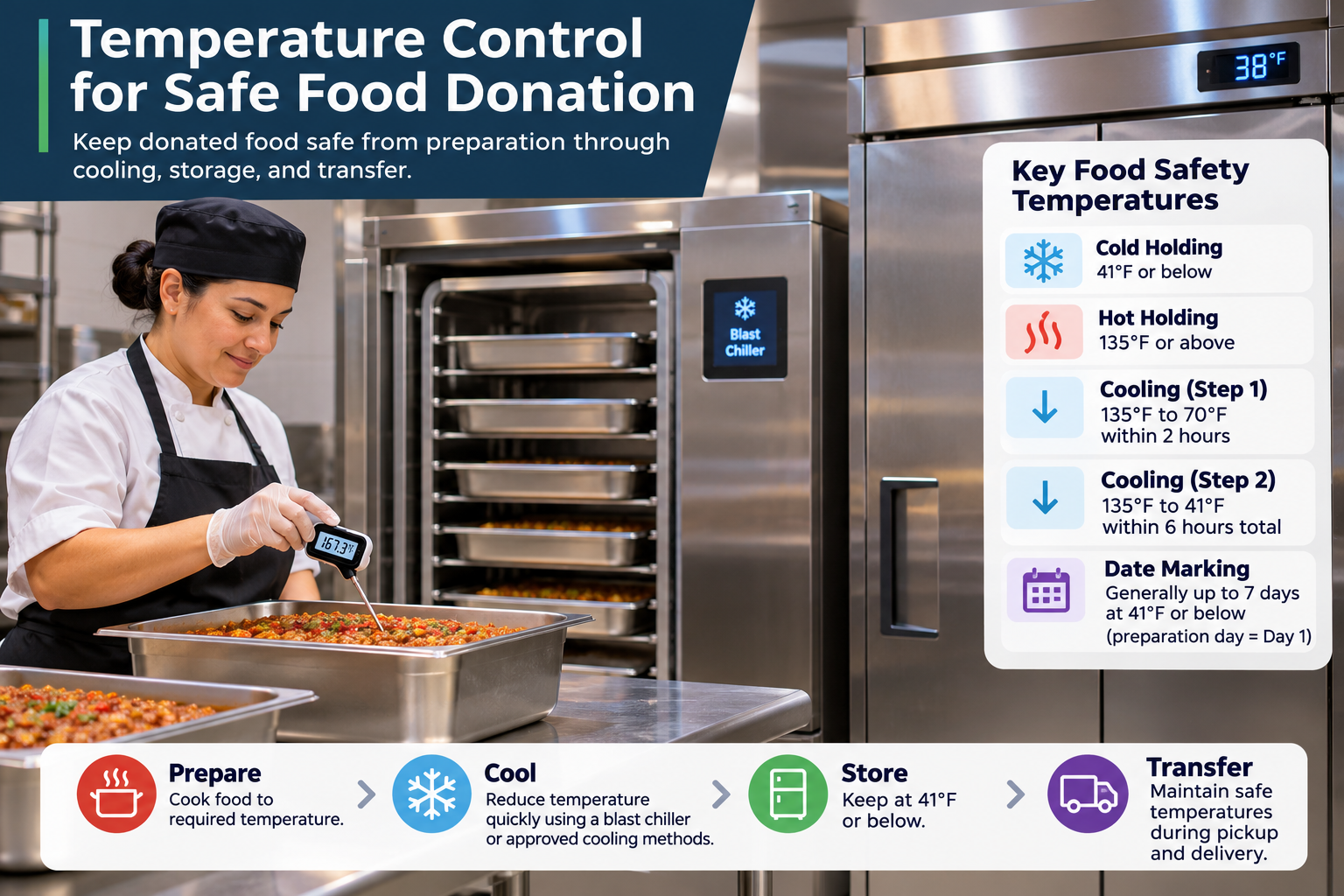
One of the greatest challenges in donating prepared food is maintaining safe temperatures from preparation through final delivery.
For foods requiring time and temperature control for safety (TCS foods), the FDA Food Code generally specifies:
These are general Food Code benchmarks. Certain products, handling methods, and regulatory exceptions have different requirements.
Why rapid cooling matters
Suppose a school kitchen prepares several large pans of soup that will be donated the following morning.
The soup must be cooled safely before refrigerated storage.
Placing large containers of hot food directly into a conventional reach-in refrigerator may not reduce the food’s internal temperature quickly enough.
Appropriate cooling methods may include shallow pans, smaller portions, ice baths, and specialized rapid cooling equipment.
For facilities preparing substantial quantities of surplus meals, a commercial blast chiller can significantly improve cooling capacity and process consistency.
Related Aldevra article: How to Select the Right Blast Chiller for Your Commercial Kitchen.
What happens if a refrigerator loses temperature?
A properly designed donation program also needs a procedure for responding to refrigeration alarms and equipment failures.
If storage temperatures become unsafe or cannot be verified, affected food should be held from donation until a qualified person evaluates its safety under applicable procedures.
An alarm reset alone does not establish that food is safe.
Read Aldevra’s Commercial Refrigerator High Temperature Alarm: Common Causes and What to Do Next.
4. Essential Equipment for a Safe Food Donation Program
A food donation program does not necessarily require an entirely new kitchen.
The appropriate equipment depends on the type of food being donated, daily volume, storage capacity, transportation distance, and the receiving organization’s capabilities.
A. Blast Chillers: Safely Cooling Prepared Meals
Equipment to consider: Commercial blast chillers, rapid cooling systems, shallow food pans, and compatible mobile racks.
Blast chillers rapidly reduce the temperature of cooked foods before they are moved into refrigerated storage.
This is particularly valuable for kitchens donating large quantities of soups, sauces, proteins, vegetables, and prepared meals.
Unlike conventional refrigerators primarily designed to maintain cold temperatures, blast chillers are engineered to remove heat from food quickly.
They can help operators improve cooling consistency, manage larger batches, protect product quality, and document cooling cycles.
Manufacturers to consider: Alto-Shaam, Victory Refrigeration, and American Panel.
Aldevra offers detailed guidance on evaluating cooling capacity, pan compatibility, utilities, and installation requirements.
Read Aldevra’s Blast Chiller Selection Guide.
For additional information about pairing cooking and cooling equipment, see Maximizing Efficiency in Commercial Kitchens: The Power of Combi Ovens and Blast Chillers.
B. Commercial Refrigeration: Protecting Food Before Pickup
Equipment to consider: Reach-in refrigerators, walk-in coolers, commercial freezers, refrigerated storage cabinets, and temperature monitoring systems.
Even perfectly prepared food can become unsafe if storage temperatures are not maintained.
Commercial refrigeration provides controlled storage for donated products awaiting collection.
Before starting a recurring donation program, evaluate whether your existing refrigeration has sufficient capacity for both normal kitchen operations and donated food.
Consider dedicating shelves or clearly labeled storage areas to donation inventory.
This can reduce accidental use, improve stock rotation, and make pickup preparation easier.
Recommended equipment features:
- Adequate capacity for anticipated donation volumes.
- Adjustable, easy-to-clean shelving.
- Accessible temperature displays.
- Temperature alarms and monitoring capabilities.
- Appropriate airflow and storage organization.
- Reliable warranty and local service support.
Manufacturers to consider: True, Beverage-Air, and Atosa.
Explore Aldevra’s Commercial Kitchen Refrigeration Solutions.
C. Heated Holding Cabinets: Maintaining Safe Temperatures Before Transfer
Equipment to consider: Heated holding cabinets, hot-food holding carts, and mobile temperature-controlled cabinets.
Not every food donation program involves refrigerated meals.
Some community organizations collect prepared food for immediate distribution, such as meals served at shelters, community centers, or emergency feeding locations.
Heated holding equipment can help maintain food at safe temperatures until it is transferred.
For example, an institutional kitchen might prepare additional meals for a nearby nonprofit organization serving dinner that evening.
A properly selected heated holding cabinet can help maintain those meals at the required temperature while transportation is arranged.
Manufacturers to consider: Dinex, Alto-Shaam, and Lakeside.
For commercial heated holding equipment, contact Aldevra’s equipment specialists.
D. Insulated Food Carriers: Protecting Food During Transportation
Equipment to consider: Insulated food carriers, transport carts, covered food pans, and refrigerated or heated transportation systems.
Transportation is often one of the most overlooked parts of a donation program.
Food may leave a commercial kitchen at a safe temperature but become unsafe if exposed to excessive temperature changes during pickup or delivery.
Insulated food carriers can help slow temperature changes during short transportation periods.
Longer routes or larger volumes may require active refrigeration or heating.
Manufacturers to consider: Cambro, Metro, and Dinex.
When selecting transportation equipment, consider:
- Typical pickup and delivery times.
- Distance between facilities.
- Whether food is transported hot, cold, or frozen.
- Quantity and size of food containers.
- Vehicle conditions.
- Cleaning and sanitation requirements.
- Whether product temperatures can be maintained throughout transportation.
Insulated carriers do not guarantee safe temperatures indefinitely. Operators must validate their transportation procedures and verify food temperatures as appropriate.
Contact Aldevra for food transport equipment recommendations.
E. Food Storage Containers and Labeling Supplies
Equipment to consider: Food-grade containers, stainless steel pans, tight-fitting lids, tamper-evident packaging, and food labels.
Proper packaging helps prevent contamination, preserve product identity, and support traceability.
A food donation label should communicate the information needed for safe handling and distribution.
Depending on the product and applicable requirements, this may include:
- Product name.
- Preparation or packaging date.
- Applicable use-by or discard date.
- Storage instructions.
- Ingredient and allergen information.
- Donating facility identification.
- Reheating instructions when appropriate.
Clear labeling is especially important when foods are transferred between organizations and handled by different employees or volunteers.
Manufacturers to consider: Cambro, Vollrath, and Rubbermaid Commercial Products.
Shop Food Storage Containers and Supplies at Aldevra.
F. Thermometers and Temperature Monitoring Equipment
Equipment to consider: Digital food thermometers, refrigerator thermometers, temperature data loggers, and monitoring systems.
A refrigerator display does not necessarily indicate the internal temperature of the food stored inside.
Foodservice teams should use appropriate calibrated thermometers to verify food temperatures during cooling, storage, and transfer.
Temperature monitoring becomes especially important when donating prepared meals that require strict temperature control.
Facilities with regular donation pickups may benefit from continuous monitoring systems and alerts.
Brands to consider: Cooper-Atkins and Taylor.
Shop Commercial Thermometers at Aldevra.
Not sure which thermometer is appropriate?
Read Aldevra’s Why the Right Measurement Tools Matter in Commercial Kitchens, which includes a Commercial Kitchen Measurement Tool Selector.
G. Shelving, Worktables, and Sanitation Equipment
Equipment to consider: Commercial shelving, stainless steel worktables, handwashing supplies, and warewashing equipment.
A well-organized donation program should provide an appropriate space for inspecting, portioning, packaging, labeling, and staging eligible foods.
This is particularly important in larger facilities where regular food production continues during donation preparation.
Dedicated work areas can help prevent cross-contamination and reduce confusion between donation inventory and other products.
Choose surfaces and shelving that are easy to clean, compatible with the storage environment, and appropriate for the expected load.
Manufacturers to consider: Metro, Advance Tabco, and Champion.
Explore:
- Commercial Shelving, Racks, and Storage Solutions
- Commercial Warewashing Equipment
- Food Measuring and Portioning Supplies
5. How to Start a Food Donation Program in Your Commercial Kitchen
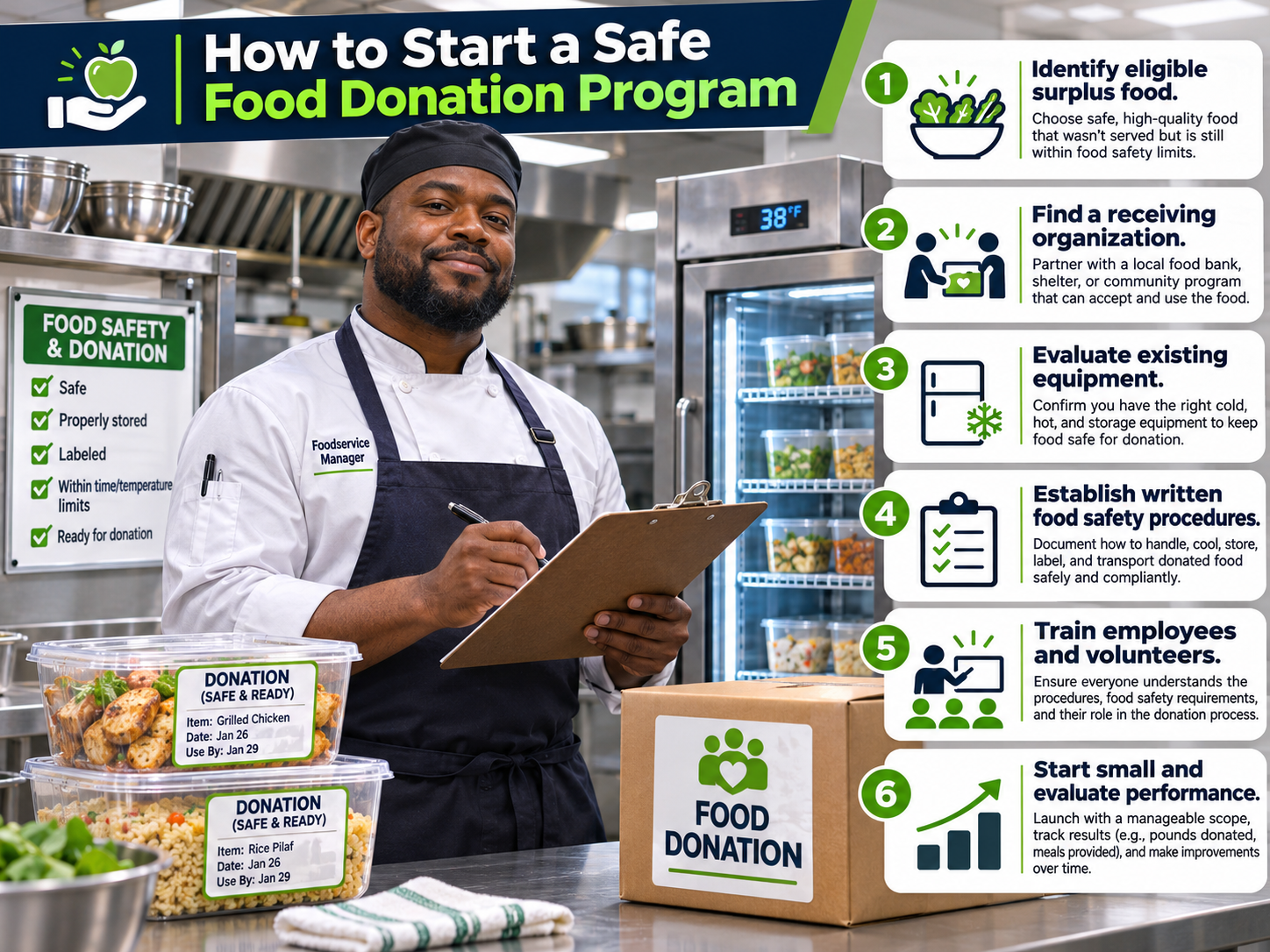
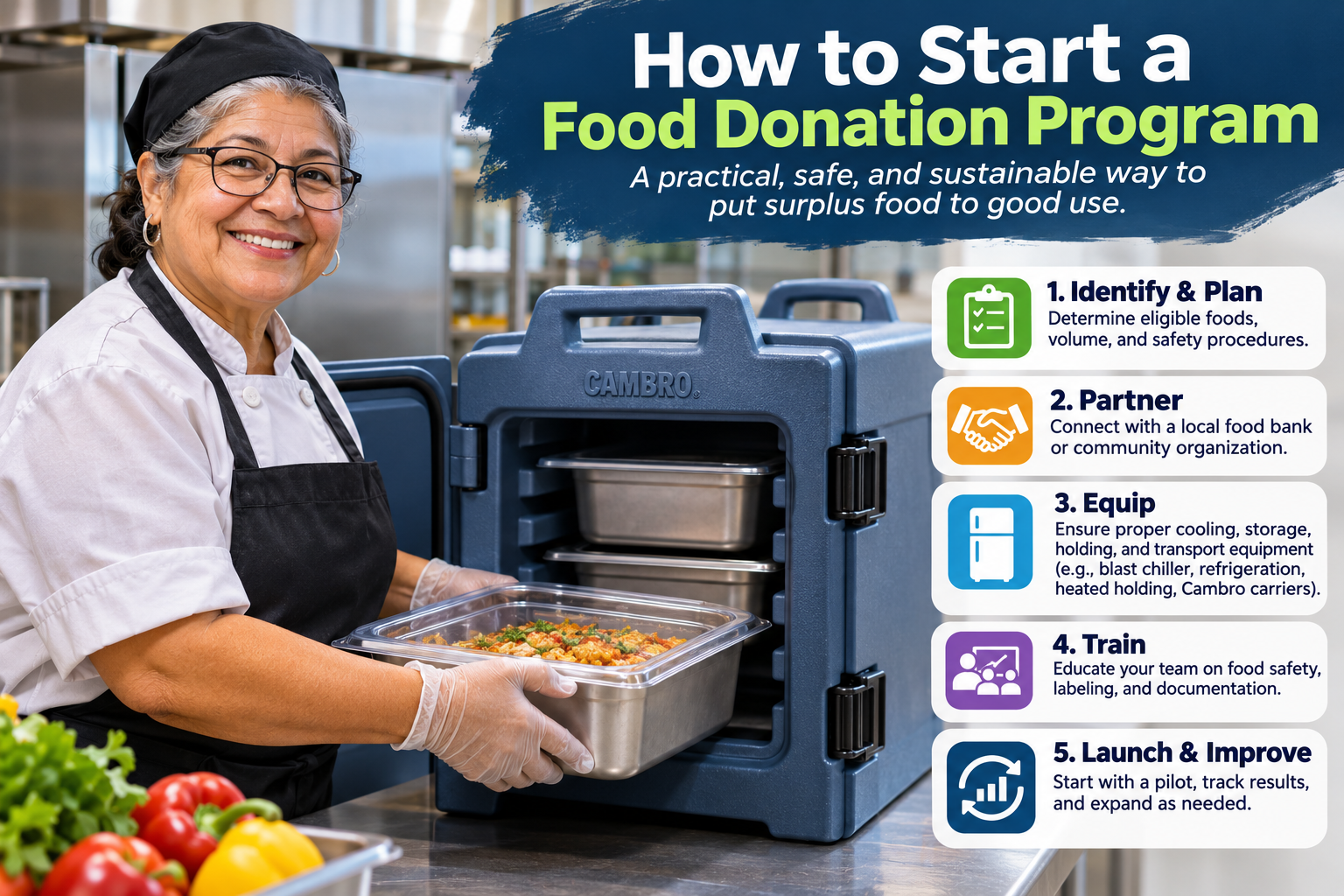
For many facilities, the best approach is to begin with a manageable pilot rather than a significant equipment investment.
Step 1: Identify the food you can safely donate
Review what your kitchen regularly has left over.
Determine which foods are eligible for donation, which require additional handling, and which should be excluded.
Step 2: Find a receiving organization
Contact local food banks, shelters, food rescue organizations, or community feeding programs.
Confirm what foods they accept, how products must be packaged, and whether they provide pickup services.
The Feeding America Food Bank Locator can help identify potential partners.
Step 3: Evaluate existing equipment
Determine whether your kitchen has sufficient refrigeration, cooling, holding, packaging, and transportation capabilities.
Before purchasing new equipment, evaluate how current equipment could support the program safely.
Step 4: Establish written food safety procedures
Document how food will be selected, cooled, packaged, labeled, stored, transported, and transferred.
Include corrective actions for missed pickups, temperature excursions, damaged packaging, and equipment failures.
Step 5: Train employees and volunteers
Ensure everyone handling donated food understands hygiene, temperature control, allergen precautions, documentation, and the conditions under which food must be rejected.
Step 6: Start small and evaluate performance
Begin with a limited number of food types or scheduled pickups.
Track donation volumes, food safety performance, operational costs, and any recurring challenges.
Use that information to determine whether the program should expand.
Free Resource: Safe Food Donation Program Starter Kit
Starting a food donation program? Don’t build your forms from scratch.
Aldevra has developed a free Food Donation Program Starter Kit to help commercial kitchens organize essential food donation procedures and records.
The kit includes:
- Program setup and equipment readiness checklist.
- Food donation acceptance checklist.
- Temperature monitoring and cooling log.
- Printable food donation labels.
- Pickup and transfer record.
- Corrective action and exception log.
- FDA Food Code reference guide.
Download Aldevra’s Free Food Donation Program Starter Kit
Use the templates as a starting point and customize them to your facility’s operations, receiving partner requirements, and applicable local food safety rules.
6. Why Donation Records Matter
Keeping accurate records helps foodservice operators demonstrate that food was handled properly before it left the facility.
A donation record should include:
- Food description and quantity.
- Preparation date and applicable discard date.
- Food temperature at transfer, when applicable.
- Date and time of pickup.
- Transportation provider.
- Receiving organization.
- Name or identification of the employee approving the donation.
- Any exceptions or corrective actions.
For smaller programs, standardized paper forms or spreadsheets may be sufficient.
Larger operations may benefit from electronic records and integrated temperature monitoring.
Documentation also helps operators respond to food recalls, investigate handling concerns, and identify opportunities to improve the donation process.
7. Are Businesses Protected From Liability When Donating Food?
Liability concerns sometimes discourage restaurants and institutional kitchens from donating food.
The federal Bill Emerson Good Samaritan Food Donation Act provides certain protections for qualifying good-faith donations of apparently wholesome food.
Amendments enacted in January 2023 expanded protections to certain qualified direct donors, including restaurants, caterers, school food authorities, and other eligible organizations that donate directly to people in need at no cost.
The protections also address qualifying donations through nonprofit organizations.
However, liability protection does not eliminate applicable food safety obligations, and the law contains conditions and exceptions.
Businesses should review the USDA’s guidance and consult their legal advisers when establishing donation policies.
Eligible food donations may also qualify for certain federal tax deductions, depending on the donor, recipient, documentation, and other requirements.
Learn More: USDA Food Donation Guidance.
8. What Equipment Does Your Food Donation Program Actually Need?
The appropriate equipment investment depends on donation volume, food type, and available infrastructure.
Start with the equipment that addresses your greatest food safety risk.
For a restaurant donating a small quantity of packaged meals once per week, a blast chiller may not be necessary if effective approved cooling methods and adequate refrigeration are already available.
For a hospital producing hundreds of meals daily, a blast chiller and dedicated refrigerated storage may make a significant operational difference.
Before investing in additional equipment, consider whether changes to menu planning, production quantities, and portion control could reduce surplus food in the first place.
Aldevra explores these strategies in Fighting Rising Food Costs with the Right Commercial Kitchen Equipment.
9. Frequently Asked Questions About Safe Food Donation Programs
1. Can restaurants donate leftover food?
Yes. Restaurants may donate eligible surplus food that has been properly handled, protected from contamination, and maintained under safe conditions.
Unserved prepared meals, unopened ingredients, and certain perishable products may qualify.
Food previously served to customers or exposed to uncontrolled self-service conditions generally should not be donated.
2. Can hospitals and schools donate prepared meals?
Yes, subject to applicable regulations, institutional policies, and receiving organization requirements.
Hospitals, school cafeterias, universities, and other institutional kitchens may be able to donate surplus meals when food safety controls are maintained.
School nutrition programs should also verify any program-specific requirements before redistributing meals.
3. What temperature must donated refrigerated food be kept at?
Under the FDA Food Code’s general cold-holding requirements, TCS foods must be maintained at 41°F or below, subject to applicable exceptions.
Use a calibrated food thermometer to verify product temperatures rather than relying exclusively on the refrigeration unit’s display.
4. Can hot food be donated without refrigerating it first?
Yes, when food is maintained under appropriate hot-holding conditions and the receiving organization can safely accept and distribute it.
The FDA Food Code generally requires hot-held TCS foods to remain at 135°F or above.
If food will instead be cooled and refrigerated for later distribution, the applicable cooling requirements must be followed.
5. How quickly must cooked food be cooled before donation?
Under the FDA Food Code’s standard cooling requirements, cooked TCS food must be cooled from 135°F to 70°F within two hours and to 41°F or below within a total of six hours.
Other cooling requirements apply to certain foods and situations.
For high-volume operations, commercial blast chillers can help achieve consistent cooling performance.
Read Aldevra’s Blast Chiller Buying Guide.
6. Do I need a blast chiller to donate prepared food?
Not necessarily.
A blast chiller is not universally required for food donation. Smaller operations may use other effective cooling methods that meet applicable safety requirements.
However, blast chillers can be especially helpful when cooling large quantities of hot food, managing repeated cooking cycles, or documenting temperatures.
7. Can food be donated after its Best By date?
Possibly, depending on the food, its condition, applicable law, and the receiving organization’s policies.
A Best By date often relates to product quality rather than an automatic safety deadline.
However, this should not be confused with a required use-by or discard date, such as applicable refrigerated ready-to-eat TCS food date marking.
Never donate spoiled, contaminated, recalled, or otherwise unsafe food.
8. Can insulated food carriers keep donated meals safe during transport?
Insulated carriers can help maintain temperatures, but their effectiveness depends on the starting food temperature, insulation, duration, load, and environmental conditions.
For longer journeys or frequent deliveries, powered refrigerated or heated transport may be necessary.
Food temperatures should remain within applicable limits during transportation.
9. Does donated food need labels?
Food must meet applicable labeling requirements.
Donating organizations should provide sufficient information to identify food, communicate allergens, establish storage requirements, and support safe distribution.
For prepared foods, a useful donation label includes the product name, preparation date, applicable discard date, storage instructions, and allergen information.
The precise legal requirements depend on the food and jurisdiction.
10. What should we do if our refrigerator alarm activates before a donation pickup?
Do not release affected food until its safety has been evaluated.
Verify product temperatures with an appropriate calibrated thermometer and follow your facility’s food safety and corrective-action procedures.
If safe handling cannot be established, the food should not be donated.
Read Aldevra’s Refrigerator Temperature Alarm Troubleshooting Guide.
11. Is there liability protection for businesses donating food?
Yes, federal law provides certain protections for qualifying good-faith donations.
The Bill Emerson Good Samaritan Food Donation Act includes conditions regarding eligible donors, recipients, and donations.
Businesses should confirm that their donation arrangements qualify and continue following all applicable food safety requirements.
12. What equipment should a small restaurant purchase first?
For a small restaurant beginning a food donation program, practical starting items often include:
- A reliable, calibrated digital food thermometer.
- Food-grade storage containers with appropriate lids.
- Food labels and date-marking supplies.
- Sufficient refrigerated storage.
- Appropriate insulated transportation containers.
Larger equipment purchases should be based on identified capacity or food safety needs.
Shop Food Storage Supplies or Browse Commercial Thermometers.
10. How Aldevra Can Help Support Safe Food Donation Programs
Aldevra works with restaurants, healthcare facilities, schools, government organizations, and institutional foodservice operations to provide commercial kitchen equipment and related support.
Whether you’re implementing a small food recovery initiative or developing a larger institutional donation program, selecting the right equipment is essential.
Aldevra can help evaluate:
- Commercial refrigeration and freezer requirements.
- Blast chillers and rapid cooling systems.
- Heated holding and food transportation equipment.
- Storage containers, shelving, and preparation equipment.
- Temperature monitoring and measurement tools.
- Equipment capacity, utilities, delivery, and installation considerations.
Our goal is to help customers select equipment that fits their operating environment, workflow, and budget.
Safe food donation begins with proper food handling, and the right equipment helps make those practices repeatable.
Turn Surplus Food Into Community Support
Food donation programs can create value far beyond the commercial kitchen.
They help businesses reduce waste while providing food to organizations that serve people in need.
But safety must remain the priority at every stage, from food preparation and cooling to packaging, storage, transportation, and distribution.
With the right procedures, employee training, and appropriately selected equipment, commercial kitchens can make food donation a practical part of their operations.
Ready to get started?
Download Aldevra’s free Food Donation Program Starter Kit, or contact our team to discuss equipment for your food recovery program.
Explore Aldevra’s Commercial Kitchen Solutions
Shop Commercial Kitchen Supplies
Food safety regulations and food donation requirements vary by jurisdiction and facility type. This article provides general educational information and does not replace applicable regulations, regulatory authority approvals, legal advice, or facility-specific food safety procedures.