Summary
A New FDA Food Code Is Here. Is Your Kitchen Ready?
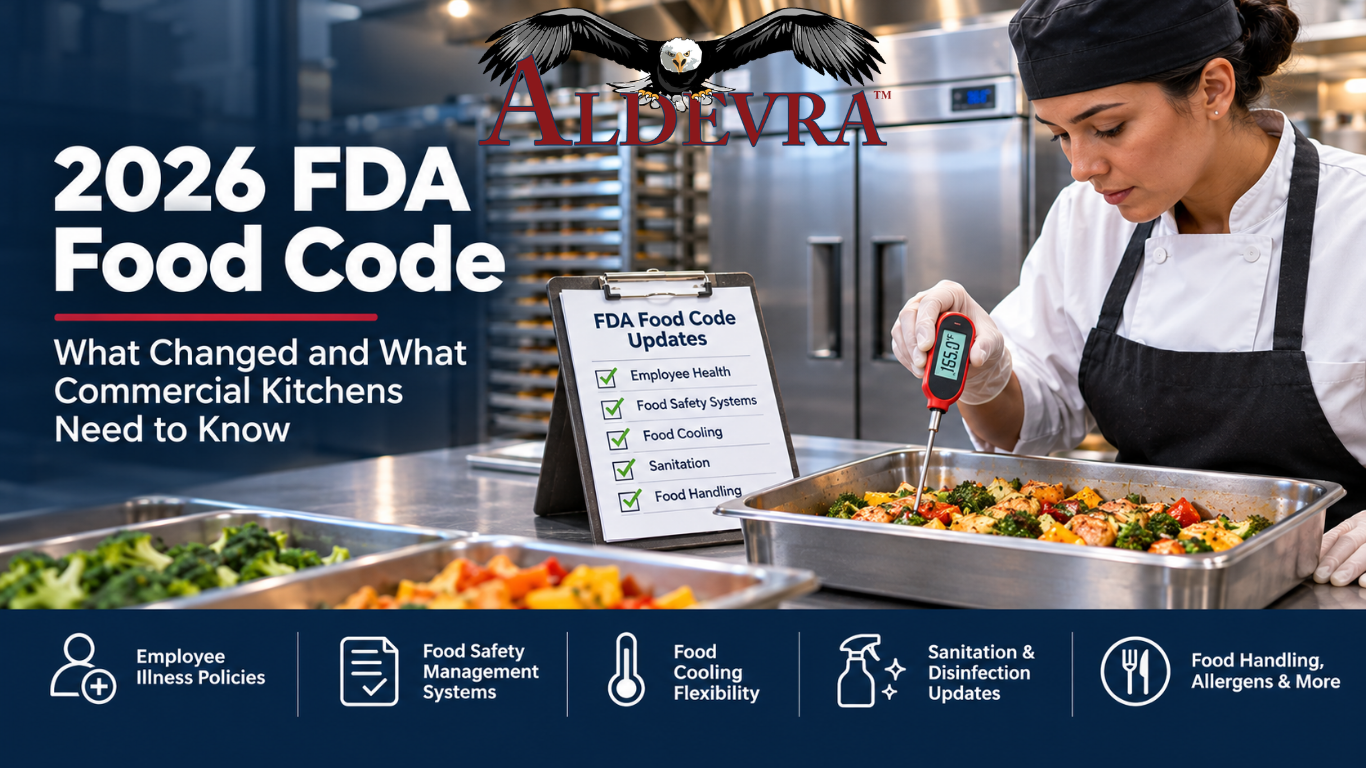
On September 17, 2026, the U.S. Food and Drug Administration released the 2026 FDA Food Code, introducing changes intended to strengthen food safety and help foodservice establishments reduce the risk of foodborne illness.
The updated code addresses everything from employee health and food cooling procedures to sanitation practices and food safety management systems.
For restaurants, institutional kitchens, hospitals, schools, military facilities, and other foodservice operations, these updates are worth reviewing now.
But does the new Food Code mean every commercial kitchen must immediately change its procedures or purchase new equipment? Not necessarily.
Here’s what operators should know.
Does the 2026 FDA Food Code Apply to Your Business?
The FDA Food Code is a model used by state, local, tribal, territorial, and federal authorities to establish food safety regulations.
It is not automatically a new federal law that applies to every restaurant.
Different jurisdictions may adopt different editions of the Food Code, modify individual requirements, or establish their own implementation schedules.
That means a restaurant operating in Michigan may have different requirements than a hospital kitchen in Texas or a federal dining facility in Virginia.
What you should do: Contact your local health department or applicable regulatory authority to determine which edition of the Food Code currently governs your operation and whether adoption of the 2026 edition is planned.
Even if your jurisdiction has not adopted it, understanding the changes can help your organization prepare.
1. Written Employee Illness Policies Receive New Emphasis
One of the most significant updates is the addition of a specific requirement for documented employee illness policies.
Under Section 2-501.11 of the new model code, food establishments must maintain a written employee illness policy that is available for review.
The policy should address employee reporting responsibilities, symptoms and illnesses that must be reported, management responses, and when employees may return to food handling duties.
For example, what happens when a kitchen employee reports vomiting or diarrhea before a scheduled shift?
Managers should have clear procedures for responding, rather than making decisions without established guidance.
What this means for foodservice operators: Review your employee illness reporting procedures, make sure they are documented, and train employees on their responsibilities.
For hospitals, nursing homes, and other facilities serving highly susceptible populations, employee illness controls are especially important.
Free Download: 2026 FDA Food Code Employee Illness Policy Template
Need help developing or updating your employee illness policy? Aldevra has created a free, customizable template aligned with the 2026 FDA Food Code.
The template includes employee illness reporting requirements, management responsibilities, exclusion and return-to-work procedures, cleanup guidance, and employee acknowledgment forms.
Download the free template in editable Word format and customize it for your operation.
Note: This is an educational template, not an FDA-approved policy. Review it against your jurisdiction’s requirements before implementation.
2. Written Food Safety Management Systems Become a New Requirement
One of the most significant changes in the 2026 FDA Food Code is the addition of Section 8-201.15, which establishes requirements for written Food Safety Management Systems (FSMS).
A Food Safety Management System helps commercial kitchens identify potential food safety hazards, establish preventive procedures, monitor operations, and document corrective actions.
Under the new model code, applicable food establishments must develop and maintain a written system that:
- Establishes procedures to manage food safety risks and comply with applicable requirements.
- Is implemented during all hours of operation.
- Is available for review by the regulatory authority upon request.
When does this take effect?
The 2026 FDA Food Code provides a four-year implementation period beginning when the applicable regulatory authority adopts the code. Certain low-risk food establishments may be exempted by their regulatory authority.
This does not establish a nationwide 2030 deadline. Operators should confirm their jurisdiction’s adoption status and implementation requirements.
What Should a Food Safety Management System Include?
Depending on the facility’s operations, a documented system may incorporate:
- Standard Operating Procedures (SOPs) for food preparation and handling.
- Cooking, cooling, reheating, and food storage temperature monitoring.
- Employee illness reporting and personal hygiene procedures.
- Cleaning, sanitizing, and allergen cross-contact prevention.
- Employee food safety training.
- Equipment inspection, calibration, and preventive maintenance.
- Corrective action procedures and recordkeeping.
The Food Code does not prescribe one universal document format. An effective system should reflect the specific food safety risks associated with the facility’s operations.
Is a Food Safety Management System the Same as HACCP?
Not necessarily.
HACCP (Hazard Analysis and Critical Control Points) is a structured, science-based approach to identifying and controlling food safety hazards.
Although HACCP principles can form the foundation of a Food Safety Management System, not every commercial kitchen is required to implement a formal HACCP plan.
Formal HACCP plans may be required for certain specialized processes, including some reduced-oxygen packaging operations and activities requiring regulatory variances.
Aldevra has previously published a guide explaining the principles of HACCP, when it may apply, and how foodservice operators can begin developing a plan.
Related Reading: What Is HACCP, When Does It Apply to Me, and What Do I Need to Do?
Resources to Help You Get Started
Foodservice operators do not necessarily need to start from scratch. Existing food safety procedures, temperature logs, employee training materials, and maintenance records may already provide a foundation for a documented management system.
Aldevra also provides sample food safety procedures and documentation examples through its Safety & Compliance Materials resource page.
What foodservice operators should do now: Review existing procedures, identify documentation gaps, verify that employees follow established food safety practices, and confirm whether your jurisdiction has adopted the new requirements.
Having reliable equipment, accurate temperature monitoring, and consistent maintenance procedures can help support an effective Food Safety Management System.
3. New Flexibility for Cooling Food Safely
Cooling cooked food is one of the most important food safety processes in a commercial kitchen.
Improper cooling can allow bacteria to multiply, particularly when large batches of food remain at unsafe temperatures for extended periods.
The FDA Food Code’s standard cooling requirements generally call for cooked time/temperature control for safety (TCS) foods to be cooled:
- From 135°F to 70°F within two hours.
- From 135°F to 41°F or below within six hours total.
These underlying temperature limits are not new.
What changed in 2026 is additional flexibility in approved cooling methods.
Section 3-501.15 adds an explicit shallow-food cooling option and establishes an alternative cooling process that regulatory authorities may approve.
Under the alternative process, qualifying cooked foods must be placed no more than two inches deep, held uncovered, and kept in refrigeration that maintains an ambient temperature of 41°F or less and continuously monitors time and ambient air temperature electronically.
This alternative requires regulatory approval and is subject to specific conditions and exclusions. Simply using shallow pans does not automatically eliminate the standard cooling requirements.
Why Commercial Kitchen Equipment Matters
For operators preparing large volumes of soups, sauces, meats, vegetables, and other cooked foods, cooling capacity should be evaluated carefully.
Equipment solutions include:
Blast Chillers: Designed to rapidly remove heat from prepared foods, helping kitchens cool large batches more efficiently than conventional refrigeration. They are especially useful in hospitals, schools, and other high-volume foodservice operations.
Not sure which type of blast chiller is right for your facility? Read Aldevra’s guide: How to Select the Right Blast Chiller for Your Commercial Kitchen.
Commercial Refrigerators and Walk-In Coolers: Properly sized refrigeration systems help maintain safe cold-storage temperatures. Facilities considering the newly approved alternative cooling process should verify whether their equipment meets the required ambient temperature and electronic monitoring conditions.
Explore Aldevra’s commercial refrigeration and kitchen equipment solutions.
Shallow Food Pans and Storage Containers: Shallow containers help increase surface area and facilitate heat transfer during cooling.
Browse food storage products at Shop Aldevra.
Food Thermometers and Temperature Monitoring: Accurate temperature measurements help employees verify cooling progress, document food safety procedures, and identify potential problems before food is served.
Explore commercial thermometers at Shop Aldevra, or read our guide on choosing the right measurement tools for commercial kitchens.
Planning a Blast Chiller Purchase or Replacement?
Selecting the right equipment involves more than choosing a brand or model. Kitchen operators should consider production volume, cooling capacity, available utilities, installation requirements, and temperature-monitoring capabilities.
Aldevra offers a free interactive Blast Chiller Statement of Work Builder to help facilities organize their equipment requirements before requesting quotes.
Need help evaluating your kitchen’s cooling equipment? Contact Aldevra at sales@aldevra.com or (269) 350-1337 to discuss refrigeration, blast chillers, and related food safety equipment.
4. Updated Sanitizing and Disinfection Requirements
Cleaning and sanitizing food-contact surfaces remain fundamental responsibilities in every commercial kitchen.
The 2026 FDA Food Code introduces additional clarification regarding chemical sanitizers, disinfectants, testing equipment, and the proper treatment of food-contact surfaces.
One specific change under Section 4-501.114 establishes a minimum solution temperature of 75°F for chemical sanitizers other than chlorine, iodine, or quaternary ammonium compounds, unless otherwise specified by the EPA-registered label instructions.
The updated code also clarifies requirements for using sanitizer and disinfectant testing devices according to manufacturer instructions.
New Guidance on Disinfection
The 2026 Food Code adds Part 4-10, addressing disinfection when pathogens of concern cannot be adequately controlled by available sanitizers.
This includes situations involving contamination from bodily fluids, foodborne illness outbreaks, and imminent health hazards.
Foodservice operators should understand the difference between routine sanitizing and disinfection, including when each is required.
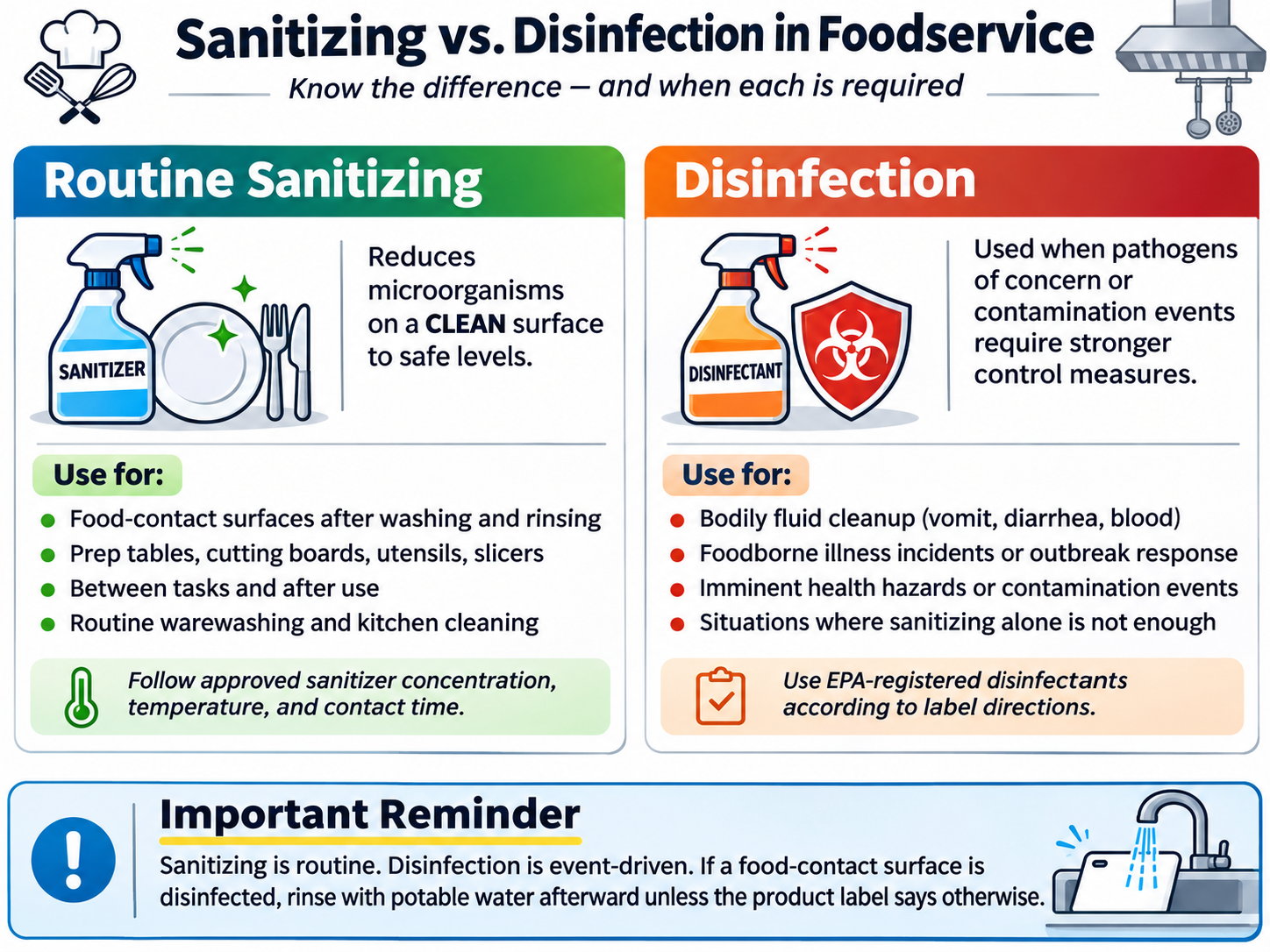
Disinfectants must be used according to their EPA-registered label directions. Food-contact surfaces must be rinsed with potable water after disinfection unless the product label specifies otherwise.
What This Means for Commercial Dishwashing Equipment
Commercial dishmachines and manual warewashing operations must consistently achieve appropriate cleaning and sanitizing conditions.
Whether your facility uses a high-temperature dishmachine or a chemical-sanitizing model, employees should understand how to verify proper operation.
Key areas to review include:
- Sanitizing temperatures: Confirm that equipment reaches the applicable operating and utensil-surface temperatures.
- Chemical concentrations: Verify that sanitizers are properly diluted and dispensed according to applicable requirements.
- Testing procedures: Use appropriate test strips, thermometers, and other monitoring devices.
- Equipment maintenance: Inspect spray arms, chemical dispensing systems, booster heaters, drains, and other essential components.
- Employee training: Ensure dishroom personnel understand cleaning, sanitizing, and when special disinfection procedures are necessary.
For additional guidance, read Aldevra’s Commercial Dishwasher Maintenance Checklist, which outlines daily, weekly, monthly, and annual maintenance activities.
Does Your Commercial Dishwasher Need to Be Replaced?
The new Food Code does not automatically require commercial kitchens to replace their existing dishwashers.
However, aging or improperly maintained equipment may struggle to deliver consistent sanitizing performance.
Facilities experiencing repeated equipment failures, inconsistent temperatures, chemical dispensing problems, or insufficient washing capacity should evaluate whether maintenance, repair, or replacement is appropriate.
Aldevra offers a comprehensive Commercial Dishroom Guide covering dishwasher selection, installation requirements, inspection readiness, and dishroom operations.
Equipment and Supplies That Support Proper Sanitation
Aldevra provides commercial kitchen equipment and supplies to help foodservice operations maintain efficient, reliable warewashing systems.
Explore these resources:
Commercial Dishwashing Equipment: Learn about equipment selection, dishroom design, and replacement planning through Aldevra’s commercial kitchen equipment solutions.
Warewashing Accessories: Browse dish racks, pre-rinse accessories, sinks, and related supplies at Shop Aldevra.
Equipment Cleaning and Maintenance Products: Explore cleaners and maintenance chemicals at Shop Aldevra. Always verify that a product is appropriate for its intended application; equipment cleaners are not necessarily approved food-contact sanitizers or disinfectants.
Installation, Maintenance, and Repair: Learn about Aldevra’s kitchen equipment installation and maintenance services.
Keep Your Dishroom Operating Safely
Proper sanitation depends on more than the equipment itself. Routine maintenance, employee training, appropriate chemical products, and reliable testing procedures all contribute to food safety.
Need help evaluating your commercial dishwashing equipment? Contact Aldevra at sales@aldevra.com or (269) 350-1337 to discuss equipment selection, replacement, installation, or maintenance needs.
5. Food Defense, Allergen Awareness, and Glove Use: Training Your Kitchen Staff
The 2026 FDA Food Code includes important updates involving food defense, allergen cross-contact, and disposable glove use.
Written procedures are important, but employees must also understand how to apply food safety practices during their daily work.
Fortunately, several free training resources can help foodservice operators educate employees and reinforce safe practices.
Food Defense: Recognizing and Reporting Suspicious Activity
Food defense focuses on protecting food from intentional contamination or tampering.
The 2026 FDA Food Code adds food defense awareness to the person in charge’s responsibilities and addresses employee training appropriate to assigned duties.
The FDA offers a free training program called Employees FIRST, which teaches five principles:
- F – Follow your company’s food defense procedures.
- I – Inspect your work area and surroundings.
- R – Recognize unusual or suspicious activity.
- S – Secure ingredients, supplies, and finished products.
- T – Tell management when something unusual occurs.
Free Training Resource: FDA Employees FIRST Posters and Training Videos
These resources can be used during employee onboarding, safety meetings, and refresher training.
Allergen Awareness: Preventing Cross-Contact
Food allergen cross-contact occurs when an allergen is unintentionally transferred to another food.
Even small amounts can cause serious reactions in susceptible individuals.
The FDA recognizes nine major food allergens: milk, eggs, fish, crustacean shellfish, tree nuts, peanuts, wheat, soybeans, and sesame.
Employees should understand how to identify allergens, verify ingredients, prevent cross-contact during food preparation, and communicate allergy concerns to management.
Free Training Resources:
FARE Restaurant Food Allergy Training Posters and Resources
FDA: What Are Major Food Allergens? Printable Infographic
These materials can help employees recognize allergens and understand appropriate food handling practices.
Glove Use: Understanding the 2026 Changes
The 2026 Food Code introduces a limited exception allowing one single-use glove to be worn over another single-use glove when specific conditions are met and regulatory approval is obtained.
This does not make double gloving a universal requirement or replace existing handwashing and glove-changing procedures.
Employees should continue following applicable requirements for handwashing, preventing bare-hand contact with ready-to-eat foods, changing gloves between tasks, and discarding soiled or damaged gloves.
Free Training Resource: FDA: Use Gloves or Utensils When Handling Ready-to-Eat Foods (PDF)
This illustrated poster can be displayed near food preparation stations and incorporated into employee training.
Free Download: Food Safety Staff Training Toolkit
To help foodservice operators reinforce these practices, Aldevra has developed a free 2026 FDA Food Code Staff Training Toolkit.
The downloadable resource includes a quick-reference kitchen poster, a 10-minute training activity, real-world scenarios for employee discussions, and a training attendance record.
Managers can use the materials during new-hire orientation, shift meetings, and periodic food safety refreshers.
Download Aldevra’s Free Food Safety Staff Training Toolkit (PDF format).
Training materials should be adapted to your facility’s procedures and applicable local food safety regulations.
6. Additional FDA Food Code Changes for Specialized Foodservice Operations
The 2026 FDA Food Code also addresses food safety considerations for businesses operating outside traditional restaurant kitchens.
These updates are particularly relevant to food trucks, commissary kitchens, catering companies, food donation programs, and establishments using specialized food preparation or preservation methods.
Some provisions clarify existing requirements, while others introduce new definitions or provide additional technical guidance.
Here’s what foodservice operators should know.
Mobile Food Establishments and Commissary Kitchens
The 2026 Food Code introduces a definition of a mobile food establishment and updates the definition of a food establishment to explicitly include commissaries.
A mobile food establishment is a business that changes locations as part of its routine operation, such as a food truck or mobile kitchen.
A commissary is a commercial food preparation or support facility that may provide mobile operators with food storage, preparation areas, warewashing, water, and waste-disposal services.
These definitions help clarify how mobile and shared foodservice operations fit into the Food Code.
However, the new definitions do not automatically require every food truck to use a commissary. Those requirements depend on the applicable regulatory authority and the operator’s activities.
What Operators Should Review
- Refrigeration and hot-holding capabilities.
- Adequate handwashing and warewashing facilities.
- Safe potable-water supply and wastewater disposal.
- Food storage and transportation procedures.
- Equipment suitability for limited spaces and utility capacity.
Related Aldevra Resources:
Getting Started with a Food Truck: What You Need and How to Buy in Phases
Food Truck Dishwashing and Commissary Requirements
Shop Aldevra: Browse commercial food thermometers to help monitor food temperatures during preparation, holding, and service.
Reusable Food Containers and Refill Stations
The 2026 Food Code updates Section 3-304.17 to clarify when food containers may be refilled by food employees or consumers and how refilling must be managed to prevent contamination.
This is particularly relevant to businesses offering reusable containers, self-service food or beverage options, and refill programs.
Allowing customers to bring or reuse containers can reduce packaging waste, but operators must have appropriate safeguards to protect food and food-contact surfaces.
What Operators Should Review
- Whether containers are suitable for their intended food-contact use.
- Cleaning and sanitizing procedures for reusable containers.
- Processes that prevent contamination during refilling.
- Storage methods that protect clean containers from contamination.
- Any additional restrictions established by the local regulatory authority.
Shop Aldevra: Explore commercial food storage containers, pans, and lids.
Properly selected food-grade containers can support organized storage, safe handling, and efficient food preparation. Operators should verify that specific containers are appropriate for their intended use, including any consumer-refill program.
Manufacturer Cooking Instructions and Commercially Dehydrated Foods
The 2026 Food Code provides additional clarification concerning manufacturer cooking instructions and commercially packaged dehydrated foods.
Section 3-401.15 addresses manufacturer cooking instructions, including the need to properly assess certain packaged foods before offering them as ready-to-eat products.
New Section 3-501.10 addresses following manufacturer instructions when rehydrating commercially packaged dehydrated foods.
These provisions are relevant to kitchens that prepare commercially packaged meals, dehydrated ingredients, and other products requiring specific preparation procedures.
Why This Matters
Foodservice employees should not assume that a packaged product is fully cooked or ready to serve simply because it has undergone some processing.
Operators should:
- Review package instructions before preparing food.
- Determine whether products require additional cooking.
- Follow applicable rehydration instructions.
- Verify required cooking temperatures using appropriate thermometers.
- Train employees to distinguish ready-to-eat products from products requiring further preparation.
Related Aldevra Article: Top Restaurant Health Inspection Violations—and How to Be Ready Before the Inspector Arrives
Shop Aldevra: Browse commercial thermometers and commercial cookware and food preparation equipment.
Specialty Mushrooms: Understanding Food Safety Risks
The updated Food Code includes additional scientific references addressing hazards associated with raw specialty mushrooms.
This is relevant to restaurants serving specialty mushrooms, farm-to-table establishments, and foodservice operations purchasing mushrooms from local or specialty suppliers.
Some mushroom varieties may present risks if improperly identified or prepared. Certain mushrooms contain naturally occurring substances that require appropriate controls, and some may remain hazardous even after cooking.
What Operators Should Review
- Whether suppliers provide appropriate identification and traceability.
- Whether mushroom varieties are suitable for foodservice use.
- Whether preparation and cooking instructions address known hazards.
- Whether employees understand the risks of using unidentified or improperly sourced wild mushrooms.
The 2026 update should not be interpreted as a blanket new equipment requirement or as authorization to serve any wild mushroom.
Foodservice operators should follow their regulatory authority’s requirements and obtain mushrooms from appropriately verified sources.
Dehydration and Freeze-Drying: New Food Safety Guidance
Dehydration and freeze-drying are increasingly used to preserve ingredients, create specialty menu items, and reduce food waste.
The 2026 Food Code adds technical guidance in Annex 6 addressing dehydration and freeze-drying conducted in food establishments.
Both processes remove moisture, but they work differently.
Dehydration removes moisture through drying processes, often involving controlled heat and airflow.
Freeze-drying removes moisture from frozen food using reduced pressure, allowing ice to transition directly into vapor.
Although both processes can help preserve food, neither automatically makes every product shelf-stable or safe to store at room temperature.
Food safety depends on factors including the product’s composition, processing conditions, water activity, packaging, and intended storage conditions.
What Operators Should Review
- Whether the planned preservation method requires regulatory approval, a variance, or a HACCP plan.
- Equipment capabilities and process controls.
- Appropriate moisture or water-activity verification.
- Packaging and labeling procedures.
- Safe storage conditions and shelf-life determinations.
- Employee training and documentation.
The new Annex 6 guidance provides additional technical information; it does not mean that every kitchen using a dehydrator or freeze-dryer automatically requires a variance.
Related Aldevra Articles:
What Is HACCP, When Does It Apply to Me, and What Do I Need to Do?
Cutting Food Waste with the Right Commercial Kitchen Equipment
Shop Aldevra: Explore food storage containers and supplies.
For specialized dehydrating or freeze-drying equipment, contact Aldevra to discuss your operation’s requirements and available manufacturers.
Sushi Rice and Specialized Food Processing
The FDA also added guidance in Annex 6 concerning acidification of sushi rice.
Acidification can be used as a food safety control when properly designed, validated, monitored, and approved as applicable.
However, adding vinegar to rice does not automatically make the finished product safe to hold without temperature control.
Establishments preparing acidified sushi rice should review their regulatory authority’s requirements, applicable HACCP or variance provisions, and the procedures necessary to verify critical limits.
The same principle applies to other specialized processes, including certain reduced-oxygen packaging and cook-chill operations: equipment selection should follow an evaluation of the food safety process, not replace it.
Related Aldevra Article: What Is HACCP, When Does It Apply to Me, and What Do I Need to Do?
Food Donations: Reducing Waste Without Compromising Safety
The FDA’s 2026 Food Code materials also address food donations as part of the broader retail food safety framework.
For restaurants, hospitals, schools, caterers, and other organizations that donate surplus food, the essential principle remains the same:
Donated food must be handled safely, just like food intended for paying customers.
Food donation programs should establish procedures for identifying suitable food, maintaining safe temperatures, protecting food from contamination, and transporting it appropriately.
Equipment That Can Support Food Donation Programs
- Commercial refrigeration: Helps maintain appropriate temperatures before donated food is transferred.
- Food storage containers: Protect food during storage and handling.
- Thermometers: Allow employees to verify temperatures before distribution.
- Insulated transport carriers: Can help maintain temperatures during transportation when properly selected and used.
- Commercial shelving: Supports organized, sanitary storage and separation of products.
Related Aldevra Articles:
Cutting Food Waste with the Right Commercial Kitchen Equipment
Do You Need a Full Commercial Kitchen for an Event Venue? Catering Kitchen vs. Full Kitchen
Shop Aldevra:
Food Storage Containers and Pans
Commercial Shelving and Storage Components
How Aldevra Can Help
Whether you’re opening a food truck, outfitting a commissary kitchen, introducing a specialized food preparation process, or improving a food donation program, selecting the right equipment is an important part of safe operations.
Aldevra works with commercial and institutional foodservice customers to identify equipment appropriate for their production volumes, facility layouts, utility requirements, and operational needs.
Our team can assist with commercial refrigeration, food preparation and cooking equipment, storage solutions, warewashing, installation, and equipment replacement planning.
Planning a new operation or equipment upgrade?
Visit Aldevra’s Commercial Kitchen Solutions or contact sales@aldevra.com to discuss your equipment needs.
Note: The FDA Food Code is a model code. Operators should confirm applicable requirements, permits, variances, and regulatory approvals with their jurisdiction before introducing specialized food processing methods.
Do You Need to Replace Commercial Kitchen Equipment Because of the New Food Code?
Not automatically.
The publication of the 2026 FDA Food Code does not mean that every foodservice establishment must purchase new refrigerators, dishwashers, or cooking equipment.
However, operators should use the update as an opportunity to assess whether their existing equipment supports safe and reliable operations.
Consider these questions:
- Can your kitchen consistently meet required cooking, cooling, hot-holding, and cold-holding temperatures?
- Is your refrigeration equipment appropriately sized for your food production and storage volumes?
- Do employees have reliable thermometers and temperature-monitoring procedures?
- Does your warewashing equipment consistently achieve the required sanitizing conditions?
- Are food-contact surfaces, storage systems, and preparation areas suitable for preventing contamination and allergen cross-contact?
- Are maintenance and service procedures documented?
Equipment that cannot consistently maintain required operating conditions may create food safety risks regardless of which Food Code edition applies.
2026 FDA Food Code Readiness Checklist
Foodservice operators can begin preparing without waiting for an equipment failure or failed inspection.
☐ Confirm applicable regulations. Determine which Food Code edition your regulatory authority has adopted.
☐ Review employee illness policies. Ensure written procedures address reporting, restriction, exclusion, and return-to-work decisions.
☐ Evaluate your Food Safety Management System. Review documented processes, training, monitoring, and corrective action procedures.
☐ Verify food cooling practices. Confirm that cooling methods meet applicable time and temperature requirements.
☐ Inspect refrigeration and monitoring equipment. Verify temperature performance, storage capacity, maintenance, and monitoring capabilities.
☐ Review sanitation procedures. Check dishmachine performance, chemical concentrations, labeling, temperatures, and test kits.
☐ Update employee training. Include relevant changes involving food defense, allergens, glove use, and safe food handling.
☐ Document corrective actions. Maintain records of equipment repairs, temperature issues, procedural changes, and completed training as appropriate.
How Aldevra Can Help Commercial Kitchens Prepare
At Aldevra, we understand that food safety depends on more than written procedures.
It also depends on equipment that performs reliably, employees who understand their responsibilities, and facilities designed to support safe food preparation.
Aldevra supplies commercial foodservice equipment for restaurants, VA medical centers, military installations, schools, healthcare organizations, and other institutional kitchens.
Our team can help customers evaluate equipment needs and identify solutions involving:
Commercial Refrigeration: Reach-in refrigerators, freezers, walk-in systems, and specialty refrigeration solutions from manufacturers such as True, Beverage-Air, and Follett.
Cooling and Food Preparation: Blast chillers, preparation equipment, stainless steel worktables, and other equipment designed to support safe food handling.
Warewashing and Sanitation: Commercial dishmachines and related equipment from manufacturers such as Champion, along with appropriate foodservice support equipment.
Cooking and Holding: Commercial cooking, food holding, and production equipment from manufacturers including RATIONAL, Blodgett, Cleveland, and Southbend.
Installation and Maintenance: Equipment installation, replacement planning, preventive maintenance, and service coordination to support reliable kitchen operations.
Explore our commercial kitchen equipment solutions and installation and maintenance services.
Prepare Now. Protect Your Operation.
The 2026 FDA Food Code is an opportunity to review how your kitchen manages food safety risks, documents procedures, and maintains essential equipment.
You do not need to wait until a new code provision becomes enforceable to improve temperature control, sanitation practices, or equipment reliability.
Whether you’re planning a kitchen renovation, replacing aging refrigeration, evaluating a new dishmachine, or improving food production capacity, Aldevra can help identify equipment solutions suited to your operation.
Contact Aldevra to discuss your commercial kitchen equipment needs.
Request a Quote or Contact Aldevra
Phone: (269) 350-1337
Email: sales@aldevra.com
Official Sources and Additional Information
FDA: Summary of Changes in the 2026 Food Code
FDA: September 17, 2026 Announcement
Disclaimer: This article provides general educational information and does not constitute regulatory or legal advice. The FDA Food Code is a model code, and applicable requirements depend on adoption and implementation by the relevant regulatory authority. Follow applicable regulations and equipment manufacturer instructions.