Summary
Door-type dishwashers—also called hood-type dish machines—are the most widely used commercial dishwashers in restaurants, schools, catering kitchens, and many institutional facilities. They deliver the ideal balance of throughput, footprint, utility demand, and inspection reliability.
WHAT IS A DOOR-TYPE (HOOD) DISHWASHER?
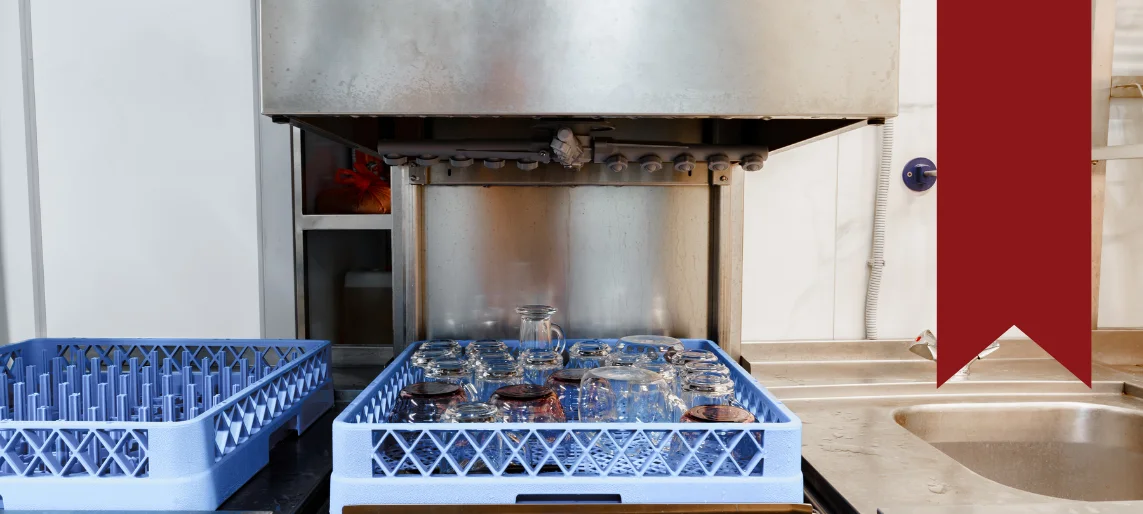
A door-type commercial dishwasher is a vertical rack-based dish machine where a hood lifts up to allow racks of dishes to be loaded and unloaded. Once the hood is lowered, the wash and sanitizing cycle begins automatically.
Unlike undercounter machines, door-type units are:
- Built for medium to high-volume operations
- Capable of handling real grease loads
- Designed to integrate into left-to-right dishroom workflows
- Compatible with pre-rinse stations, clean tables, and rack carts
BEST USE CASES FOR DOOR-TYPE DISHWASHERS
Door-type machines are ideal for:
- Full-service restaurants
- School kitchens
- Churches & community kitchens
- Catering operations
- Bars with full kitchens
- Medium-volume healthcare support kitchens
- Employee cafeterias
They are typically not sufficient alone for:
- Large hospitals with full tray service
- Universities with massive meal volume
- Correctional institutions
- Mega-commissaries
Those operations generally require conveyor or flight-type systems.
HEAT VS CHEMICAL IN DOOR-TYPE MACHINES
Door-type machines are commonly available in both sanitizing methods:
High-Temp (Heat) Door-Type
- Final rinse at 180°F
- Requires a booster heater
- Simplest inspection verification
Preferred for:
- Schools
- Institutional kitchens
- Federal facilities
Low-Temp (Chemical) Door-Type
- Lower water temperature
- Uses chemical sanitizer
- Requires test strips and ppm logging
- Lower utility demand
- Higher inspection risk if staff is inconsistent
Use the Heat vs Chemical Decision Tool
TYPICAL CAPACITY & PERFORMANCE
Well suited for 150–400 meals per hour depending on menu and ware type.
SPACE & WORKFLOW REQUIREMENTS
Door-type machines must be designed into a proper workflow to perform correctly:
- Dirty landing table or pre-rinse station
- Left-to-right or right-to-left flow
- Clean outfeed landing table
- Air-dry zone
- Rack cart staging
- 3-comp sink within code distance
- Hand sink within code distance
Improper layout is one of the top reasons door-type dishrooms fail inspection and efficiency targets.
View Door-Type Dishroom Layouts
UTILITIES REQUIRED BY SANITIZING TYPE
High-Temp Door-Type
- Electrical or gas booster heater
- Hot water supply with proper recovery
- Drain with indirect connection / air gap
- Optional but strongly recommended water softener
- Hood ventilation may be required depending on jurisdiction
Chemical Door-Type
- Cold or warm water supply
- Drain with indirect connection
- Chemical pumps
- Test strips
- Chemical storage with SDS documentation
Check My Utility Readiness
COMMON INSPECTION FAILURES WITH DOOR-TYPE MACHINES
- Final rinse below 180°F (heat systems)
- Chemical sanitizer below required ppm
- No test strips on site
- Improper air-drying (stacking while wet)
- No indirect drain / air gap
- Grease residue not removed before washing
- No temperature or ppm logs
- Hood not properly ventilated (where required)
View Full Dishroom Inspection Defense Guide
PROS & CONS OF DOOR-TYPE DISHWASHERS
Pros
- Excellent balance of capacity and footprint
- Handles grease better than undercounter
- Faster throughput during peak periods
- Good upgrade path from small dishrooms
- Works with both heat and chemical sanitizing
- Lower install complexity than conveyor systems
Cons
- Requires dedicated workflow space
- Still labor-intensive for very high-volume operations
- Booster heater adds utility cost (for heat models)
- Can bottleneck if poorly designed
WHEN A DOOR-TYPE IS TOO SMALL
You’ve outgrown a door-type machine if:
- Trays back up during peak
- Staff is running multiple re-washes
- Dishroom is constantly congested
- Inspection logs show temp or ppm instability
- You exceed 400+ meals per hour consistently
That’s when a conveyor dishwasher becomes necessary.
MANUFACTURERS COMMONLY USED FOR DOOR-TYPE DISHWASHERS
Well-known manufacturers in this category include:
- Champion
- Hobart / Moyer Diebel
- Jackson
- CMA Dishmachines
- VRX / Insinger
- Meiko (institutional-heavy)
Manufacturer selection should be based on:
- Local factory-authorized service coverage
- Available heat vs chemical configurations
- Parts availability
- Water quality tolerance
- Federal or healthcare compliance needs
View Dishwasher Manufacturers by Type
STAFF TRAINING REQUIREMENTS (DOOR-TYPE)
Staff must be trained on:
- Proper pre-scraping and pre-rinsing
- Correct rack loading
- Hood open/close safety
- Temp verification (heat systems)
- PPM verification (chemical systems)
- Air-drying procedures
- Daily end-of-shift cleaning
What to do when:
- Booster heater fails
- Temp or ppm falls out of range
- Drains back up
Download Door-Type Training Checklist
IDEAL UPGRADES THAT SUPPORT DOOR-TYPE PERFORMANCE
- Dedicated pre-rinse station
- Scrap trough or pulper
- Clean outfeed roller tables
- Rack carts for staging
- Water treatment & softening
- Power washdown hose
These upgrades dramatically improve:
- Wash quality
- Inspection scores
- Labor efficiency
- Machine lifespan
READY TO CONFIRM YOUR MACHINE TYPE?
Not Sure If a Door-Type Dishwasher Will Keep Up With Your Peak Volume?
- Start the Dishwasher Selection Tool
- Take the Heat vs Chemical Quiz
- Request a Dishroom Assessment
Built by Aldevra, a Service-Disabled Veteran-Owned Small Business supporting federal agencies, healthcare systems, schools, and commercial kitchens nationwide with compliant, high-performance dishroom systems.