Summary
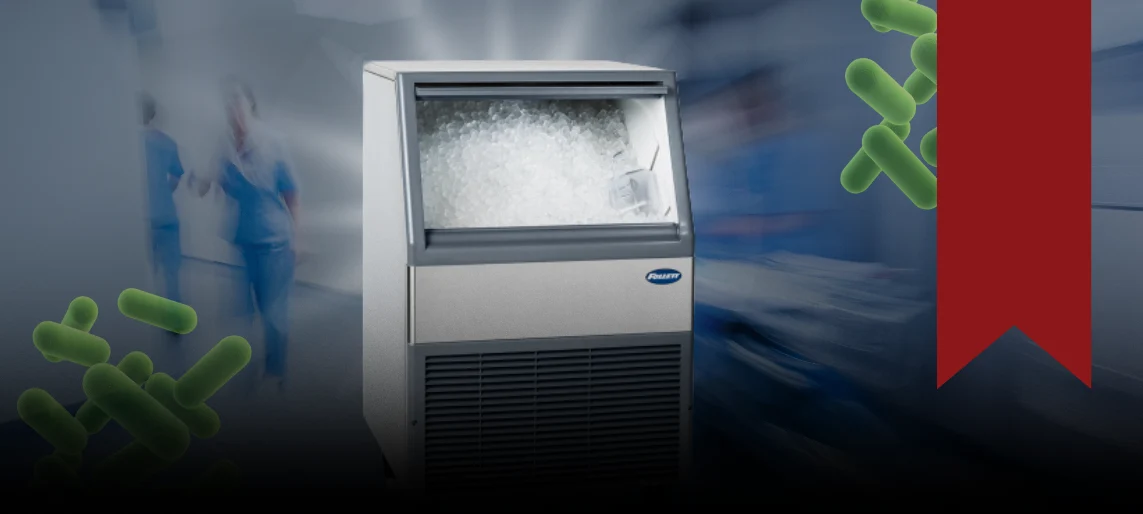
If you run a hospital or clinic, your ice machine is part of patient care—hydration, comfort, even nutrition. But like any water-fed equipment, it can become a home for Legionella (the bacteria that causes Legionnaires’ disease) if water isn’t filtered, cleaned, and monitored. The good news: a few straightforward filter choices and habits make a big difference in a healthcare setting. This guide explains, in plain language, what to do and why—so you can protect patients without becoming a water engineer.
What is Legionella (and why do ice machines matter)?
Legionella loves slow-moving, lukewarm water. In healthcare buildings, plumbing is complex and water can sit in pipes, machines, and bins. If the bacteria get into an ice machine, they can end up in ice that is used for drinks, oral care, or patient cooling. Patients with weaker immune systems are most at risk.
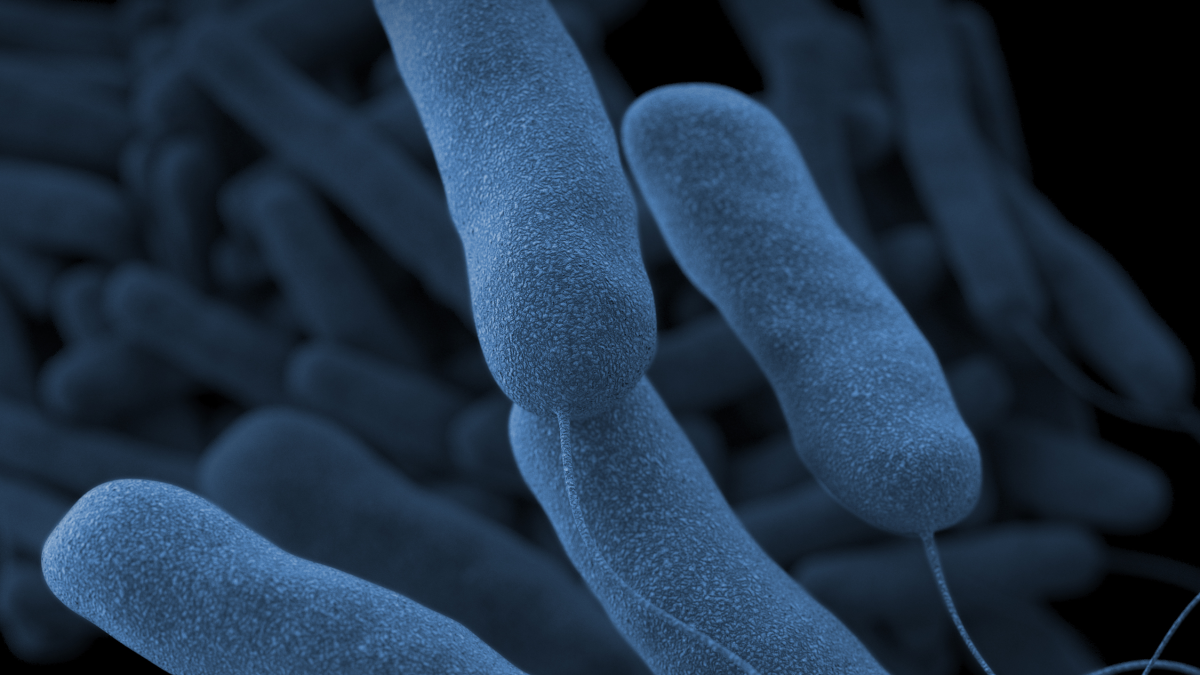
Bottom line: controlling Legionella in a healthcare setting means paying attention to the filters, the ice machine, and a few simple maintenance steps.
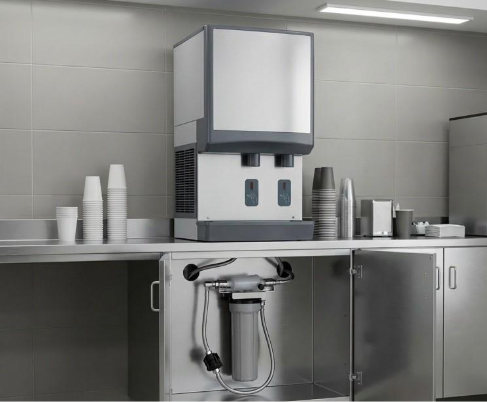
The simplest safe setup (what to put on the line)
Think of your ice machine like a front door. You want a good door mat and a solid lock:
- Sediment pre-filter (the door mat)
- Catches grit, rust, and scale so the fine filter doesn’t clog.
- In most healthcare locations, use a carbon-less pre-filter so you don’t remove the chlorine disinfectant in the water.
- 0.2 micron “absolute” bacterial-retentive filter (the lock)
- This is the safety step that helps block bacteria like Legionella right before water enters the ice machine.
Carbon vs. carbon-less pre-filters:
- Carbon improves taste and removes chlorine. Great for foodservice areas, but removing chlorine can increase risk in patient-care areas.
- Carbon-less leaves disinfectant in place. Better for healthcare settings where safety beats taste.
“Absolute” vs. “Nominal” filters
- Nominal means “usually catches most”—it reduces about 85–95% of particles that size.
- Absolute means “really catches almost all”—it’s tested to block ~99.9% at that size.
- For Legionella protection, choose 0.2 micron absolute at the ice machine.
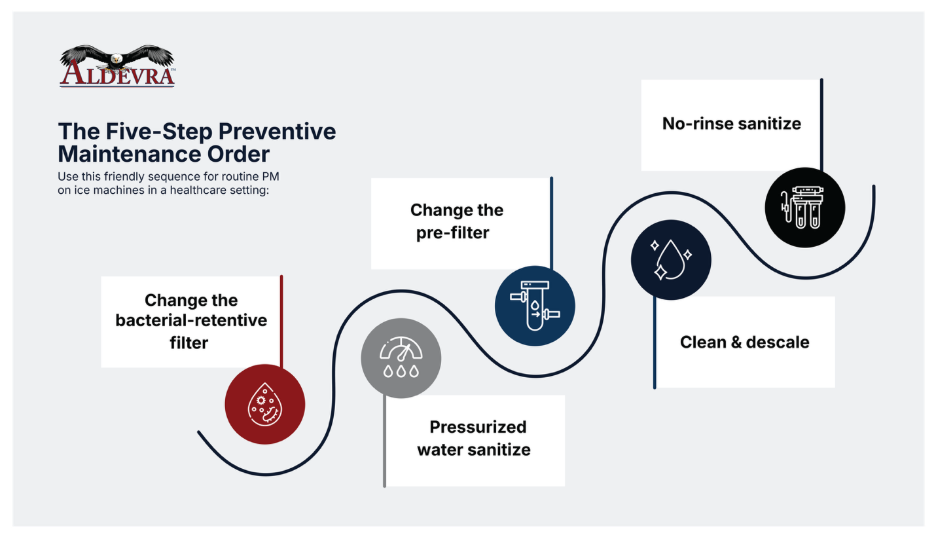
The five-step preventive maintenance order
Use this friendly sequence for routine PM on ice machines in a healthcare setting:
- Change the bacterial-retentive filter (the final filter closest to the machine).
- Pressurized water sanitize the line using an EPA-registered sanitizer.
- Change the pre-filter (the upstream sediment filter).
- Clean & descale the ice machine (remove slime and mineral buildup).
- No-rinse sanitize food-contact parts (bin, chute) before putting the machine back in service.
Why this order?
You protect the machine first (new final filter), sanitize the plumbing, refresh the pre-filter, then clean and sanitize the ice side. It’s logical, thorough, and helps keep bacteria from coming back.
Temperature and flow: two small habits, big impact
- Keep hot water hot and cold water cold. Aim for cold water into the machine ≤ 68°F (20°C) to slow bacteria growth.
- Flush low-use lines weekly. Stagnant water = higher risk.
Testing and simple recordkeeping (don’t overthink it)
You don’t need a lab in your basement. A basic testing & monitoring log proves you’re paying attention:
- Temperature (weekly): Cold supply to the machine ≤ 68°F.
- Disinfectant (monthly): Make sure there’s still chlorine (or other disinfectant) in the water feeding the machine.
- Legionella testing (quarterly is a common practice): Confirms your controls are working.
- Filter dates & pressures (monthly): Replace filters if flow slows or pressure drops.
Tip: Keep one page per machine/outlet. Write the date, what you checked, the reading, any action, and your initials. That’s it.
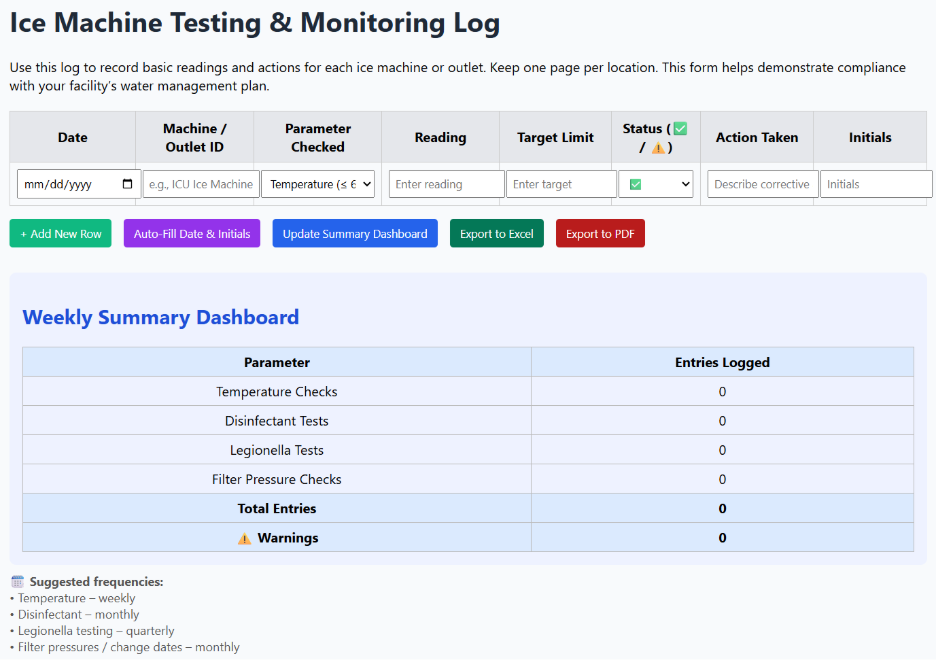
Aldevra created an interactive Ice Machine Testing & Monitoring Log Tool to help healthcare facilities record readings, filter changes, and testing results — no spreadsheets required. 🧊 Open the Ice Machine Log Tool
Staff do’s & don’ts (share this with your team)
Do
- Use only ice scoops (not cups or hands).
- Empty and wipe ice bins on a schedule.
- Report slow flow, unusual taste/odor, or slime right away.
Don’t
- Store drinks, meds, or anything else in the bin.
- Ignore wet floors or slow drains—standing water can spread germs.
If you’re on a tight budget, start here
- Protect the highest-risk areas first (ICU, oncology, transplant, long-term care).
- Add a 0.2 micron absolute filter at those ice machines.
- Flush weekly and log temperature/disinfectant monthly.
- Do quarterly Legionella testing to validate your efforts.
- Document everything—even small steps count during surveys.
These basics greatly reduce risk from Legionella in healthcare settings without big capital projects.
Central vs. local protection (how the layers work)
- Central (building-wide): Your city water arrives disinfected, but levels can drop inside a big building. Some hospitals add systems like chlorine dioxide or ionization to keep protection strong across the whole site.
- Local (point-of-use): The filter right before the ice machine is your last line of defense—especially important where patients receive care.
Together, they form a safety net. If one layer slips, the other helps catch problems.
A simple plan you can start today
- List your ice machines and note where patients are served.
- Install (or confirm) the two-filter setup: carbon-less pre-filter + 0.2 micron absolute filter.
- Follow the five-step PM order (final filter → pressurized sanitize → pre-filter → clean/descale → no-rinse sanitize).
- Log weekly temps and monthly disinfectant; schedule quarterly Legionella testing.
- Train staff on ice handling.
- Review quarterly with facilities and infection prevention; fix issues fast.
VA facilities: This approach supports the goals of VHA Directive 1061(4) (the VA’s water safety policy). Non-VA facilities can map these steps to ASHRAE 188 and the CDC Water Management Toolkit.
Quick FAQ
Does a filter replace cleaning?
No. Filters reduce what gets in, but you still need to clean, descale, and sanitize on schedule.
Is UV a replacement for filters?
No. UV helps kill germs where it shines, but it doesn’t leave protection downstream. You still need a 0.2 micron absolute filter at the ice machine.
Is carbon always bad in hospitals?
Not always. Carbon filters are fine in cafeterias for taste and odor. In patient-care areas, choose carbon-less pre-filters to keep disinfectant in the water.
Key takeaways
- Your ice machine is part of patient safety.
- Use a carbon-less pre-filter and a 0.2 micron absolute filter at the machine.
- Follow the five-step PM order to keep systems clean.
- Log simple checks (temperature, disinfectant, testing, filter dates).
- Start with high-risk areas and build from there.
Clean water, clean ice, safer patients. That’s the goal.
Need help picking the right filter setup or building a simple plan?
Aldevra helps healthcare teams choose the right ice machine filters, set up easy logs, and train staff—so you can reduce Legionella risk in your healthcare setting without the headache.
Email: sales@aldevra.com • Phone: (269) 350-1337


.png)
.png)