Summary
NSF, ETL and UL marks are common on commercial kitchen equipment, but they do not all mean the same thing. Learn how sanitation and electrical safety certifications differ, when alternative certification marks may demonstrate compliance with the same standard, and how to write clearer equipment requirements.
NSF vs. ETL vs. UL: What Commercial Kitchen Equipment Buyers Need to Know
If you have ever reviewed the specifications for a commercial refrigerator, oven, ice machine, dishwasher, food processor or other piece of foodservice equipment, you have probably seen certification marks such as NSF, ETL and UL.
The marks are common. What they actually mean is often misunderstood.
One of the biggest mistakes a commercial kitchen buyer can make is assuming that NSF, ETL and UL are simply three competing versions of the same certification.
They are not.
Some certifications address sanitation and public health. Others address electrical or product safety. And in some cases, different certification organizations can evaluate equipment against the same underlying standard.
KEY TAKEAWAY CALLOUT
Do not compare certification logos alone.
When evaluating commercial kitchen equipment, ask four questions:
- What is being certified?
- What standard applies?
- Who performed the certification?
- Does the exact model hold the required certification?
Understanding those distinctions can prevent a compliant piece of equipment from being rejected simply because its certification mark looks different.
First: Understand the Difference Between a Standard and a Certification Organization
This is the most important concept in understanding NSF, ETL and UL.
A standard establishes the technical requirements a product is expected to meet.
A certification organization independently evaluates the product and determines whether it conforms to those requirements.
That distinction matters because the organization that develops a standard does not necessarily have to be the organization that certifies every product to that standard.
NSF develops many of the sanitation standards widely used for commercial foodservice equipment. NSF also certifies products.
However, other accredited certification organizations can evaluate commercial food equipment against applicable NSF/ANSI sanitation standards.
Intertek, for example, issues its ETL Sanitation Mark to qualifying equipment tested to applicable NSF/ANSI sanitation standards. UL Solutions also performs foodservice sanitation certification using numerous NSF sanitation standards.
That is why asking only: “Is it NSF?”
may not tell the entire story.
A more precise question is:
“What sanitation standard is this exact model certified to, and who performed that certification?”
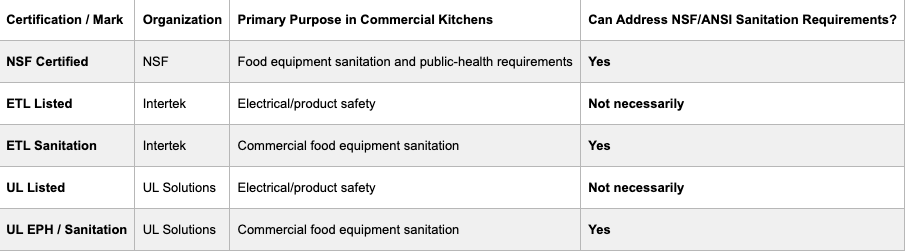
NSF vs. ETL vs. UL at a Glance
IMPORTANT CALLOUT
ETL Listed and ETL Sanitation are not the same certification.
Likewise:
UL Listed and UL EPH/Sanitation are not the same certification.
A commercial appliance may carry multiple marks because sanitation and electrical safety are separate considerations.
What Is NSF Certification?
NSF is one of the best-known names in commercial food equipment sanitation.
NSF has facilitated the development of numerous standards and protocols covering sanitary food equipment and also certifies products against those standards.
NSF food equipment standards can address areas such as:
- Material safety
- Hygienic design
- Construction
- Cleanability
- Food-contact surfaces
- Equipment performance
- Temperature performance, where applicable
NSF describes its food-equipment standards as addressing material safety, design, construction and product performance.
Common NSF/ANSI Standards for Commercial Kitchen Equipment
Different equipment categories are covered by different standards.
NSF/ANSI Standard
Common Equipment Covered
NSF/ANSI 2
Food equipment, tables, counters, sinks, shelving and similar equipment
NSF/ANSI 3
Commercial warewashing equipment
NSF/ANSI 4
Commercial cooking, rethermalization and powered hot-food-holding equipment
NSF/ANSI 7
Commercial refrigerators and freezers
NSF/ANSI 8
Commercial powered food-preparation equipment
NSF/ANSI 12
Automatic ice-making equipment
For example, NSF/ANSI 4 covers equipment such as commercial ranges, ovens, fryers, griddles, broilers, steam cookers, kettles and hot-food-holding equipment. NSF/ANSI 8 covers powered equipment such as grinders, mixers, slicers and saws. NSF/ANSI 12 applies to automatic ice-making equipment and related components.
So when someone asks whether a commercial refrigerator is “NSF compliant,” the more useful question may be whether the exact refrigerator is certified to the applicable commercial refrigeration sanitation standard, such as NSF/ANSI 7.
What Is ETL?
ETL is a certification mark issued by Intertek.
For product safety, Intertek operates as an OSHA-recognized Nationally Recognized Testing Laboratory, commonly called an NRTL.
The ETL Listed Mark indicates that Intertek independently tested and certified the product to applicable product-safety standards. OSHA currently identifies Intertek Testing Services NA, Inc. as a recognized NRTL.
This leads to an important distinction.
ETL Listed
An ETL Listed mark commonly relates to electrical or product safety.
It does not, by itself, establish that a piece of foodservice equipment has been certified for sanitation.
ETL Sanitation
Intertek also operates a separate food-equipment sanitation certification program.
Intertek states that it tests foodservice products against applicable NSF/ANSI sanitation standards and, when compliant, issues the ETL Sanitation Mark.
Therefore:
ETL Listed ≠ automatically sanitation certified
but:
ETL Sanitation = certification addressing applicable food-equipment sanitation requirements
That difference is critical when evaluating equivalent equipment.
What Is UL?
UL Solutions is another major testing and certification organization.
A standard UL Listed certification is commonly associated with electrical and product safety.
UL LLC is also included on OSHA's current list of Nationally Recognized Testing Laboratories.
But, like Intertek, UL Solutions also performs food-equipment sanitation testing and certification.
UL EPH / Sanitation
UL Solutions' foodservice sanitation program evaluates commercial food equipment against applicable sanitation standards.
UL lists numerous NSF standards within its foodservice sanitation certification program, including standards covering:
- Food equipment
- Warewashing equipment
- Cooking equipment
- Refrigerators and freezers
- Powered food-preparation equipment
- Automatic ice-making equipment
UL identifies its EPH Mark as a sanitation certification for commercial food equipment.
So a commercial appliance might legitimately carry:
UL Listed — addressing electrical/product safety
and
UL EPH — addressing sanitation
Those are separate evaluations.
Is ETL Equivalent to UL?
For electrical/product-safety certification, the key question should not simply be whether the mark says UL or ETL.
Both UL and Intertek are OSHA-recognized NRTLs.
OSHA explains that NRTLs are private-sector organizations recognized to test and certify products to applicable consensus-based safety standards. OSHA also specifically states that recognition does not represent a comparative ranking of one NRTL against another.
OSHA further states that it does not require one universal “NRTL” certification mark. Each recognized laboratory uses its own registered certification mark.
SIMPLE EXAMPLE
Suppose two commercial appliances are required to be certified to the same applicable electrical safety standard.
- Equipment A is certified by UL.
- Equipment B is certified by Intertek and carries the ETL Listed Mark.
If both certifications properly cover the applicable product and safety standard within the laboratory's recognized scope, the difference is principally which qualified organization performed the certification, not a hierarchy where UL is automatically “better” than ETL.
Can ETL Sanitation or UL EPH Be Equivalent to NSF Certification?
This question requires careful wording.
1It is usually more accurate to say:
ETL Sanitation or UL sanitation certification can demonstrate conformity to the same applicable NSF/ANSI sanitation standard.
For example:
Product Sanitation Certification Applicable Standard
Product A NSF NSF/ANSI 7
Product B ETL Sanitation NSF/ANSI 7
Product C UL Sanitation / EPH NSF/ANSI 7
All three may have been independently evaluated against the same underlying sanitation requirements, although different organizations performed the certification.
Intertek specifically states that its ETL Sanitation program tests products against applicable NSF/ANSI standards. UL Solutions similarly lists NSF standards used within its foodservice sanitation certification program.
AN IMPORTANT PROCUREMENT DISTINCTION
These two requirements do not necessarily mean the same thing:
Requirement A:
“Equipment shall be NSF certified.”
Requirement B:
“Equipment shall be certified for sanitation to NSF/ANSI 7 by an appropriately accredited certification program.”
Requirement A specifically identifies NSF certification.
Requirement B identifies the technical standard and certification requirement.
If the Government, facility or other buyer's actual objective is compliance with a recognized sanitation standard rather than use of one particular certification organization's mark, standards-based language may better reflect the intended requirement.
What Does the FDA Food Code Say?
The FDA Food Code provides useful context for commercial food-equipment sanitation.
Section 4-205.10 of the 2022 FDA Food Code provides that food equipment certified or classified for sanitation in conformity with a recognized American National Standard by an ANSI-accredited certification program is deemed to satisfy the applicable equipment sanitation provisions in Parts 4-1 and 4-2 of the Food Code.
FDA's summary of the 2022 changes likewise explains that Section 4-205.10 was revised to clarify the treatment of equipment certified for conformity with an appropriate American National Standard.
This is one reason it is important to distinguish between:
- The applicable sanitation standard;
- The organization performing the certification; and
- The certification mark shown on the equipment.
NOTE
The FDA Food Code is a model code. State and local adoption and the requirements of the applicable Authority Having Jurisdiction (AHJ) should always be considered for a specific project.
Contract requirements also control. If an RFQ explicitly requires a particular certification or listing, an offeror should not assume a different mark will automatically be accepted without reviewing the solicitation and, when appropriate, requesting clarification.
Why Does Commercial Kitchen Equipment Often Have Multiple Certification Marks?
Because one certification does not necessarily address every requirement.
Consider a commercial refrigerator.
SANITATION
The sanitation evaluation may address questions such as:
- Can food-contact and interior surfaces be properly cleaned?
- Are the materials appropriate for the intended application?
- Does the construction minimize sanitation hazards?
- Can the refrigerator maintain required temperatures under the applicable test conditions?
That could be demonstrated through certification to an applicable sanitation standard such as NSF/ANSI 7.
ELECTRICAL / PRODUCT SAFETY
A separate evaluation may address:
- Electrical shock hazards
- Wiring
- Grounding
- Components
- Fire hazards
- Mechanical hazards
- Appliance construction
That may be demonstrated through an appropriate UL Listed, ETL Listed or other qualifying NRTL certification.
THE RESULT
One refrigerator may therefore have:
A sanitation certification + an electrical safety certification
Neither automatically replaces the other.
A Common Equipment Comparison Mistake
Imagine an RFQ requires:
“NSF commercial refrigerator.”
A proposed alternate refrigerator has ETL shown on its specification sheet.
Can it be considered equivalent?
The word “ETL” alone does not provide enough information.
SCENARIO 1 — ETL LISTED ONLY
If the refrigerator is only ETL Listed for product safety, that certification does not by itself demonstrate sanitation certification.
SCENARIO 2 — ETL SANITATION TO NSF/ANSI 7
If the exact refrigerator is ETL Sanitation certified to NSF/ANSI 7, then the proposed product may have third-party certification to the same sanitation standard underlying the requirement.
That is a materially different situation.
The same analysis applies to UL.
UL Listed should not automatically be treated as equivalent to food-equipment sanitation certification.
UL EPH/Sanitation certification to the applicable standard should be evaluated based on the actual standard and project requirement.
What Buyers Should Check Before Rejecting an Alternate Product
Use the following checklist when comparing commercial kitchen equipment.
1. VERIFY THE EXACT MODEL NUMBER
Certifications can be model-specific.
Do not assume that every product manufactured by the same company carries the same certification.
2. IDENTIFY WHAT THE CERTIFICATION COVERS
Determine whether the mark relates to:
- Sanitation
- Electrical safety
- Gas safety
- Plumbing
- Energy performance
- Another requirement
3. IDENTIFY THE UNDERLYING STANDARD
Do not stop at the logo.
Determine the exact standard against which the equipment was evaluated.
4. IDENTIFY THE CERTIFICATION ORGANIZATION
Determine whether NSF, Intertek, UL Solutions or another organization actually issued the certification.
5. VERIFY THE LISTING
When certification is material to the procurement, verify the exact model through the applicable certification organization's directory or certification documentation.
6. READ THE ACTUAL RFQ OR PROJECT SPECIFICATION
There is a difference between:
“NSF certified”
and:
“Certified to NSF/ANSI 7.”
Do not assume they are interchangeable without reviewing the requirement.
7. CONSIDER THE AUTHORITY HAVING JURISDICTION
Local health departments, electrical inspectors, building officials and other AHJs may have requirements applicable to the installation.
Writing Better NSF, ETL and UL Requirements in an RFQ or Statement of Work
Certification language can unintentionally restrict competition when a specification names a certification organization even though the actual technical requirement is conformity with a particular standard.
For example:
LESS PRECISE
Unit shall be NSF certified and UL listed.
This may be exactly what the buyer intends.
But if the real objective is third-party sanitation certification to a particular NSF/ANSI standard and electrical certification by a recognized NRTL, a standards-based requirement may communicate the need more clearly.
Recommended General Sanitation Language
COPY/PASTE RFQ OR SOW LANGUAGE
Sanitation Certification: Equipment shall be certified or classified for sanitation to the applicable recognized NSF/ANSI food-equipment standard by an ANSI-accredited certification program. Acceptable certification may include NSF certification, ETL Sanitation, UL EPH/Sanitation, or equivalent third-party certification demonstrating conformity with the specified standard, subject to the requirements of the Authority Having Jurisdiction.
Example — Commercial Refrigerators and Freezers
Sanitation Certification: Commercial refrigeration equipment shall be certified or classified for sanitation to NSF/ANSI 7, Commercial Refrigerators and Freezers, by an ANSI-accredited certification program. NSF certification, ETL Sanitation, UL EPH/Sanitation, or equivalent certification demonstrating conformity with the specified standard is acceptable, subject to applicable code and Authority Having Jurisdiction requirements.
Example — Commercial Cooking Equipment
Sanitation Certification: Commercial cooking equipment shall be certified or classified for sanitation to NSF/ANSI 4, Commercial Cooking, Rethermalization and Powered Hot Food Holding and Transport Equipment, by an ANSI-accredited certification program. NSF certification, ETL Sanitation, UL EPH/Sanitation, or equivalent certification demonstrating conformity with the specified standard is acceptable.
NSF identifies NSF/ANSI 4 as establishing sanitation and food-protection requirements for commercial cooking and related equipment.
Example — Commercial Warewashing Equipment
Sanitation Certification: Commercial warewashing equipment shall be certified or classified for sanitation to NSF/ANSI 3, Commercial Warewashing Equipment, by an ANSI-accredited certification program. NSF certification, ETL Sanitation, UL EPH/Sanitation, or equivalent certification demonstrating conformity with the specified standard is acceptable.
Example — Commercial Ice Machines
Sanitation Certification: Automatic ice-making equipment shall be certified or classified for sanitation to NSF/ANSI 12, Automatic Ice Making Equipment, by an ANSI-accredited certification program. NSF certification, ETL Sanitation, UL EPH/Sanitation, or equivalent certification demonstrating conformity with the specified standard is acceptable.
NSF identifies NSF/ANSI 12 as covering sanitation requirements for automatic ice-making equipment and related components used with ice intended for human consumption.
Suggested RFQ/SOW Language for Electrical Safety
Where electrical/product-safety certification is required, it is generally clearer to address it separately from sanitation.
COPY/PASTE LANGUAGE
Electrical/Product Safety Certification: Electrically operated equipment shall be listed, labeled or certified to the applicable product-safety standard by an OSHA-recognized Nationally Recognized Testing Laboratory (NRTL) whose scope of recognition includes the applicable product and test standard. UL Listed, ETL Listed, or equivalent certification from an appropriately recognized NRTL is acceptable.
This language reflects OSHA's NRTL framework while avoiding the implication that OSHA prefers a particular recognized laboratory. OSHA states that it does not prefer one NRTL over another when they are recognized for the same product-safety test standard.
Recommended Combined Certification Requirement
For electrically powered commercial foodservice equipment requiring both sanitation and electrical/product-safety certification:
COPY/PASTE LANGUAGE
Certifications:
a. Sanitation: Equipment shall be certified or classified for sanitation to the applicable NSF/ANSI food-equipment standard by an ANSI-accredited certification program. NSF certification, ETL Sanitation, UL EPH/Sanitation, or equivalent certification demonstrating conformity with the applicable standard is acceptable.
b. Electrical/Product Safety: Electrically operated equipment shall be listed, labeled or certified to the applicable product-safety standard by an OSHA-recognized Nationally Recognized Testing Laboratory (NRTL) whose scope of recognition covers the applicable product and test standard. UL Listed, ETL Listed, or equivalent NRTL certification is acceptable.
c. Documentation: The offeror shall provide manufacturer literature or third-party certification documentation sufficient to demonstrate that the exact manufacturer and model offered satisfy the required standards.
Require Certification Documentation With the Quote
Buyers can make technical evaluations considerably easier by requiring offerors to identify certifications as part of their submission.
COPY/PASTE LANGUAGE
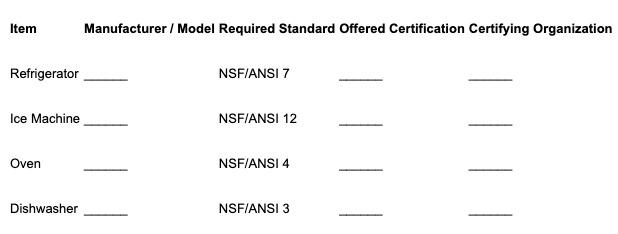
Certification Documentation: The offeror shall identify the manufacturer and exact model number offered and provide manufacturer literature, certification records, or third-party listing documentation demonstrating conformity with each required sanitation and product-safety standard. The Government reserves the right to verify certification through the applicable certification organization's product directory.
A simple certification matrix can also be required:
Procurement Language to Avoid
“NSF OR ETL CERTIFIED”
This phrase can create ambiguity:
Equipment must be NSF or ETL certified.
Why?
Because ETL Listed and ETL Sanitation represent different types of certification.
If sanitation is the concern, say so explicitly.
BETTER
Equipment shall be certified for sanitation to the applicable NSF/ANSI standard by an ANSI-accredited certification program.
Then specify the electrical/product-safety requirement separately if one is required.
“UL OR NSF”
This can create the same problem.
A UL product-safety listing and an NSF sanitation certification do not necessarily address the same requirements.
Instead of listing certification logos as interchangeable options, identify:
the function → the standard → the acceptable certification pathway.
Quick Reference: Better Specification Language
Instead of Writing
Consider Writing
NSF certified
Certified for sanitation to the applicable NSF/ANSI standard by an ANSI-accredited certification program
UL only
Listed/certified to the applicable product-safety standard by an OSHA-recognized NRTL
NSF or ETL
NSF, ETL Sanitation, UL EPH/Sanitation, or equivalent certification to the specified sanitation standard
UL or ETL
Certified to the applicable product-safety standard by an OSHA-recognized NRTL
Must have certification
Identify the specific required standard, certification type and documentation
Frequently Asked Questions About NSF, ETL and UL Certification
Is ETL the same as NSF?
No.
ETL and NSF are different certification organizations and the marks do not automatically represent the same type of evaluation.
NSF develops many commercial food-equipment sanitation standards and also certifies products.
ETL is a certification mark issued by Intertek.
However, Intertek can certify commercial foodservice equipment to applicable NSF/ANSI sanitation standards through its ETL Sanitation program.
Therefore, an ETL Sanitation-certified product may demonstrate conformity with the same NSF/ANSI sanitation standard used for another product certified by NSF.
Is ETL as good as UL?
For product-safety certification, the appropriate comparison is whether each recognized laboratory certified the equipment to the required safety standard within its scope of recognition.
Both Intertek and UL LLC are currently recognized under OSHA's NRTL program.
OSHA does not rank one recognized NRTL as better than another for the same standard.
Therefore, an ETL Listed product should not be considered inherently less compliant simply because its certification was issued by Intertek rather than UL.
Is ETL accepted instead of UL?
Often, yes, when the requirement is certification to an applicable product-safety standard by an OSHA-recognized NRTL.
The exact specification and applicable codes still need to be reviewed.
If a contract explicitly requires a particular mark, do not assume an alternate mark will automatically be accepted without clarification.
Is ETL Sanitation equivalent to NSF?
The more technically precise statement is:
ETL Sanitation can certify equipment to the same applicable NSF/ANSI sanitation standard.
For example, a product certified by NSF and a product certified through Intertek's ETL Sanitation program could both demonstrate conformity with the same applicable NSF/ANSI standard.
The certification organizations are different, but the underlying standard may be the same.
Is UL the same as NSF?
No.
A standard UL product-safety listing and an NSF food-equipment sanitation certification generally address different requirements.
However, UL Solutions also provides food-equipment sanitation certification through its sanitation/EPH program and lists numerous NSF standards among those used for certification.
Is UL EPH equivalent to NSF?
UL EPH/Sanitation certification can demonstrate conformity with applicable food-equipment sanitation standards, including NSF standards.
The better question is therefore not simply:
“UL or NSF?”
Instead ask:
“Are both products certified to the same applicable sanitation standard?”
What does ETL Sanitation mean?
The ETL Sanitation Mark is issued by Intertek for qualifying foodservice equipment evaluated against applicable sanitation requirements.
Intertek states that it tests products against applicable NSF/ANSI standards as part of this program.
It should not be confused with a standard ETL Listed product-safety certification.
What does NSF certification mean on commercial kitchen equipment?
NSF certification means NSF has independently evaluated the product against the applicable certification requirements.
Depending on the equipment and standard, the evaluation may address areas such as sanitary design, materials, construction, cleanability and performance.
The applicable standard is important because different types of equipment are evaluated under different standards.
Does commercial kitchen equipment have to be NSF certified?
Not necessarily NSF-certified specifically in every circumstance.
The requirements depend on:
- The equipment
- The applicable code
- State and local requirements
- The Authority Having Jurisdiction
- The facility
- The project specification or contract
The FDA Food Code recognizes food equipment certified or classified for sanitation to a recognized American National Standard through an ANSI-accredited certification program for purposes of its applicable equipment sanitation provisions.
Always verify the requirements applicable to the actual project.
Does NSF certification mean equipment is electrically safe?
Not necessarily.
A sanitation certification and an electrical/product-safety certification address different risks.
Electrically operated commercial equipment may also require an applicable product-safety certification from an OSHA-recognized NRTL.
Does UL Listed mean equipment is NSF compliant?
No.
A standard UL Listed mark should not automatically be interpreted as commercial food-equipment sanitation certification.
UL Solutions also provides a separate sanitation/EPH certification program.
When sanitation compliance matters, verify the sanitation certification and underlying standard, not merely the presence of a UL logo.
Does ETL Listed mean equipment is NSF compliant?
No.
A standard ETL Listed mark generally demonstrates product-safety certification.
For commercial food-equipment sanitation, look for the applicable ETL Sanitation certification and verify the underlying sanitation standard.
Which NSF standard applies to commercial refrigerators?
NSF/ANSI 7 applies to commercial refrigerators and freezers.
When evaluating equivalent commercial refrigeration, buyers should verify that the exact model has the required sanitation certification rather than assuming certification based solely on the manufacturer.
Which NSF standard applies to commercial ice machines?
NSF/ANSI 12 applies to automatic ice-making equipment and related components used in connection with ice intended for human consumption.
Which NSF standard applies to commercial ovens and cooking equipment?
NSF/ANSI 4 covers commercial cooking, rethermalization and powered hot-food-holding and transport equipment.
This includes many types of commercial ovens, ranges, fryers, griddles, broilers, steamers and kettles.
Which NSF standard applies to commercial dishwashers?
NSF/ANSI 3 addresses commercial warewashing equipment, including commercial dishwashing, glasswashing and pot, pan and utensil washing machines and related components.
How can I verify whether commercial kitchen equipment is actually certified?
Start with the exact manufacturer and model number.
Then verify:
- The certification mark;
- What the certification covers;
- The applicable standard;
- The certification organization; and
- The model's actual listing or certification record.
Do not rely solely on a reseller webpage, a generic manufacturer's statement or a certification logo shown elsewhere in a product family.
The Bottom Line
NSF, ETL and UL are not three different grades of commercial kitchen equipment.
Each can play a different role in demonstrating compliance.
The simplest way to evaluate equipment is:
Purpose → Standard → Certification Organization → Exact Model
For sanitation, determine the applicable sanitation standard and whether the exact model has appropriate third-party certification.
For electrical and product safety, determine the applicable safety standard and whether the equipment has been properly certified by an OSHA-recognized NRTL whose scope covers that product and standard.
And when writing an RFQ or Statement of Work, specifying the technical standard and required type of certification can often provide a clearer basis for evaluating equivalent products than simply listing certification logos.
Need Help Comparing Commercial Kitchen Equipment?
Commercial kitchen equipment specifications can become complicated quickly.
Dimensions, utilities, capacity, performance, sanitation certifications, electrical listings, installation requirements and individual salient characteristics all need to be considered when determining whether one product is truly comparable to another.
Aldevra helps government agencies, healthcare facilities and other institutional foodservice customers evaluate commercial kitchen equipment against project requirements and identify compliant solutions from leading manufacturers.
If you are developing an equipment specification, reviewing an alternate manufacturer or trying to determine whether a proposed NSF, ETL, UL or other certification satisfies your requirement, contact Aldevra for assistance evaluating the equipment and supporting documentation.


.png)
.png)