Summary
Why the Right Measurement Tools Matter in Commercial Kitchens
In a commercial kitchen, accuracy matters. Temperatures, timing, weights, and measurements all affect food quality, safety, consistency, and efficiency. Whether a facility is preparing meals for patients, students, service members, staff, residents, or the public, the right measurement tools help kitchen teams work with confidence.
Thermometers, timers, and scales may seem like small items compared to major kitchen equipment, but they support some of the most important daily functions in foodservice operations. From receiving and storage to cooking, holding, service, and dishwashing, measurement tools help teams reduce guesswork and maintain consistent procedures.
Commercial Kitchen Measurement Tool Selector
Not sure which tool fits your kitchen task? Use our Commercial Kitchen Measurement Tool Selector to quickly identify whether you need a thin-tip thermometer, infrared thermometer, refrigerator/freezer thermometer, scale, timer, or dishwasher thermometer.
Every kitchen setup is different. For a quick recommendation based on your application, try the Commercial Kitchen Measurement Tool Selector.
Temperature Checks Start at Receiving
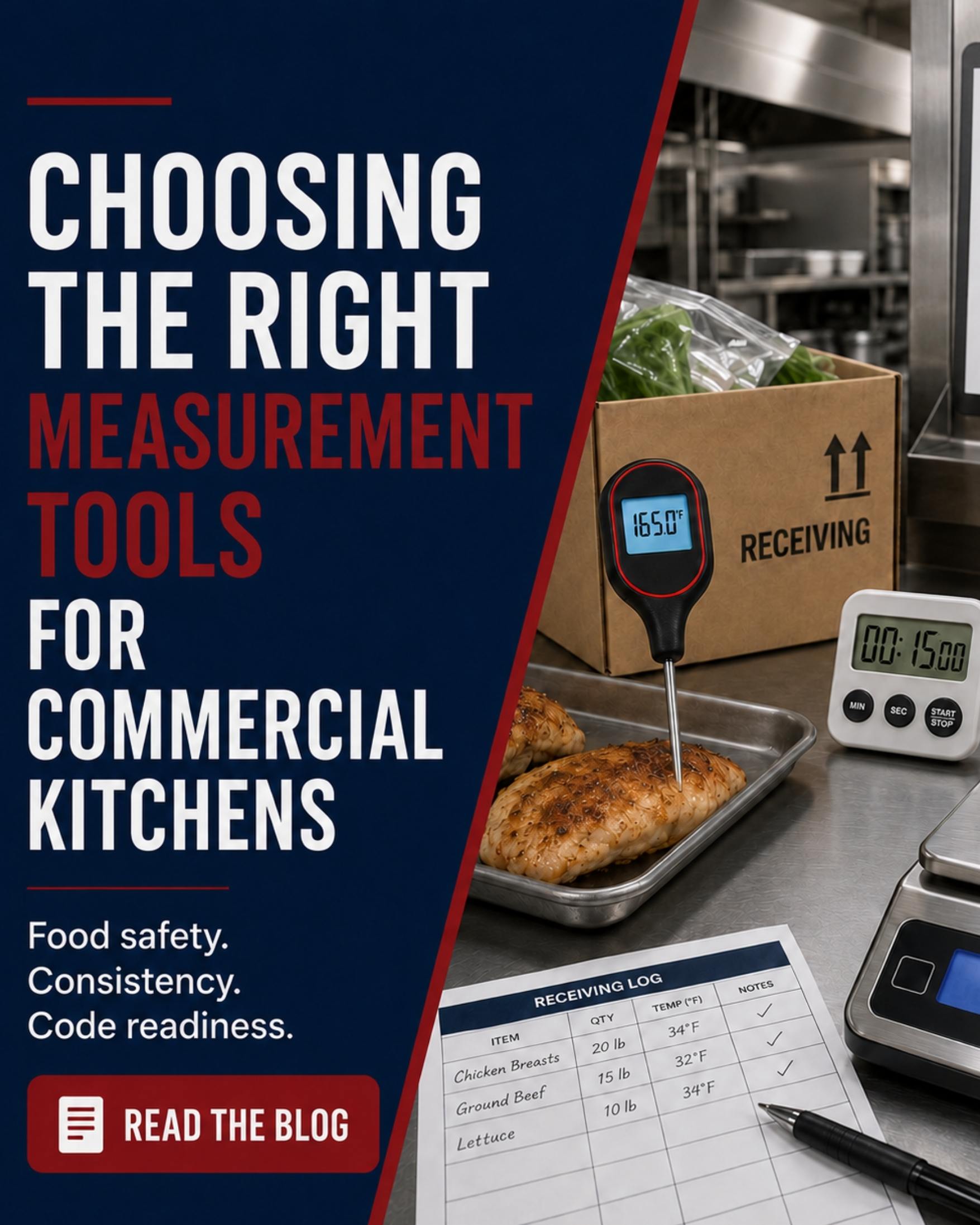
Food quality control begins before products ever reach the prep table. When deliveries arrive, staff may need to verify that refrigerated, frozen, or hot-held items are within acceptable temperature ranges. Having the right thermometer available at receiving helps teams make quick decisions and document product condition when needed.
Infrared thermometers, probe thermometers, long-stem thermometers, and receiving scales can all serve different purposes in this part of the operation. The best choice depends on the type of product being checked, the speed needed, and whether surface or internal temperature verification is required.

Cold Storage Requires Ongoing Monitoring
Refrigerators, freezers, walk-ins, reach-ins, and prep tables all depend on consistent temperature control. Even small variations can affect product quality and create operational risk.
Dedicated refrigerator and freezer thermometers help staff monitor storage conditions throughout the day. These tools are especially important in high-volume kitchens where food storage procedures are closely managed.
Cold storage tools should be easy to read, placed where staff can access them, and included in routine opening, closing, or shift-change checks.
Cooking Accuracy Supports Food Quality and Consistency
Cooking temperature is one of the most obvious uses for a thermometer, but not every cooking application requires the same type of tool.
A thin cut of meat, a thick roast, a batch of soup, a fryer, a grill surface, and an oven cavity all call for different measurement approaches. A fast-response thermometer may be ideal for quick checks during service, while an oven thermometer or probe thermometer/timer may be better suited for longer cook cycles.
Using the right tool for the application helps improve consistency across shifts and reduces reliance on visual checks alone.

Measurement Tools and Food Code Readiness
Measurement tools also support food code readiness. The FDA Food Code addresses the use of accurate temperature measuring devices for food, ambient air, and water; thermometer functionality; availability of food temperature measuring devices; and good repair and calibration.
In practical terms, foodservice operations should not only have thermometers available, but should also make sure the tools are appropriate for the task, accurate in the intended range of use, accessible to employees, and maintained in good working order.
For example, thin foods may require a thermometer with a smaller-diameter probe. Refrigerators, freezers, dish machines, and hot-holding equipment may require tools suited to ambient air, water, or equipment temperature checks. Thermometers should also be calibrated at a frequency that supports accuracy, based on facility procedures and applicable requirements.
For facility managers, foodservice directors, and procurement teams, this is an important point: the right thermometer, timer, or scale is not just about convenience. It can support documented procedures, inspection preparedness, quality control, and consistent execution across shifts.
Timing Matters, Too
Timers are another simple but essential tool in commercial kitchens. They help staff manage cook times, cooling procedures, prep tasks, baking, holding, and cleaning routines.
In busy kitchens, multiple tasks often happen at once. Clear, reliable timers help reduce missed steps and support repeatable processes. For teams preparing high volumes of food, even small improvements in timing can help protect quality and workflow.
Timers are especially useful when paired with written procedures. They help teams stay consistent, even when shifts are busy or multiple menu items are being prepared at the same time.
Scales Help Control Portions, Costs, and Consistency
Scales support more than baking and recipe prep. In commercial foodservice, they can also help with portion control, inventory management, receiving, and production consistency.
Accurate weighing helps kitchens manage food costs, reduce waste, and deliver consistent serving sizes. This is especially valuable in operations with standardized menus, patient or resident meals, school nutrition programs, correctional foodservice, and large-scale production.
Portion control scales can also support training. When new employees learn what a standard portion looks like, scales give them a practical reference point instead of relying only on judgment.
Measurement Tools Support Dishwashing and Sanitation Processes
Warewashing is another area where measurement tools can be useful. Dishwasher thermometers can help staff verify temperatures during routine checks and troubleshooting.
For kitchens that rely on high-volume dish machines, having the right tool available can help support daily procedures and give staff a practical way to monitor performance.
Still narrowing down what your facility needs? Use the Commercial Kitchen Measurement Tool Selector as a starting point, then contact Aldevra for help sourcing thermometers, timers, scales, and other commercial kitchen equipment.
Small Tools, Big Operational Impact
Thermometers, timers, and scales may be small compared to major kitchen equipment, but they support some of the most important daily controls in a foodservice operation. The right tools help teams verify temperatures, manage timing, control portions, monitor storage, support warewashing checks, and stay ready for inspections.
The goal is not to have one tool do everything. The goal is to give staff the right tool for each task.
Popular Brands
Frequently Asked Questions About Commercial Kitchen Measurement Tools
What measurement tools should every commercial kitchen have?
Most commercial kitchens should have a basic set of thermometers, timers, and scales. At minimum, this typically includes probe thermometers for food temperature checks, refrigerator/freezer thermometers for cold storage, timers for cooking and holding procedures, portion control scales for consistency, and dishwasher temperature tools if the facility needs to verify warewashing temperatures. The exact mix depends on the kitchen’s menu, equipment, food safety procedures, and inspection requirements.
Why are thermometers important in a commercial kitchen?
Thermometers help kitchen teams verify that food is received, stored, cooked, held, cooled, and served at appropriate temperatures. The United States Department of Agriculture Food Safety and Inspection Service states that using a food thermometer is the only reliable way to know food has reached a safe internal temperature.
What type of thermometer is best for thin foods?
Thin foods, such as hamburger patties, chicken breasts, pork chops, and fish fillets, are often best checked with a thin-probe thermometer. The USDA notes that for thin foods, the thermometer should be inserted from the side so the sensing area reaches the center of the food.
How often should commercial kitchen thermometers be calibrated?
Thermometers should be checked and calibrated according to the facility’s food safety procedures, manufacturer instructions, and applicable inspection requirements. Calibration is especially important if a thermometer is dropped, exposed to extreme temperatures, or appears to give inconsistent readings.
How do you calibrate a food thermometer?
Common calibration methods include the ice point method and boiling point method. The University of Maryland Extension notes that boiling point calibration can be affected by altitude and barometric pressure, so kitchens should account for local conditions when using boiling water as a reference point.
Do commercial kitchens need dishwasher thermometers?
Dishwasher thermometers can be useful for kitchens that need to verify dish machine temperature performance during routine checks, troubleshooting, or internal quality control. They are especially helpful in high-volume kitchens where warewashing is a critical daily process.
What is the difference between an infrared thermometer and a probe thermometer?
An infrared thermometer measures surface temperature without direct contact. A probe thermometer measures internal food temperature when inserted into the food. In many commercial kitchens, both tools are useful because surface temperature and internal temperature are not the same thing.
Are cheap food thermometers reliable?
A low-cost thermometer may be acceptable for some uses, but commercial kitchens should focus on accuracy, durability, response time, cleanability, and whether the tool is appropriate for the task.
Why do kitchens need portion control scales?
Portion control scales help kitchens maintain recipe consistency, manage food cost, reduce waste, and train staff on standard serving sizes. They are especially helpful in schools, healthcare, corrections, senior living, military, and other institutional foodservice environments where consistency matters.
What should procurement teams consider before buying thermometers, timers, or scales?
Procurement teams should confirm the intended use, temperature range, response time, probe size, waterproof needs, calibration requirements, display readability, warranty coverage, and whether spare units are needed. They should also consider whether the tool will support food safety procedures, inspection readiness, and daily documentation practices.
How should food thermometers be cleaned?
Food thermometers should be cleaned and sanitized before and after use according to facility procedures and manufacturer instructions.
Where can I buy commercial kitchen thermometers, timers, and scales?
Aldevra can help source commercial foodservice measurement tools, including thermometers, timers, scales, dishwasher temperature tools, and broader commercial kitchen equipment packages for federal, institutional, and commercial customers.
Aldevra Can Help Source Foodservice Measurement Tools
Aldevra supports federal, institutional, and commercial foodservice customers with commercial kitchen equipment, smallwares, supplies, and operational solutions. Measurement tools may be small compared to major equipment purchases, but they play an important role in daily kitchen performance.
Whether your facility needs thermometers, timers, scales, dishwasher temperature tools, or a broader commercial kitchen equipment package, Aldevra can help identify practical options for your operation.
Contact Aldevra to discuss foodservice measurement tools and commercial kitchen equipment solutions for your facility.

.png)
.png)