Summary
In a hospital, human milk should be stored in dedicated medical/lab-grade refrigerators and freezers with continuous temperature monitoring, alarms, secure access, and organized binning/labeling—with extra controls for PDHM and any milk intended for infants other than the mother’s own baby.
Hospitals treat human milk like a high-value clinical nutrition product—because it is. Whether you’re storing Mother’s Own Milk (MOM) for a specific infant or Pasteurized Donor Human Milk (PDHM) for medically vulnerable babies, the storage equipment and workflow must support temperature control, access control, and traceability. This guide breaks down what to use, how to set it up, and what to avoid.
Quick definitions hospitals use
Mother’s Own Milk (MOM)
Milk expressed by the infant’s parent and intended only for that parent’s baby (typically stored in the unit under strict labeling/ID rules).
Pasteurized Donor Human Milk (PDHM)
Milk dispensed by an accredited milk bank, screened and pasteurized, intended for infants when MOM is unavailable or insufficient (commonly in NICU settings).
Important note: “Sharing” unpasteurized milk between families is generally not handled like standard clinical nutrition in hospitals. If milk is intended for an infant other than the parent’s baby, hospitals typically rely on PDHM programs and strict custody controls.
What refrigerator should a hospital use?
The standard: Dedicated medical/lab-grade refrigerator (not a breakroom fridge)
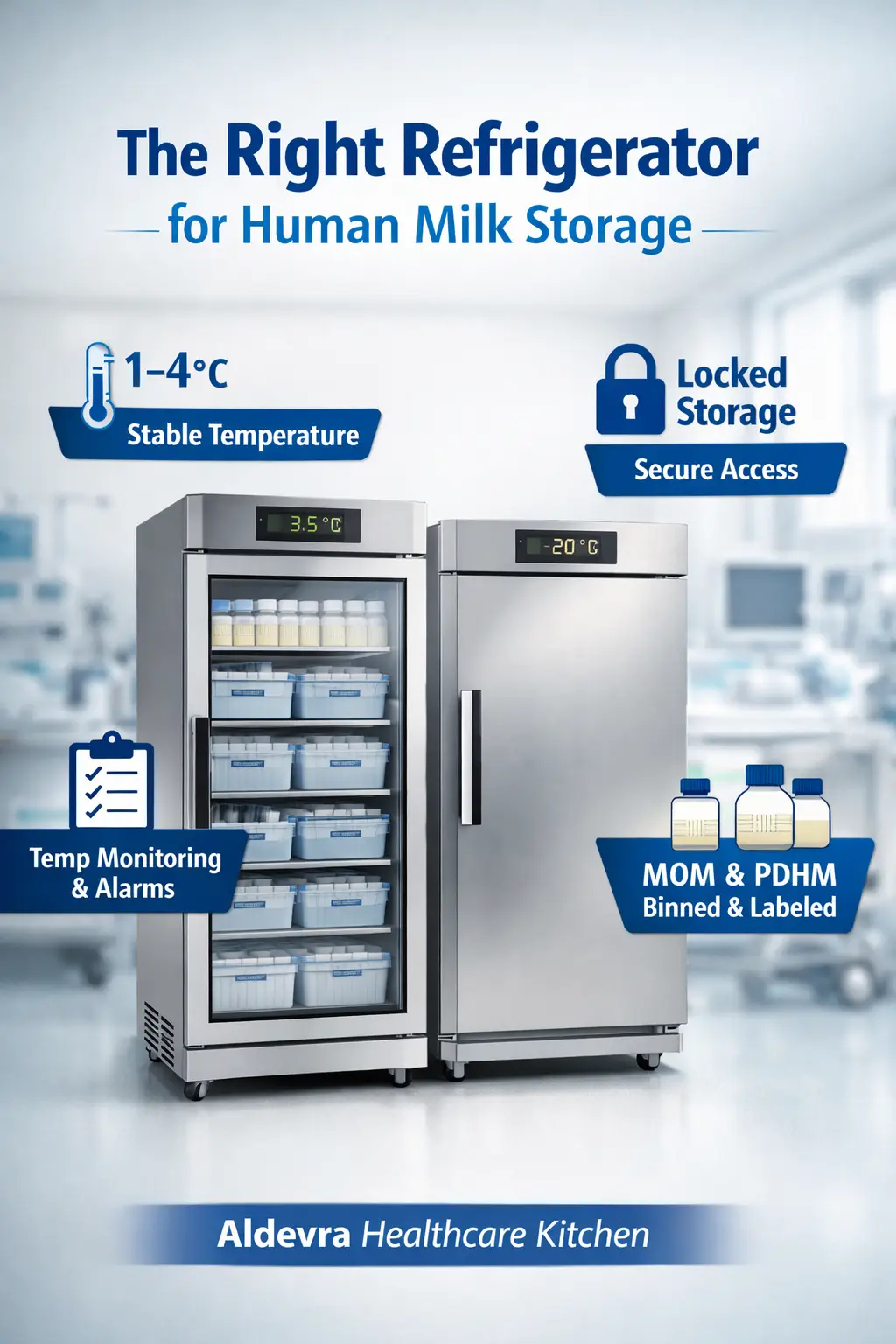
For hospital storage, the best practice is a dedicated, medical/lab-grade refrigerator used only for human milk—because it holds a stable temperature and supports monitoring and alarms.
Core requirements:
- Temperature setpoint: keep milk refrigerated at about 4°C / 39–40°F or colder (per your policy; many facilities target 1–4°C).
- Continuous temperature monitoring with a calibrated probe and logging.
- Alarm capability (out-of-range temp, power loss, door ajar) routed per your facility’s escalation process.
- Dedicated space & airflow: store milk in the back of the unit, not in the door (less temperature swing).
- Security: lock or badge-controlled access, especially for PDHM or shared milk rooms.
When you also need a freezer
If your unit stores frozen human milk (common for PDHM inventory or longer holding), add a dedicated freezer:
- Typical target for frozen storage is ≤ −18°C / 0°F or colder.
- Use a freezer that supports monitoring/alarms like the refrigerator.
How storage differs for MOM vs PDHM
Mother’s Own Milk (MOM): prioritize identification and segregation
Your biggest risk isn’t just temperature—it’s the “wrong baby” event. MOM storage should emphasize:
- One infant = one bin (or one sealed tote), clearly labeled.
- Barcode/2-identifier labeling (infant name + MRN, date/time expressed, expressed by, diet/fortification notes if applicable).
- First-in, first-out (FIFO) organization.
- Defined discard windows per policy (many facilities align with pediatric guidance that refrigerated milk is best used within several days).
PDHM: prioritize inventory control, chain-of-custody, and cold chain
PDHM is often managed like a pharmacy/nutrition inventory:
- Locked storage (restricted access) and lot tracking.
- Separate shelves/bins from MOM (physical segregation).
- Receiving protocol (verify shipper temps, documentation, lot numbers).
- Thaw management (document thaw time/date and beyond-use time per milk bank/facility policy).
Setup checklist: Milk refrigerator “done right”
Equipment features to spec:
- Medical/lab-grade refrigerator and (if needed) freezer
- External display + min/max history
- Alarm contacts / remote notification
- Data logging (downloadable)
- Locking door or lockable room placement
Interior organization:
- Bins labeled by infant (MOM) and by product/lot (PDHM)
- “Newly received,” “Ready to use,” and “Quarantine/hold” zones (especially for PDHM receiving)
- Dedicated area for thawed milk (if your policy permits) separated from frozen inventory
Placement & daily practice:
- Store milk in the back, not the door
- Avoid overfilling (needs airflow)
- Standard work: daily temp review + corrective action workflow
What to avoid (common problem areas)
- Using a staff food refrigerator for human milk
- Storing milk in the door (temperature swings)
- No alarms / no documented temperature checks
- No physical segregation between MOM and PDHM
- Inconsistent labeling (missing MRN, date/time, or preparer initials)
How Aldevra Healthcare Kitchen can help
If you’re outfitting a NICU milk room or upgrading unit nutrition storage, Aldevra can help you spec and source:
- Medical/lab-grade refrigeration and freezer solutions
- Mobile carts, stainless worktables, and organized bin systems
- Safe, cleanable storage layouts that support workflow and compliance expectations
FAQs
Do hospitals need a “lab-grade” refrigerator for breast milk?
For hospital use, a dedicated medical/lab-grade unit is the safer choice because it supports stable temperatures, monitoring, and alarms—key controls for patient safety and risk reduction.
What temperature should breast milk be stored at in the hospital refrigerator?
Common guidance places refrigerated milk at about 4°C (39–40°F) or colder, and it’s best stored in the back of the refrigerator, not the door.
What’s the safest option if milk will be fed to babies other than the mother’s baby?
Hospitals typically use pasteurized donor human milk (PDHM) managed through formal milk bank programs with strict custody, tracking, and cold chain controls.
How long can breast milk be stored?
Time limits vary by patient population and facility policy. Pediatric guidance commonly notes using refrigerated milk within a few days and freezing for longer storage when needed.

.png)
.png)