.png)
Summary
Shopping for a commercial pizza oven? Learn how to compare deck, conveyor, stone-hearth, ventless and countertop ovens based on pizza style, production capacity, utilities, ventilation, installation and total cost.
Commercial Pizza Oven Buying Guide: How to Choose the Right Pizza Oven
Pizza ovens aren’t one-size-fits-all.
A neighborhood pizzeria producing artisan pies has very different equipment requirements from a school cafeteria serving hundreds of students at lunch. A convenience store may need a compact ventless solution, while a high-volume pizza operation may need multiple stacked conveyor ovens.
The right commercial pizza oven affects much more than how the pizza tastes. It can affect production capacity, labor, consistency, kitchen layout, ventilation, utility requirements, maintenance, and total operating cost.
Before requesting quotes, it helps to understand the major types of commercial pizza ovens and the questions that should drive your equipment decision.
This guide walks through what to consider when buying a commercial pizza oven, including oven types, capacity, gas versus electric, ventilation, installation, manufacturers, costs, and common purchasing mistakes.
Start With the Pizza, Not the Oven
It can be tempting to start by comparing manufacturers and models. Start with your menu instead.
Ask:
- What style of pizza are you making?
- What is the largest pizza diameter?
- Are you using fresh dough, par-baked crusts, or frozen pizza?
- What bake time are you trying to achieve?
- How many pizzas do you need during your busiest hour?
- Is pizza your primary product or one item on a larger menu?
- Will you cook other foods in the oven?
- How much operator involvement do you want?
- Do you expect pizza volume to grow?
These answers can quickly eliminate equipment that isn’t appropriate for the application.
For example, an operation serving frozen pizzas as a secondary menu item probably doesn’t need the same equipment as a restaurant producing made-to-order artisan pizzas throughout the day.
What Are the Different Types of Commercial Pizza Ovens?
There are several major commercial pizza oven categories. Each approaches the cooking process differently.
Deck Pizza Ovens
Deck ovens are a traditional choice for commercial pizza production.
Pizzas are generally placed directly on a stone, ceramic, or similar baking deck. Heat stored in the deck transfers into the bottom of the pizza while the oven chamber cooks the remainder of the product.
This can produce the crisp bottom and developed crust associated with many traditional pizza styles.
Advantages of Deck Ovens
- Excellent crust development
- Strong heat retention
- Significant operator control
- Multiple deck configurations available
- Can accommodate products other than pizza
- Many heavy-duty commercial options
Things to Consider
Deck ovens generally require more operator attention than conveyor ovens. Employees may need to monitor pizzas, rotate them, and adjust their position within the chamber.
They also require recovery time when repeatedly loading cold product into the oven.
For restaurants where the finished pizza and traditional cooking process are priorities, however, a deck oven can be an excellent choice.
Conveyor and Impingement Pizza Ovens
Conveyor ovens move food through a heated cooking chamber on a belt.
Many commercial conveyor ovens use impingement technology, which directs heated air toward the food to accelerate and control cooking.
The operator establishes the temperature and conveyor speed. Once those parameters are set correctly, pizzas move through the oven under repeatable cooking conditions.
Advantages of Conveyor Ovens
- High production capacity
- Consistent results
- Relatively easy employee training
- Less operator intervention
- Repeatable cooking time
- Stackable configurations on many models
- Good choice for standardized menus
Things to Consider
Conveyor ovens can consume considerable space because the conveyor extends beyond the cooking chamber on both sides.
You also need adequate space for employees to load and unload the belt.
For operations where throughput and repeatability are major priorities, conveyor ovens are particularly attractive.
Brick, Stone-Hearth and Refractory Pizza Ovens
Brick and stone-hearth ovens are commonly associated with artisan pizza operations.
The category includes everything from traditional masonry installations to factory-manufactured commercial ovens incorporating refractory hearths and cooking chambers.
Depending on the equipment, fuel can include:
- Wood
- Natural gas
- Propane
- Electricity
- Combination fuel systems
Advantages
- High-temperature cooking capabilities
- Excellent crust characteristics
- Strong heat retention
- Distinctive cooking environment
- Can become a centerpiece of an open kitchen
- Particularly attractive for artisan concepts
Things to Consider
The installation can be considerably more complicated than installing a conventional commercial oven.
Depending on the equipment and building, considerations can include:
- Equipment weight
- Floor loading
- Structural support
- Exhaust
- Chimney or flue requirements
- Make-up air
- Fire suppression
- Combustible clearances
- Gas service
- Fuel storage
- Building permits
- Fire-code requirements
- Installation access
A beautiful hearth oven can be an important part of a restaurant concept, but installation requirements should be evaluated before ordering the equipment.
Countertop Pizza Ovens
Not every foodservice operation needs a full-size pizza oven.
Commercial countertop pizza ovens can make sense for:
- Bars
- Cafés
- Convenience stores
- Concessions
- Small restaurants
- Satellite kitchens
- Hotels
- Grab-and-go operations
- Facilities where pizza is a secondary menu item
The smaller footprint can reduce the amount of kitchen space dedicated to pizza production.
However, countertop does not necessarily mean standard electrical service. Always check voltage, amperage, phase, and plug configuration.
Ventless Pizza Ovens
Ventless cooking equipment can be particularly valuable in locations where adding a traditional exhaust system would be difficult or expensive.
Depending on the manufacturer and technology, these ovens may use catalytic converters, filtration, or other systems to manage cooking emissions.
Ventless equipment can be attractive for:
- Convenience stores
- Kiosks
- Cafés
- Bars
- Hotels
- Nontraditional foodservice locations
- Existing facilities with limited ventilation infrastructure
However, ventless does not mean install anywhere.
Approval can depend on the exact equipment listing, foods being cooked, installation configuration, local mechanical and fire codes, and the authority having jurisdiction.
Verify those requirements before purchasing an oven specifically because it is marketed as ventless.
Comparing Commercial Pizza Oven Types
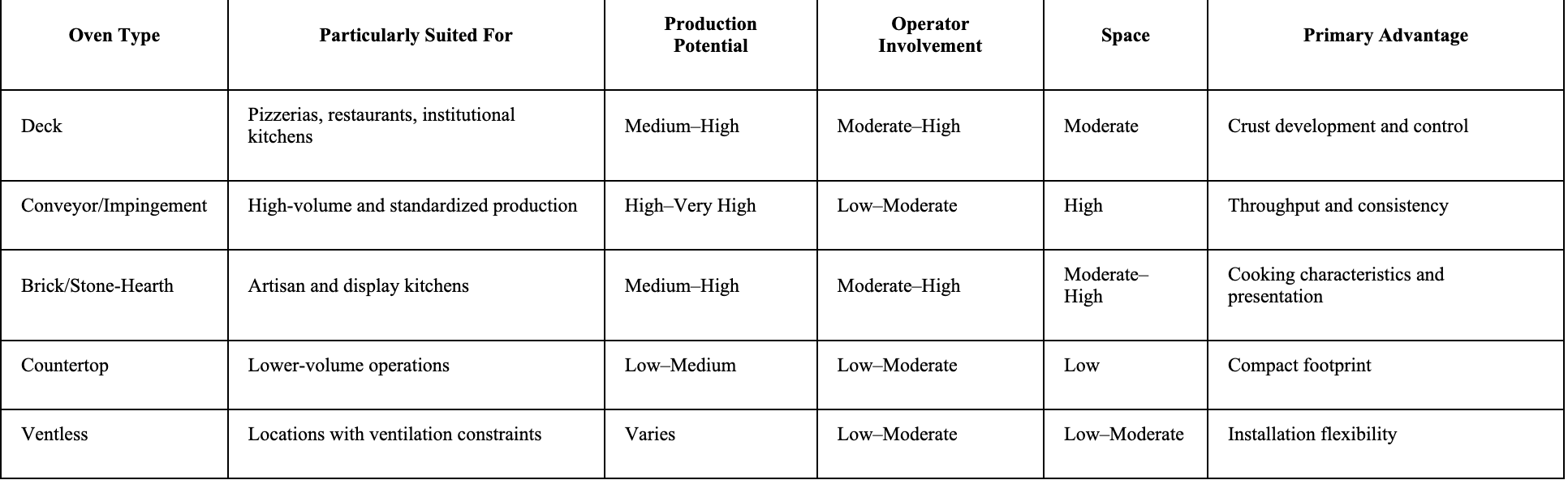
How Many Pizzas Do You Need to Make Per Hour?
This may be the most important sizing question.
Don’t size an oven based only on average daily sales.
Instead, determine what happens during your busiest 30 to 60 minutes.
Suppose an operation averages 15 pizzas per hour throughout the day but needs to produce 60 pizzas between noon and 1 p.m. The oven has to accommodate the lunch rush.
When evaluating equipment, ask:
How many pizzas of our actual size can this oven produce per hour under our intended cooking conditions?
That’s much more useful than a general statement that an oven is “high capacity.”
Production depends on:
- Pizza diameter
- Product thickness
- Dough formulation
- Toppings
- Bake time
- Temperature
- Deck area
- Number of decks
- Conveyor width
- Belt speed
- Number of belts
- Loading pattern
- Oven recovery
Build in some reserve capacity as well.
An oven that has to operate at maximum theoretical production from opening day provides little room for business growth, unusually busy periods, or operational delays.
Pizza Diameter Matters
Know the largest pizza you plan to produce.
For deck ovens, compare:
- Deck width
- Deck depth
- Deck height
- Door opening
- Number of pizzas per deck
- Number of decks
For conveyor ovens, compare:
- Belt width
- Cooking chamber dimensions
- Opening height
- Conveyor length
- Belt speed
- Number of belts
- Approved stacking configurations
Don’t assume that a 16-inch oven opening automatically makes an oven practical for continuous production of 16-inch pizzas.
Usable cooking capacity matters more than the headline dimension.
Single, Double or Triple Stack?
Many commercial pizza ovens can be stacked.
This is particularly common with deck and conveyor equipment.
Stacking allows an operation to increase production capacity vertically rather than consuming substantially more floor space.
It can also provide operational flexibility.
For example, two independently controlled ovens may allow an operator to:
- Run different temperatures
- Use different conveyor speeds
- Cook different products
- Shut down one oven during slower periods
- Retain some production capability if one oven needs service
But stacking also increases:
- Gas demand
- Electrical load
- Ventilation requirements
- Heat output
- Equipment height
- Initial investment
Always use manufacturer-approved stacking configurations.
Gas vs. Electric Pizza Ovens
There isn’t a universal answer to whether gas or electric is better.
The facility often helps determine the answer.
Gas Pizza Ovens
Gas ovens may offer substantial heating capacity and can be economical where sufficient gas infrastructure already exists.
Before ordering, verify:
- Natural gas or propane
- Required BTU input
- Incoming gas pressure
- Gas-line capacity
- Connection size
- Ventilation requirements
An existing gas line does not necessarily have enough capacity for the proposed oven.
Electric Pizza Ovens
Electric ovens can provide precise control and may offer installation advantages in some applications.
Verify:
- Voltage
- Phase
- Amperage
- Kilowatt load
- Breaker requirements
- Plug configuration
- Hardwired versus cord-and-plug connection
Large commercial electric pizza ovens can require substantial electrical capacity.
A relatively inexpensive oven can become an expensive project if the building needs a major electrical upgrade.
Does a Pizza Oven Need a Hood?
This needs to be determined before purchasing equipment.
Depending on the oven and application, installation could require:
- Type I or other applicable exhaust hood
- Ductwork
- Exhaust fan
- Make-up air
- Fire suppression
- Roof penetrations
- Electrical work
- Gas piping
- Permits and inspections
Some commercial pizza ovens are specifically designed and listed for ventless operation under defined conditions.
Being electric, however, does not automatically mean an oven is ventless.
Confirm requirements for the exact model and proposed application with the manufacturer and applicable authority having jurisdiction.
Measure the Entire Delivery Path
One of the easiest equipment-purchasing mistakes to make is measuring the kitchen space but not the path required to get the equipment there.
Measure:
Loading dock or receiving area → exterior door → hallways → elevators → interior doors → kitchen entrance → final equipment location
Document:
- Door widths
- Door heights
- Hallway widths
- Tight corners
- Elevator dimensions
- Elevator weight capacity
- Stairs
- Thresholds
- Ceiling restrictions
Large deck, conveyor, and hearth ovens can create significant delivery challenges.
Determine whether legs, stands, conveyor extensions, decks, or other components can be removed during delivery.
Understand What “Installation” Includes
Don’t assume two pizza oven quotes include the same scope.
There is a major difference between:
Delivered to your loading dock
and
Delivered, brought inside, assembled, connected, started, tested and ready for operation.
Depending on the project, installation could include:
- Freight
- Liftgate service
- Inside delivery
- Uncrating
- Debris removal
- Equipment assembly
- Setting in place
- Stacking
- Anchoring
- Gas connections
- Electrical connections
- Ventilation work
- Fire suppression modifications
- Start-up
- Testing
- Operator training
- Removal and disposal of existing equipment
Define those responsibilities before comparing prices.
How Much Does a Commercial Pizza Oven Cost?
Commercial pizza oven prices vary enormously.
As a general planning concept:
- Smaller countertop commercial ovens: often start in the low thousands of dollars.
- Commercial deck ovens: can range from several thousand dollars into the tens of thousands depending on size and configuration.
- Commercial conveyor ovens: commonly represent a larger investment, particularly for wide-belt and stacked systems.
- Stone-hearth and specialty ovens: can reach tens of thousands of dollars, with elaborate installations costing substantially more.
These are planning ranges—not quotes.
Configuration, controls, fuel source, accessories, freight, manufacturer pricing and installation can materially change the project cost.
The more useful calculation is:
Equipment + Freight + Delivery + Installation + Ventilation + Utility Modifications + Permits + Operating Cost + Maintenance
That’s your real pizza oven investment.
New vs. Used Commercial Pizza Ovens
A used pizza oven can appear attractive when comparing equipment prices.
But purchase price is only one part of the decision.
Before buying used equipment, determine:
- Manufacturer
- Exact model
- Serial number
- Age
- Service history
- Parts availability
- Warranty status
- Condition of decks or refractory materials
- Condition of burners or heating elements
- Conveyor and motor condition
- Control condition
- Required utilities
- Cost to move the equipment
- Cost to install it
Pizza ovens can be large and expensive to transport.
Saving several thousand dollars on the equipment may not be worthwhile if the oven needs major repairs or expensive facility modifications after arrival.
Labor Should Be Part of the Equipment Decision
Pizza ovens can require very different levels of operator involvement.
A skilled employee using a deck or hearth oven may actively manage multiple pizzas, reposition products, monitor crust development and adjust cooking locations.
A conveyor oven moves more of that process into standardized temperature and belt-speed settings.
For operations experiencing frequent employee turnover, standardized operation and training may be particularly valuable.
For artisan restaurants, greater operator control may be desirable.
Neither model is inherently right or wrong. It depends on the operation.
Cleaning and Maintenance
Consider serviceability before purchasing.
Ask:
- What requires daily cleaning?
- What requires weekly or periodic cleaning?
- Are crumb trays removable?
- Can employees easily reach cooking surfaces?
- How is a conveyor removed and cleaned?
- How are deck surfaces maintained?
- Are filters or catalytic components required?
- What preventive maintenance does the manufacturer recommend?
- Are replacement parts readily available?
- Is authorized service available in your area?
Equipment that is difficult to clean or service can create costs that aren’t obvious on the original quote.
Commercial Pizza Oven Manufacturers to Consider
There are many commercial pizza oven manufacturers, and they don’t all compete in exactly the same segment.
Blodgett
Blodgett is a long-established commercial oven manufacturer with deck-oven options suitable for restaurant and institutional foodservice applications.
Blodgett can be worth considering when buyers are looking for traditional, heavy-duty commercial oven construction and deck configurations.
Bakers Pride
Bakers Pride has a strong association with commercial pizza production and offers multiple deck-oven configurations.
Its pizza equipment is commonly considered by traditional pizzerias, restaurants, and other operations looking for commercial deck cooking.
Lincoln
Lincoln is particularly well known for commercial conveyor and impingement cooking.
Its equipment is relevant to buyers prioritizing repeatability, throughput, and conveyor-based production.
Middleby Marshall
Middleby Marshall is another major name in conveyor pizza production.
Its conveyor systems are widely associated with high-volume pizza applications where consistent cooking and production capacity are priorities.
Marsal
Marsal specializes heavily in pizza equipment and is particularly associated with commercial deck and brick-lined ovens.
It can be an attractive manufacturer to evaluate for traditional pizzeria applications.
Wood Stone
Wood Stone manufactures commercial stone-hearth cooking equipment.
Its ovens are particularly relevant when the cooking equipment is both a production appliance and a visible component of the restaurant concept.
Moretti Forni
Moretti Forni produces commercial pizza equipment across multiple technologies, including deck and conveyor systems.
It is particularly relevant to operators evaluating high-performance electric pizza cooking and specialized pizza applications.
TurboChef
TurboChef specializes in high-speed cooking technology and offers equipment suitable for certain pizza applications.
It can be particularly relevant where speed, compact equipment, or approved ventless applications are important.
Pizza Oven Manufacturer Comparison
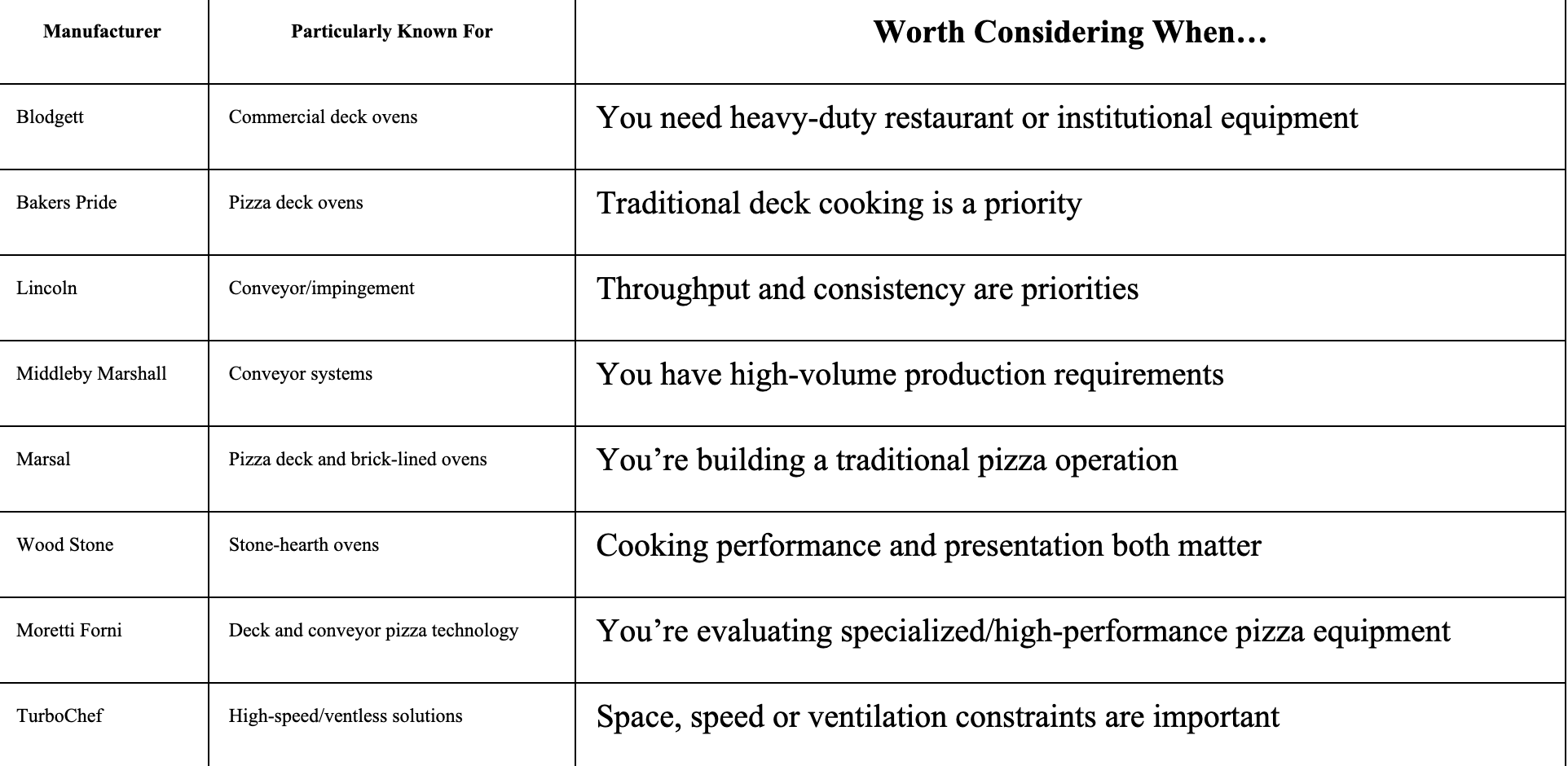
This isn’t a ranking. The appropriate manufacturer depends on the application.
Aldevra’s recommendation is to define the operating requirement first and select the manufacturer and model second.
Common Mistakes When Buying a Commercial Pizza Oven
Several mistakes can turn an otherwise good equipment purchase into an expensive project.
1. Buying Based on Price Alone
The least expensive oven isn’t necessarily the least expensive installed solution.
2. Ignoring Peak Production
Size for the busiest part of the day, not average hourly production.
3. Forgetting Utility Requirements
Confirm voltage, phase, amperage, gas type, gas pressure and capacity before ordering.
4. Assuming Electric Means Ventless
It doesn’t.
5. Measuring Only the Kitchen
The equipment still has to fit through the building.
6. Ignoring Installation Costs
Freight, rigging, electrical, gas, ventilation and fire suppression can materially change the project budget.
7. Buying Too Little Capacity
If the oven is already at maximum production on opening day, there is no room to grow.
8. Buying More Oven Than You Need
A small café serving a few pizzas each hour probably doesn’t need equipment designed for a high-volume pizza chain.
9. Ignoring Service Availability
Before buying specialized equipment, determine who can service it and how easily replacement parts can be obtained.
10. Starting With a Brand Instead of the Requirement
A familiar manufacturer isn’t automatically the best solution for every kitchen.
Commercial Pizza Oven Buying Checklist
Before requesting a quote, gather the following information:
Menu and Production
- Pizza style
- Fresh, par-baked or frozen crust
- Largest pizza diameter
- Average pizzas per hour
- Peak pizzas per hour
- Desired bake time
- Other products to be cooked
Utilities
- Available voltage
- Natural gas
- Availabile voltage
- Phase
- Amperage
- Existing gas-line size and capacity
- Existing exhaust hood
- Available ventilation capacity
Space and InstallationOperational Considerations
- Desired level of operator involvement
- Employee training requirements
- Cleaning expectations
- Local service availability
- Parts availability
- Warranty requirements
- Anticipated future production growth
If you are replacing an existing pizza oven, also provide the manufacturer, model number and serial number of the current equipment.Photographs of the existing oven, utility connections, exhaust system and proposed installation area can also be extremely helpful.
Don’t Just Ask, “What’s the Best Pizza Oven?”A better question is:What’s the right pizza oven for this operation?
The answer depends on what you’re making, how much you’re making, how quickly you need to make it, who will operate the equipment, what utilities are available and what the building can support.For one operation, the answer might be a traditional double-deck pizza oven.For another, it might be a stacked conveyor system capable of continuously producing pizzas during a two-hour lunch rush.Another location may need a compact ventless oven because installing a new exhaust hood isn’t practical.And a restaurant building its concept around artisan pizza may decide that a stone-hearth oven is worth the additional investment and installation complexity.The objective isn’t to buy the most expensive oven or the oven with the longest specification sheet.It’s to match the equipment to the operation.
Frequently Asked Questions About Commercial Pizza OvensHow much does a commercial pizza oven cost?
Commercial pizza oven pricing varies considerably.Smaller countertop commercial ovens may start in the low thousands of dollars, while full-size deck and conveyor ovens can cost tens of thousands of dollars. Large stacked systems, specialty hearth ovens and custom installations can cost substantially more.More importantly, the oven price isn’t necessarily the project price.Buyers may also need to budget for:
- Freight
- Inside delivery
- Rigging
- Installation
- Electrical work
- Gas piping
- Ventilation
- Make-up air
- Fire suppression
- Permits
- Start-up
- Removal of existing equipment
When comparing ovens, compare total installed cost, not just equipment price.
What is the best type of commercial pizza oven?
There isn’t one best type for every operation.Deck ovens are commonly selected when crust development and operator control are important. Conveyor ovens are particularly useful when production capacity and repeatability are priorities. Stone-hearth ovens can be appropriate for artisan concepts, while countertop and ventless equipment can make sense for smaller or nontraditional operations.The right choice depends on the pizza, production requirement, facility and operating model.
What is the difference between a deck oven and a conveyor pizza oven?
A deck oven generally cooks pizza directly on a heated stone, ceramic or similar baking surface. Employees manually load and remove pizzas and may reposition them during cooking.A conveyor oven moves pizzas through a heated cooking chamber at a controlled speed. Once temperature and belt speed are established, the process becomes highly repeatable.Deck ovens generally provide more operator control. Conveyor ovens generally provide more automation and production consistency.
Are conveyor ovens good for pizza?
Yes.Commercial conveyor ovens are widely used for pizza production, particularly in operations requiring high throughput and consistent results.They can also reduce the amount of operator judgment required for each pizza because cooking time is largely controlled by conveyor speed.
Are deck ovens better for pizza?
Not necessarily.Deck ovens can provide excellent crust characteristics and operator control, making them attractive for many traditional pizzerias.But an operation producing large quantities of standardized pizzas may benefit more from the consistency and throughput of a conveyor system.“Better” depends on the desired product and operation.
What is an impingement pizza oven?
An impingement oven uses directed streams of heated air to transfer heat rapidly to food.The technology is commonly used in commercial conveyor ovens and can produce fast, repeatable cooking.Lincoln and Middleby Marshall are two manufacturers strongly associated with commercial conveyor/impingement cooking.
What is a stone-hearth pizza oven?
A stone-hearth oven uses a heated stone or refractory cooking surface.The hearth stores heat and transfers it into the bottom of the pizza while the surrounding cooking chamber heats the remainder of the product.Commercial stone-hearth equipment ranges from manufactured deck-style ovens to large restaurant showpiece ovens.
What is the difference between a brick oven and a deck oven?
The terminology sometimes overlaps.A deck oven is typically a manufactured commercial appliance containing one or more baking chambers and decks.A brick or masonry-style oven generally incorporates a larger refractory cooking chamber and hearth designed around traditional high-temperature cooking.Some modern commercial “brick ovens” are actually factory-manufactured refractory systems rather than ovens constructed entirely onsite.Buyers should evaluate the actual equipment design rather than relying only on the terminology.
How hot does a commercial pizza oven get?
It depends on the oven.Different pizza styles use substantially different cooking temperatures and bake times. Some commercial pizzas bake for several minutes at moderate temperatures, while certain artisan styles use much higher temperatures and much shorter cooking times.Maximum advertised temperature shouldn’t be the only consideration.An oven also needs to maintain the necessary cooking conditions while repeatedly loading product during peak production.
What temperature should a commercial pizza oven be?
There isn’t one correct commercial pizza temperature.The appropriate temperature depends on:
- Dough
- Crust thickness
- Pizza style
- Toppings
- Moisture
- Desired finished product
- Oven technology
- Desired bake time
Determine the pizza you want to produce first and then select equipment capable of consistently producing it.
How many pizzas can a commercial pizza oven cook per hour?
There isn’t one standard capacity.Production depends on pizza diameter, bake time, temperature, oven dimensions, deck area, conveyor width, belt speed, number of decks or belts and loading pattern.When comparing ovens, ask:
How many pizzas of our actual diameter can this model produce per hour at our intended bake time?
That’s much more useful than a generic pizzas-per-hour claim.
What size commercial pizza oven do I need?
Start with your largest pizza and your peak hourly demand.If you need 50 16-inch pizzas during your busiest hour, evaluate equipment against that requirement—not your average daily volume.Also consider future growth.Buying equipment that must operate at maximum capacity immediately leaves little production reserve.
Can a commercial pizza oven cook a 16-inch pizza?
Many can, but not all.Check the actual deck dimensions, door opening, chamber dimensions or conveyor width.You also need enough usable space to efficiently load, position and remove the pizza.Don’t determine capacity solely from the exterior dimensions of the oven.
Should I buy a gas or electric pizza oven?
Evaluate the building first.If adequate gas service already exists, a gas oven may be practical. If the facility has sufficient electrical capacity, electric equipment may offer other advantages.Compare:
- Equipment cost
- Utility availability
- Required utility upgrades
- Local energy costs
- Ventilation
- Equipment performance
- Installation expense
The cheapest oven can become the more expensive option if significant utility modifications are required.
Are electric pizza ovens as good as gas pizza ovens?
Both can produce excellent results.Fuel source alone doesn’t determine pizza quality.Oven design, heat transfer, temperature control, recovery and how well the equipment matches the product are more important considerations.Modern commercial electric pizza ovens can offer sophisticated temperature control and high-performance cooking.
Does a commercial pizza oven need a hood?
Many do, but not every commercial pizza oven requires the same ventilation system.Requirements depend on the specific equipment, fuel source, listing, foods being cooked and applicable codes.Some ovens are designed and listed for ventless operation under specified conditions.Verify the requirements for the exact model and application before ordering.
Does an electric pizza oven need a hood?
Possibly.Electric does not automatically mean ventless.Ventilation requirements can depend on cooking emissions and equipment listings, not simply whether the appliance burns gas.If avoiding a hood is critical to the project, evaluate equipment specifically designed and listed for the intended ventless application.
What is a ventless pizza oven?
A ventless commercial oven is designed and listed to operate without a conventional external exhaust hood under specified conditions.Depending on the design, it may use catalytic technology, filtration or another method of managing cooking emissions.But ventless doesn’t mean unrestricted.Always confirm:
- Approved foods
- Equipment listing
- Clearances
- Installation requirements
- Local fire requirements
- Mechanical-code requirements
- AHJ acceptance
before purchasing.
Can I put a commercial pizza oven anywhere?
No.The installation location has to accommodate the equipment dimensions, required clearances, utilities, ventilation, fire requirements and service access.The building must also provide a practical delivery path.Large commercial ovens can be difficult or expensive to relocate after purchase, making site planning particularly important.
Can pizza ovens be stacked?
Many commercial deck and conveyor ovens can be stacked.Stacking can substantially increase production without proportionally increasing the equipment footprint.However, stacking can also increase:
- Electrical demand
- Gas demand
- Exhaust requirements
- Heat output
- Equipment height
Use only configurations approved by the manufacturer.
Is it better to have one large pizza oven or two smaller ovens?T
here can be operational advantages to having multiple independently controlled ovens.For example, two ovens may allow an operator to:
- Use different temperatures
- Use different conveyor speeds
- Separate products
- Shut down capacity during slow periods
- Maintain limited production if one oven needs service
However, multiple ovens may increase acquisition cost, utility requirements and maintenance.The right configuration depends on production and operational priorities.
Can you cook other foods in a pizza oven?
Often, yes.Depending on the oven, operators may also prepare:
- Flatbreads
- Sandwiches
- Breads
- Appetizers
- Baked dishes
- Roasted products
- Certain proteins and vegetables
However, adding products—particularly grease-producing foods—can affect ventilation requirements.Check the manufacturer’s approved applications before expanding the menu.
Can I use a convection oven for pizza?
Yes, particularly for certain frozen, par-baked and lower-volume applications.But a general-purpose convection oven may not provide the same crust characteristics, recovery, cooking surface or production capacity as equipment designed specifically for commercial pizza production.If pizza represents a significant portion of the menu, dedicated pizza equipment deserves consideration.
Should I buy a new or used commercial pizza oven?
Used equipment can reduce the initial purchase price, but inspect the complete economics.Determine:
- Age
- Model and serial number
- Service history
- Parts availability
- Deck condition
- Refractory condition
- Heating-element or burner condition
- Conveyor condition
- Controls condition
- Warranty
- Required utilities
- Freight
- Rigging
- Installation cost
An inexpensive used oven that needs repairs or major building modifications may ultimately cost more than new equipment.How long does a commercial pizza oven last?There isn’t one fixed service life.Heavy-duty commercial ovens can remain in operation for many years when appropriately maintained.During that time, components such as burners, heating elements, controls, motors, belts, doors, stones and refractory materials may require maintenance or replacement.Manufacturer support, replacement-parts availability and local service should therefore be considered during equipment selection.
How often should a commercial pizza oven be cleaned?
Follow the manufacturer’s instructions for the specific model.Cleaning frequency varies depending on equipment design and usage, but food debris, flour, cheese, grease and carbon buildup shouldn’t be allowed to accumulate.Some components require daily attention while others are part of periodic preventive maintenance.Accessibility for cleaning is worth evaluating before purchasing an oven.
What are the best commercial pizza oven brands?
There isn’t a single brand that is appropriate for every application.Established manufacturers serving different parts of the commercial pizza market include Blodgett, Bakers Pride, Lincoln, Middleby Marshall, Marsal, Wood Stone, Moretti Forni and TurboChef, among others.The more useful question is which manufacturers make equipment suited to your required oven type, pizza, production capacity, utilities and installation.
What should I look for when buying a commercial pizza oven?
At minimum, consider:
- Pizza style
- Pizza diameter
- Peak pizzas per hour
- Bake time
- Temperature requirements
- Oven technology
- Gas versus electric
- Utility capacity
- Ventilation
- Footprint
- Delivery access
- Installation
- Labor
- Cleaning
- Maintenance
- Parts availability
- Service support
- Warranty
- Purchase price
- Total installed cost
- Future production requirements
What information should I provide when requesting a pizza oven quote?
The more information you provide, the better a foodservice equipment dealer can narrow the options.Provide:
- Type of pizza
- Fresh, frozen or par-baked crust
- Largest pizza diameter
- Peak pizzas per hour
- Desired bake time
- Gas or electric preference
- Available voltage and phase
- Available gas type
- Existing hood information
- Available installation dimensions
- Delivery-path restrictions
- Installation address
- Installation requirements
- Existing equipment requiring removal
- Desired completion date
If you’re replacing an existing oven, provide the manufacturer, model and serial number along with photographs whenever possible.
Before You Buy: Focus on the Entire Pizza-Oven Project
A pizza oven shouldn’t be selected in isolation.A $10,000 oven requiring substantial electrical work, a new hood and major building modifications could be a more expensive project than a higher-priced oven compatible with existing infrastructure.Likewise, a more expensive oven may make economic sense if it significantly improves throughput, consistency or labor efficiency.Evaluate the complete project:
What are we making?
How much do we need to make?
What equipment can consistently produce it?
Can our facility support that equipment?
What will it cost to install and operate?
Those questions provide a much better purchasing framework than simply asking which pizza oven is best.
Need Help Choosing a Commercial Pizza Oven?
Choosing between deck, conveyor, impingement, stone-hearth, countertop and ventless equipment can get complicated quickly—especially once utilities, ventilation and installation are considered.
Aldevra helps commercial, institutional and government foodservice customers identify and source equipment based on the actual application.
When contacting us about a pizza oven, send us as much information as possible about your pizza, production volume, available space, utilities and installation requirements.If you’re replacing existing equipment, send us the manufacturer and model number and, if possible, a few photographs.We’ll use that information to help identify appropriate commercial pizza oven options for your operation.
Need a commercial pizza oven? Contact Aldevra to discuss your equipment requirements and request a quote.
No. That was only Part 1, and it was itself cut off at the checklist. I should have made that explicit before the writing block.Here is Part 2, starting exactly where Part 1 stopped. This includes the rest of the checklist, the buyer guidance, full FAQ section, Aldevra CTA, and Webflow fields.Utilities
- Natural gas, propane or electric
- Available voltage
- Phase
- Amperage
- Existing gas-line size and capacity
- Existing exhaust hood
- Available ventilation capacity
Space and Installation
- Available equipment width
- Available equipment depth
- Available equipment height
- Required clearances
- Door and hallway dimensions
- Elevator dimensions and weight capacity, if applicable
- Delivery access
- Floor loading concerns
- Existing equipment to be removed
- Installation requirements
Operational Considerations
- Desired level of operator involvement
- Employee training requirements
- Cleaning expectations
- Local service availability
- Parts availability
- Warranty requirements
- Anticipated future production growth
If you are replacing an existing pizza oven, also provide the manufacturer, model number and serial number of the current equipment.Photographs of the existing oven, utility connections, exhaust system and proposed installation area can also be extremely helpful.
Don’t Just Ask, “What’s the Best Pizza Oven?”
A better question is:What’s the right pizza oven for this operation?
The answer depends on what you’re making, how much you’re making, how quickly you need to make it, who will operate the equipment, what utilities are available and what the building can support.For one operation, the answer might be a traditional double-deck pizza oven. For another, it might be a stacked conveyor system capable of continuously producing pizzas during a two-hour lunch rush. Another location may need a compact ventless oven because installing a new exhaust hood isn’t practical. And a restaurant building its concept around artisan pizza may decide that a stone-hearth oven is worth the additional investment and installation complexity. The objective isn’t to buy the most expensive oven or the oven with the longest specification sheet.It’s to match the equipment to the operation.
Frequently Asked Questions About Commercial Pizza OvensHow much does a commercial pizza oven cost?
Commercial pizza oven pricing varies considerably.Smaller countertop commercial ovens may start in the low thousands of dollars, while full-size deck and conveyor ovens can cost tens of thousands of dollars. Large stacked systems, specialty hearth ovens and custom installations can cost substantially more.More importantly, the oven price isn’t necessarily the project price.Buyers may also need to budget for:
- Freight
- Inside delivery
- Rigging
- Installation
- Electrical work
- Gas piping
- Ventilation
- Make-up air
- Fire suppression
- Permits
- Start-up
- Removal of existing equipment
When comparing ovens, compare total installed cost, not just equipment price.What is the best type of commercial pizza oven?
There isn’t one best type for every operation.Deck ovens are commonly selected when crust development and operator control are important. Conveyor ovens are particularly useful when production capacity and repeatability are priorities. Stone-hearth ovens can be appropriate for artisan concepts, while countertop and ventless equipment can make sense for smaller or nontraditional operations.The right choice depends on the pizza, production requirement, facility and operating model.
What is the difference between a deck oven and a conveyor pizza oven?
A deck oven generally cooks pizza directly on a heated stone, ceramic or similar baking surface. Employees manually load and remove pizzas and may reposition them during cooking.
A conveyor oven moves pizzas through a heated cooking chamber at a controlled speed. Once temperature and belt speed are established, the process becomes highly repeatable.
Deck ovens generally provide more operator control. Conveyor ovens generally provide more automation and production consistency.
Are conveyor ovens good for pizza?
Yes.
Commercial conveyor ovens are widely used for pizza production, particularly in operations requiring high throughput and consistent results.
They can also reduce the amount of operator judgment required for each pizza because cooking time is largely controlled by conveyor speed.
Are deck ovens better for pizza?
Not necessarily.
Deck ovens can provide excellent crust characteristics and operator control, making them attractive for many traditional pizzerias.
But an operation producing large quantities of standardized pizzas may benefit more from the consistency and throughput of a conveyor system.
“Better” depends on the desired product and operation.
What is an impingement pizza oven?
An impingement oven uses directed streams of heated air to transfer heat rapidly to food.
The technology is commonly used in commercial conveyor ovens and can produce fast, repeatable cooking.
Lincoln and Middleby Marshall are two manufacturers strongly associated with commercial conveyor/impingement cooking.
What is a stone-hearth pizza oven?
A stone-hearth oven uses a heated stone or refractory cooking surface.
The hearth stores heat and transfers it into the bottom of the pizza while the surrounding cooking chamber heats the remainder of the product.
Commercial stone-hearth equipment ranges from manufactured deck-style ovens to large restaurant showpiece ovens.
What is the difference between a brick oven and a deck oven?
The terminology sometimes overlaps.
A deck oven is typically a manufactured commercial appliance containing one or more baking chambers and decks.
A brick or masonry-style oven generally incorporates a larger refractory cooking chamber and hearth designed around traditional high-temperature cooking.
Some modern commercial “brick ovens” are actually factory-manufactured refractory systems rather than ovens constructed entirely onsite.
Buyers should evaluate the actual equipment design rather than relying only on the terminology.
How hot does a commercial pizza oven get?
It depends on the oven.
Different pizza styles use substantially different cooking temperatures and bake times. Some commercial pizzas bake for several minutes at moderate temperatures, while certain artisan styles use much higher temperatures and much shorter cooking times.
Maximum advertised temperature shouldn’t be the only consideration.
An oven also needs to maintain the necessary cooking conditions while repeatedly loading product during peak production.
The appropriate temperature depends on:
- Dough
- Crust thickness
- Pizza style
- Toppings
- Moisture
- Desired finished product
- Oven technology
- Desired bake time
Determine the pizza you want to produce first and then select equipment capable of consistently producing it.
How many pizzas can a commercial pizza oven cook per hour?
There isn’t one standard capacity.
Production depends on pizza diameter, bake time, temperature, oven dimensions, deck area, conveyor width, belt speed, number of decks or belts and loading pattern.
When comparing ovens, ask:
How many pizzas of our actual diameter can this model produce per hour at our intended bake time?
That’s much more useful than a generic pizzas-per-hour claim.
What size commercial pizza oven do I need?
Start with your largest pizza and your peak hourly demand.
If you need 50 16-inch pizzas during your busiest hour, evaluate equipment against that requirement—not your average daily volume.
Also consider future growth.
Buying equipment that must operate at maximum capacity immediately leaves little production reserve.
Can a commercial pizza oven cook a 16-inch pizza?
Many can, but not all.
Check the actual deck dimensions, door opening, chamber dimensions or conveyor width.
You also need enough usable space to efficiently load, position and remove the pizza.
Don’t determine capacity solely from the exterior dimensions of the oven.
Should I buy a gas or electric pizza oven?
Evaluate the building first.
If adequate gas service already exists, a gas oven may be practical. If the facility has sufficient electrical capacity, electric equipment may offer other advantages.
Compare:
- Equipment cost
- Utility availability
- Required utility upgrades
- Local energy costs
- Ventilation
- Equipment performance
- Installation expense
The cheapest oven can become the more expensive option if significant utility modifications are required.
Are electric pizza ovens as good as gas pizza ovens?
Both can produce excellent results.
Fuel source alone doesn’t determine pizza quality.
Oven design, heat transfer, temperature control, recovery and how well the equipment matches the product are more important considerations.
Modern commercial electric pizza ovens can offer sophisticated temperature control and high-performance cooking.
Does a commercial pizza oven need a hood?
Many do, but not every commercial pizza oven requires the same ventilation system.
Requirements depend on the specific equipment, fuel source, listing, foods being cooked and applicable codes.
Some ovens are designed and listed for ventless operation under specified conditions.
Verify the requirements for the exact model and application before ordering.
Does an electric pizza oven need a hood?
Possibly.
Electric does not automatically mean ventless.
Ventilation requirements can depend on cooking emissions and equipment listings, not simply whether the appliance burns gas.
If avoiding a hood is critical to the project, evaluate equipment specifically designed and listed for the intended ventless application.
What is a ventless pizza oven?
A ventless commercial oven is designed and listed to operate without a conventional external exhaust hood under specified conditions.
Depending on the design, it may use catalytic technology, filtration or another method of managing cooking emissions.
But ventless doesn’t mean unrestricted.
Always confirm:
- Approved foods
- Equipment listing
- Clearances
- Installation requirements
- Local fire requirements
- Mechanical-code requirements
- AHJ acceptance
before purchasing.
Can I put a commercial pizza oven anywhere?
No.
The installation location has to accommodate the equipment dimensions, required clearances, utilities, ventilation, fire requirements and service access.
The building must also provide a practical delivery path.
Large commercial ovens can be difficult or expensive to relocate after purchase, making site planning particularly important.
Can pizza ovens be stacked?
Many commercial deck and conveyor ovens can be stacked.
Stacking can substantially increase production without proportionally increasing the equipment footprint.
However, stacking can also increase:
- Electrical demand
- Gas demand
- Exhaust requirements
- Heat output
- Equipment height
Use only configurations approved by the manufacturer.
Is it better to have one large pizza oven or two smaller ovens?
There can be operational advantages to having multiple independently controlled ovens.
For example, two ovens may allow an operator to:
- Use different temperatures
- Use different conveyor speeds
- Separate products
- Shut down capacity during slow periods
- Maintain limited production if one oven needs service
However, multiple ovens may increase acquisition cost, utility requirements and maintenance.
The right configuration depends on production and operational priorities.
Can you cook other foods in a pizza oven?
Often, yes.
Depending on the oven, operators may also prepare:
- Flatbreads
- Sandwiches
- Breads
- Appetizers
- Baked dishes
- Roasted products
- Certain proteins and vegetables
However, adding products—particularly grease-producing foods—can affect ventilation requirements.
Check the manufacturer’s approved applications before expanding the menu.
Can I use a convection oven for pizza?
Yes, particularly for certain frozen, par-baked and lower-volume applications.
But a general-purpose convection oven may not provide the same crust characteristics, recovery, cooking surface or production capacity as equipment designed specifically for commercial pizza production.
If pizza represents a significant portion of the menu, dedicated pizza equipment deserves consideration.
Should I buy a new or used commercial pizza oven?
Used equipment can reduce the initial purchase price, but inspect the complete economics.
Determine:
- Age
- Model and serial number
- Service history
- Parts availability
- Deck condition
- Refractory condition
- Heating-element or burner condition
- Conveyor condition
- Controls condition
- Warranty
- Required utilities
- Freight
- Rigging
- Installation cost
An inexpensive used oven that needs repairs or major building modifications may ultimately cost more than new equipment.
How long does a commercial pizza oven last?
There isn’t one fixed service life.
Heavy-duty commercial ovens can remain in operation for many years when appropriately maintained.
During that time, components such as burners, heating elements, controls, motors, belts, doors, stones and refractory materials may require maintenance or replacement.
Manufacturer support, replacement-parts availability and local service should therefore be considered during equipment selection.
How often should a commercial pizza oven be cleaned?
Follow the manufacturer’s instructions for the specific model.
Cleaning frequency varies depending on equipment design and usage, but food debris, flour, cheese, grease and carbon buildup shouldn’t be allowed to accumulate.
Some components require daily attention while others are part of periodic preventive maintenance.
Accessibility for cleaning is worth evaluating before purchasing an oven.
What are the best commercial pizza oven brands?
There isn’t a single brand that is appropriate for every application.
Established manufacturers serving different parts of the commercial pizza market include Blodgett, Bakers Pride, Lincoln, Middleby Marshall, Marsal, Wood Stone, Moretti Forni and TurboChef, among others.
The more useful question is which manufacturers make equipment suited to your required oven type, pizza, production capacity, utilities and installation.
What should I look for when buying a commercial pizza oven?
At minimum, consider:
- Pizza style
- Pizza diameter
- Peak pizzas per hour
- Bake time
- Temperature requirements
- Oven technology
- Gas versus electric
- Utility capacity
- Ventilation
- Footprint
- Delivery access
- Installation
- Labor
- Cleaning
- Maintenance
- Parts availability
- Service support
- Warranty
- Purchase price
- Total installed cost
- Future production requirements
What information should I provide when requesting a pizza oven quote?
The more information you provide, the better a foodservice equipment dealer can narrow the options.
Provide:
- Type of pizza
- Fresh, frozen or par-baked crust
- Largest pizza diameter
- Peak pizzas per hour
- Desired bake time
- Gas or electric preference
- Available voltage and phase
- Available gas type
- Existing hood information
- Available installation dimensions
- Delivery-path restrictions
- Installation address
- Installation requirements
- Existing equipment requiring removal
- Desired completion date
If you’re replacing an existing oven, provide the manufacturer, model and serial number along with photographs whenever possible.
Before You Buy: Focus on the Entire Pizza-Oven Project
A pizza oven shouldn’t be selected in isolation.
A $10,000 oven requiring substantial electrical work, a new hood and major building modifications could be a more expensive project than a higher-priced oven compatible with existing infrastructure.
Likewise, a more expensive oven may make economic sense if it significantly improves throughput, consistency or labor efficiency.
Evaluate the complete project:
What are we making?
How much do we need to make?
What equipment can consistently produce it?
Can our facility support that equipment?
What will it cost to install and operate?
Those questions provide a much better purchasing framework than simply asking which pizza oven is best.
Need Help Choosing a Commercial Pizza Oven?
Choosing between deck, conveyor, impingement, stone-hearth, countertop and ventless equipment can get complicated quickly—especially once utilities, ventilation and installation are considered.
Aldevra helps commercial, institutional and government foodservice customers identify and source equipment based on the actual application.
When contacting us about a pizza oven, send us as much information as possible about your pizza, production volume, available space, utilities and installation requirements.
If you’re replacing existing equipment, send us the manufacturer and model number and, if possible, a few photographs.
We’ll use that information to help identify appropriate commercial pizza oven options for your operation.
Need a commercial pizza oven? Use the Aldevra Pizza Oven Selector buying tool and then request a quote from us.

.png)